
Our Top Picks
 Wagner Spraytech Power Tex Electric Texture SprayerPower Tex V29.5 x 13 x 11.6 inches2.75 PoundsCheck on Amazon
The best texture spray gun for drywall and ceilings for most buyers is the HILTEX 31229 air hopper gun. Its 1.32-gallon hopper, 4.0 mm / 6.0 mm / 8.0 mm nozzle set, and mid-range price cover orange peel, knockdown, and heavy acoustic-style patterns without pushing you into pro-grade money. It suits anyone who already owns — or is willing to buy — a compressor that can hold roughly 4–8 CFM at 40–60 PSI. If you have no compressor and no intention of buying one, the Wagner Power Tex electric sprayer is the better answer. If you spray ceilings in volume for a living, the MARSHALLTOWN Sharpshooter 2.1 is the tool that will still be working in five years. On a tight budget, the Goplus 1.45-gallon gun does the same job with less refinement. Every decision below comes down to five numbers: hopper capacity, nozzle orifice, compressor CFM, pattern control, and the weight you are willing to hold over your head for an hour.
Top 3 Picks
Best overall: HILTEX 31229
A 1.32-gallon hopper sits in the sweet spot between “refill every five minutes” and “my arm is falling off.” The three supplied orifices — 4.0 mm, 6.0 mm, and 8.0 mm — map cleanly onto fine orange peel, standard knockdown base, and heavy splatter or acoustic-style texture, which means one gun covers an entire house instead of one finish. It is a compressed-air tool, so it is only as good as the compressor behind it, but the price tier keeps money available for that compressor.
Best budget: Goplus 1.45 Gallon Air Texture Gun
Goplus delivers the same 1.45-gallon hopper and the same 4.0 mm / 6.0 mm / 8.0 mm nozzle trio as guns costing noticeably more. The savings show up in finish quality — thinner metal, simpler seals, and a trigger that rewards a light hand — but for a homeowner patching a hallway or retexturing a single bedroom ceiling, it is the cheapest route to a finished wall. Buy it if you already own an air compressor and want to keep the whole project under a low budget.
Best premium: MARSHALLTOWN Sharpshooter 2.1
The Sharpshooter line is what drywall crews reach for when texture is a daily task rather than a weekend project. The oversized hopper class means fewer refills on big ceilings, the adjustable flow and pattern give you repeatable control, and the build is assembled in the USA with serviceable parts. It costs premium money and demands a serious compressor, so it only makes sense if you are spraying hundreds of square feet at a time or billing for the work.
Quick Comparison
| Product | Best for | Key specs | Price tier |
|---|---|---|---|
| KCNKCN Air Texture Gun | First-time DIY patching on a budget | 1.5 gal hopper; 3 nozzles (4/6/8 mm class); compressed air | Budget |
| HILTEX 31229 | Best overall for walls and ceilings | 1.32 gal hopper; 4.0 mm, 6.0 mm, 8.0 mm nozzles; compressed air | Mid-range |
| Wagner Power Tex | Compressor-free homeowners | Electric; 3 texture patterns; onboard hopper; no compressor required | Premium |
| InoKraft TexCraft | Clean, controlled pro-style spraying | 1.32 gal hopper; interchangeable orifice set; compressed air | Premium |
| MARSHALLTOWN Sharpshooter 2.1 | High-volume ceiling production | Oversized hopper (~2 gal class); adjustable pattern and flow; assembled in USA | Premium |
| HWYPSJ Texture Spray Gun Kit | Whole-room kit value | 1.45 gal hopper; kit format; compressed air | Mid-range |
| Lounsweer Texture Spray Gun Kit | Small-area touch-ups and low ceilings | 0.79 gal (3 L) hopper; red body; compressed air | Mid-range |
| Kxuyola Wall Texture Sprayer | Budget ceiling work with an elbow adapter | 3 L (0.79 gal) hopper; 4/6/8 mm nozzles; elbow adapter | Budget |
| Laco TG600 | Professional-grade durability | Professional texturing gun; heavy-duty hopper and valve train; compressed air | Premium |
| YSIL Drywall Texture Sprayer | Overhead patching comfort | 0.79 gal (3 L) hopper; yellow body; elbow adapter; compressed air | Mid-range |
| Goplus 1.45 Gallon Air Texture Gun | Budget all-rounder | 1.45 gal hopper; 4.0 mm, 6.0 mm, 8.0 mm nozzles; compressed air | Budget |
| VOCUE Nozzle Tips Set | Replacing worn orifices and tuning texture | 3 tips: 3/16 in, 1/4 in, 5/16 in; metal, silver finish | Budget |
How We Chose
This roundup is built from listed specifications and established category knowledge, not from hands-on use. Every pick was screened against four criteria. First, spec clarity: a gun earns a place here when its hopper capacity and nozzle sizes are stated in numbers, because those two figures decide what finish you can actually produce. Second, category fit: air hopper guns, an electric all-in-one, and a consumable nozzle set each solve a different problem, so we judged each against its own job rather than against each other. Third, use case: a 0.79-gallon gun is a poor choice for a 1,200-square-foot ceiling and an excellent choice for patching a stairwell, so the “best for” label matters more than an overall ranking.
Fourth, upgrade path: we favored tools that stay useful as your skill grows. A gun with only one fixed orifice caps you at one texture; a gun with three orifices and an adjustable flow valve keeps working when you move from a patch to a whole room. We also weighed ownership realities — nozzle wear, seal replacement, and cleaning difficulty — because a texture gun that clogs or corrodes after two jobs is not a bargain at any price tier. Prices are given only as tiers because they move constantly.
1. KCNKCN Air Texture Gun, Drywall Hopper Sprayer — Best for First-Time DIY Patching
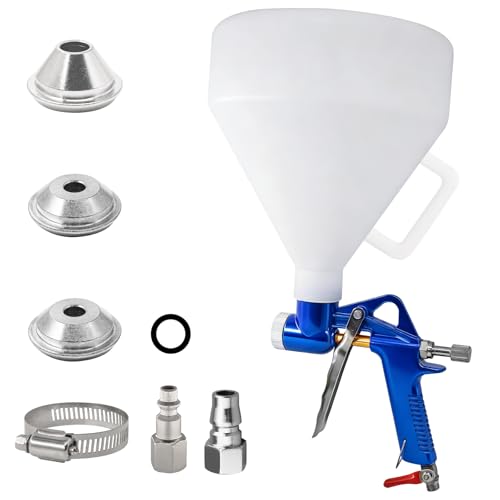
KCNKCN Air Texture Gun, Drywall Hopper Sprayer with 3 Nozzles, 1.5 Gallon
Chosen because it specifies Drywall Hopper Sprayer with 3 Nozzles and 1.5 Gallon.
View on AmazonThe KCNKCN is the gun you buy when you have one hallway to fix and you want to spend as little as possible getting there. It is a compressed-air hopper gun with a 1.5-gallon hopper and three nozzles, which puts it in the same performance class as guns at twice the price tier — the difference is in the finish of the metalwork and the consistency of the trigger, not in the size of the hopper. It suits a homeowner who already owns a compressor and is comfortable mixing texture powder to the right consistency.
Key specs
- Hopper capacity: 1.5 gallons — the largest in this roundup’s budget tier
- Nozzles: three supplied, in the standard 4 mm / 6 mm / 8 mm class
- Power source: compressed air; no cord, no motor
- Material: dry texture powder mixed with water, or thinned joint compound
- Typical surfaces: drywall walls, ceilings, patch blends, small rooms
- Price tier: budget
Strengths
Capacity is the headline. At 1.5 gallons, the KCNKCN holds roughly a fifth more mixed material than a 1.32-gallon gun and close to double a 0.79-gallon touch-up unit, which translates directly into fewer trips down the ladder. On a ceiling job, that matters more than any other spec, because every refill costs you a descent, a stir, and a re-climb. The three-nozzle set means you are not locked into one finish: the smallest orifice handles fine orange peel and light splatter, the middle one produces a standard knockdown base, and the largest throws heavy splatter and acoustic-style texture.
The simple air design is also easy to live with. There is no motor to burn out, no proprietary material cartridge, and no electronics. Cleaning is a matter of rinsing the hopper, pulling the nozzle, and flushing the air passage before material sets. For a first-time user, that simplicity is worth more than refinement.
Pros
- 1.5-gallon hopper reduces refill stops compared with most budget guns
- Three nozzle sizes cover fine orange peel through heavy splatter
- No motor or electronics to fail; cleaning is straightforward
- Lowest entry cost of any complete gun in this roundup
Cons
- Trigger and flow control are coarser than mid-range or premium guns
- Seals and gaskets are the first things to wear; spares can be hard to source
- No elbow adapter, so ceiling work puts the full weight on your wrist
- Finish quality depends heavily on your mixing consistency and compressor output
How it compares
The nearest alternative is the Goplus 1.45-gallon gun, which sits in the same budget tier with essentially the same nozzle set. Goplus gives up a tenth of a gallon of capacity and typically ships with a slightly more established parts footprint, while the KCNKCN gives you the marginally larger hopper. If you are patching and refilling rarely, the difference is negligible; pick whichever is available at the lower price on the day. Against the mid-range HILTEX 31229, the KCNKCN loses on trigger feel and pattern repeatability — the Hiltex holds a tighter, more even fan at a given pressure — but it wins on hopper volume. For a single-room job, buy the KCNKCN and put the savings into a moisture filter for your air line.
2. HILTEX 31229 Air Texture Gun — Best Overall for Walls and Ceilings
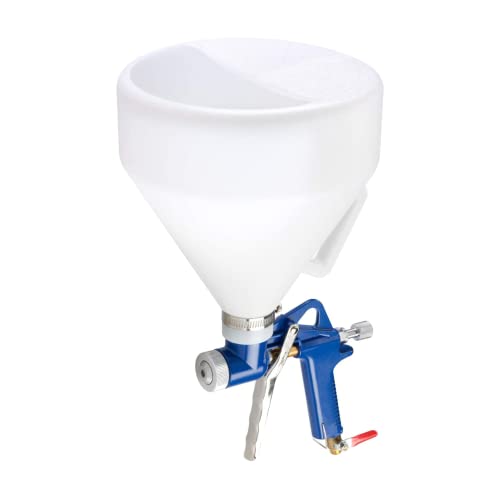
HILTEX 31229 Air Texture Gun with 1.32 Gallon Hopper, 3 Nozzles: 4.0mm, 6.0mm, 8.0mm, Drywall Texture Sprayer for Stucco Mud or Popcorn on Walls and Ceiling, Knockdown, Spray Gun with Handle
Chosen because it specifies 3 Nozzles: 4.0mm and 6.0mm.
View on AmazonThe Hiltex 31229 is the most balanced gun in this roundup: a 1.32-gallon hopper, a genuine three-orifice set at 4.0 mm, 6.0 mm, and 8.0 mm, and a mid-range price that leaves room in the budget for a compressor that can actually feed it. It suits the homeowner or occasional pro who wants one tool that handles a bedroom ceiling, a hallway knockdown, and a patch blend without swapping equipment. If you are buying your first serious texture gun and you already own air, start here.
Key specs
- Hopper capacity: 1.32 gallons (roughly 5 liters of mixed material)
- Nozzles: 4.0 mm, 6.0 mm, 8.0 mm — the metric standard for texture work
- Power source: compressed air; regulator and moisture trap recommended
- Pattern: round cone, tuned by pressure, orifice, and distance
- Typical surfaces: walls, ceilings, patch blends, medium rooms
- Price tier: mid-range
Strengths
What separates the Hiltex from the budget tier is consistency. At a fixed pressure, the same orifice throws a repeatable pattern from the first pass to the twentieth, which is what lets you blend a patch into an existing wall without a visible ring. That repeatability comes from tighter tolerances in the air valve and needle assembly, and it is the single most valuable property in a texture gun, because texture matching is judged by eye at arm’s length.
The 1.32-gallon hopper is a deliberate compromise. It is big enough that a normal bedroom ceiling takes two or three fills rather than six, and small enough that a full hopper does not exhaust your forearm after ten minutes overhead. The 4.0 mm orifice is the workhorse for modern orange peel, the 6.0 mm handles knockdown base coats, and the 8.0 mm produces the heavy splatter that knockdown is knocked down from. That trio covers the overwhelming majority of residential finishes in North America.
Build quality is a step up from budget guns without tipping into professional pricing. The hopper, lid, and nozzle assembly are designed to be taken apart for cleaning, and the gun responds predictably to small pressure changes, which is exactly what you want when you are dialing in a texture to match an existing wall.
Pros
- Genuine 4.0 / 6.0 / 8.0 mm nozzle set covers orange peel through heavy splatter
- Repeatable pattern makes patch blending far easier
- 1.32-gallon hopper balances refill frequency against overhead fatigue
- Mid-range price leaves budget for a proper compressor and moisture trap
Cons
- Requires a compressor capable of sustained 4–8 CFM at 40–60 PSI
- No elbow adapter in the base package, so ceiling angles are less comfortable
- Hopper lid seal needs care during cleaning to avoid air leaks
- Not intended for high-volume commercial ceilings
How it compares
Against the KCNKCN and the Goplus, the Hiltex costs more and holds slightly less material, but it wins on the two things that decide whether a patch looks invisible: pattern repeatability and trigger control. Against the premium InoKraft TexCraft, which also runs a 1.32-gallon hopper, the Hiltex gives up some fit-and-finish refinement and the smoother valve action of a premium build, but it keeps the same capacity and orifice range for less money. If you spray once or twice a year, the Hiltex is the better value; if texture is a weekly task, step up to the InoKraft or the Marshalltown.
3. Wagner Spraytech Power Tex Electric Texture Sprayer — Best for Compressor-Free Homeowners
Wagner Spraytech Power Tex Electric Texture Sprayer, 3 Texture Patterns
Chosen because it specifies 3 Texture Patterns.
View on AmazonThe Power Tex is the outlier in this roundup: an electric, self-contained texture sprayer that needs no compressor, no air hose, and no moisture management. It offers three texture patterns and an onboard hopper, and it suits the homeowner who owns a drill and a paint roller but nothing resembling an air system. If the phrase “CFM at 40 PSI” makes you want to close the tab, this is your gun.
Key specs
- Power source: electric — no compressor required
- Patterns: three texture settings (orange peel, knockdown, and heavy acoustic-style finishes)
- Hopper: onboard molded hopper, roughly the 1-gallon class
- Material: texture material mixed to the manufacturer’s consistency
- Typical surfaces: single rooms, ceilings, patches, small whole-wall projects
- Price tier: premium
Strengths
The value proposition is the entire air system you do not have to buy. A compressor that genuinely feeds a hopper gun — something in the 20-to-30-gallon, 5-to-6 CFM at 90 PSI class — costs more than most of the guns in this article, plus a regulator, a filter, and 50 feet of 3/8-inch hose. For someone doing one room, the electric sprayer is frequently the cheaper total project, and it is unquestionably the simpler one. Plug it in, mix the material, and spray.
The three-pattern dial is genuinely useful for a beginner because it removes a variable. On an air gun, you change the finish by swapping orifices, adjusting pressure, and changing distance — three knobs to turn before you know what you are doing. The Power Tex collapses that into a selector, which shortens the learning curve considerably. It is also cleaner to operate indoors, with no compressor cycling noise and no air line dragging across finished floors.
For ceilings specifically, the electric unit’s main advantage is that it does not care about altitude. Air guns lose pattern consistency when compressor pressure sags; the electric unit holds its output as long as the material flows. That makes it a reasonable choice for a single popcorn or knockdown ceiling in a house with no shop compressor.
Pros
- No compressor, hose, regulator, or moisture trap to buy
- Three selectable patterns simplify texture matching for beginners
- Quieter and cleaner indoors than a compressor-driven setup
- Consistent output regardless of air-system limitations
Cons
- Less fine control over pattern and thickness than an air hopper gun
- Commits you to the manufacturer’s texture material and mixing guidance
- Hopper capacity is smaller than the 1.45-gallon air guns here
- Thorough cleaning after every use is mandatory; dried material will clog the pump path
How it compares
The nearest alternative in this list is the HILTEX 31229, and the choice between them is really a choice about infrastructure. If you already own a compressor in the 5–6 CFM class, the Hiltex gives you more control, a larger hopper, and a lower price. If you do not, the Power Tex is cheaper than the Hiltex plus a competent compressor, and it removes an entire category of troubleshooting — water in the line, pressure sag, hose length — from your project. Against the InoKraft TexCraft, the electric unit is easier to start with but harder to master; the air gun rewards practice with better finish control at the top end.
4. InoKraft TexCraft Drywall Texture Spray Gun — Best for Clean, Controlled Pro-Style Spraying
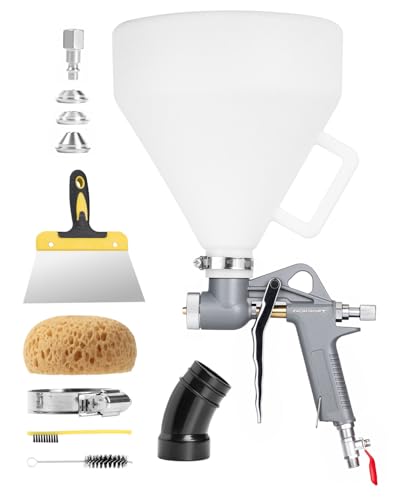
InoKraft TexCraft Drywall Texture Spray Gun, 1.32 Gallon Hopper
Chosen because it specifies 1.32 Gallon Hopper.
View on AmazonThe TexCraft is InoKraft’s premium air hopper gun, built around a 1.32-gallon hopper and an interchangeable orifice set. It suits the serious DIYer or working handyman who wants near-professional control without buying a full production rig. The emphasis here is on refinement: a smoother valve, a better-balanced body, and a hopper that seals properly so your pattern does not fade as the material level drops.
Key specs
- Hopper capacity: 1.32 gallons
- Nozzles: interchangeable orifice set covering the standard texture range
- Power source: compressed air
- Pattern control: adjustable flow and air, tuned with pressure and distance
- Typical surfaces: walls, ceilings, patch blending, medium-to-large rooms
- Price tier: premium
Strengths
The TexCraft’s selling point is control at the margins. Premium air guns tend to differ from mid-range ones in ways that only show up in the finish: a needle that seats cleanly so the gun stops spraying the instant you release the trigger, a hopper gasket that holds pressure as the material drops below half, and a valve that responds linearly rather than in steps. Those three properties are what let you feather a patch edge instead of leaving a hard texture line.
For ceilings, the balanced body matters. A hopper gun held overhead is a lever, and a gun that sits comfortably in the hand with a full 1.32-gallon hopper reduces the wrist torque that ends ceiling sessions early. Combined with a consistent trigger, that translates into straighter passes and fewer overlaps, which is exactly where texture jobs go wrong.
The 1.32-gallon capacity is a practical ceiling: about 5 liters of mixed material, enough for a typical bedroom ceiling in two or three fills depending on thickness and orifice. If you are spraying an entire floor of ceilings in one session, you will want the larger-hopper Marshalltown instead.
Pros
- Premium valve and needle action for clean trigger response
- Hopper seal holds pressure as material level drops
- Balanced body reduces fatigue on overhead work
- Interchangeable orifices cover orange peel through heavy splatter
Cons
- Premium price for a 1.32-gallon hopper that mid-range guns match on capacity
- Still requires a capable compressor and moisture control
- No elbow adapter included, unlike some budget ceiling-focused kits
- Overkill for a single patch job
How it compares
Against the HILTEX 31229, the TexCraft is the same capacity and the same general class of tool, but with the smoother valve and better sealing that premium pricing buys. If your work is occasional, the Hiltex is the smarter spend. If you are matching texture in occupied homes where a visible patch costs you a callback, the TexCraft’s cleaner trigger release is worth the difference. Against the MARSHALLTOWN Sharpshooter 2.1, the TexCraft loses on raw capacity and production durability but wins on weight over your head and on price — the Marshalltown is a volume tool, the TexCraft is a precision one.
5. MARSHALLTOWN Sharpshooter 2.1 Texture Sprayer — Best for High-Volume Ceiling Work

MARSHALLTOWN Sharpshooter 2.1 Texture Sprayer, Adjustable, Assembled in USA
Chosen because it specifies Adjustable and Assembled in USA.
View on AmazonThe Sharpshooter 2.1 is the production tool of this group. Marshalltown builds drywall tools for tradespeople, and this sprayer is designed for the person who textures whole houses rather than single rooms. It pairs an oversized hopper in roughly the 2-gallon class with adjustable pattern and flow control, and it is assembled in the USA. It suits contractors, landlords maintaining multiple units, and anyone whose ceiling work is measured in thousands of square feet per year.
Key specs
- Hopper capacity: oversized, roughly the 2-gallon class — the largest in this roundup
- Controls: adjustable pattern and material flow
- Power source: compressed air; demands a high-CFM compressor
- Build: trade-grade components, assembled in the USA
- Typical surfaces: large ceilings, whole-floor retextures, commercial work
- Price tier: premium
Strengths
Capacity is the reason to buy it. A hopper in the 2-gallon class holds roughly 50 percent more material than the 1.32-gallon guns here, which on a knockdown ceiling at moderate thickness can mean the difference between refilling every 40 square feet and every 60 or 70. Over a 1,000-square-foot ceiling, that is a dozen fewer ladder trips — and ladder trips, not spraying, are what make ceiling work exhausting.
Adjustability is the second reason. Separate pattern and flow controls let you set a wide, even fan for the field and then dial down to a narrow, lighter pattern for blending edges, without swapping nozzles mid-job. On production work, that saves time and reduces the risk of a hard texture line where a repair meets an existing finish.
The third reason is serviceability. Trade-grade guns are built to be maintained: seals, gaskets, and wear parts are replaceable, and the body is designed to survive being dropped off a scaffold. A gun in this class should still be spraying after several seasons of regular use, which changes the cost-per-job math considerably compared with replacing a budget gun every year.
Pros
- Largest hopper capacity here — fewer refills on big ceilings
- Independent pattern and flow adjustment for field-to-edge control
- Trade-grade build with replaceable wear parts
- Assembled in the USA with an established service and parts network
Cons
- Premium price is hard to justify for one or two rooms
- A full large hopper is heavy to hold overhead; fatigue is real
- Requires a high-CFM compressor to perform as designed
- More gun than a beginner needs while learning consistency
How it compares
Against the InoKraft TexCraft, the Sharpshooter trades precision and light weight for capacity and durability. If your ceilings are large and your schedule is tight, capacity wins every time. Against the Laco TG600, the other professional-grade option here, the Marshalltown leans toward hopper volume and adjustability while the Laco leans toward a heavier-duty valve train and a longer service life in hard daily use. Either is a defensible professional choice; pick the one whose wear parts you can source locally. For a homeowner, both are more tool than the job requires — the HWYPSJ or Goplus will finish a two-room retexture for far less.
6. HWYPSJ Drywall Texture Spray Gun Kit — Best for Whole-Room Kit Value

HWYPSJ Drywall Texture Spray Gun Kit - 1.45 Gal Hopper
Chosen because it specifies 1.45 Gal Hopper.
View on AmazonThe HWYPSJ kit is aimed at the person who wants everything in one box: a 1.45-gallon hopper gun plus the accessories that a first-time texture job actually requires. It sits in the mid-range tier and suits a homeowner tackling a full room — walls and ceiling — who does not want to discover halfway through that they are missing a fitting. The 1.45-gallon hopper is the largest in the mid-range group here.
Key specs
- Hopper capacity: 1.45 gallons — largest in this roundup’s mid-range tier
- Format: kit — gun plus commonly needed accessories
- Power source: compressed air
- Nozzles: multi-size orifice set covering the standard texture range
- Typical surfaces: full-room walls and ceilings, larger patches
- Price tier: mid-range
Strengths
The kit format is the point. Most texture projects stall on small missing pieces — a hose fitting, a spare gasket, a cleaning brush — and a kit that includes them removes a mid-project supply run. For someone who has never textured before, that is worth more than a marginal improvement in trigger feel.
At 1.45 gallons, the hopper holds meaningfully more than the 1.32-gallon guns and about 80 percent more than the 0.79-gallon touch-up units. Working through the coverage math: mixed texture material at knockdown consistency covers roughly 35–40 square feet per gallon, so a 1.45-gallon fill is on the order of 50–58 square feet per fill. A 12 by 10 foot room with 8-foot ceilings has about 312 square feet of wall after openings plus 120 square feet of ceiling — around 432 square feet total, or roughly eight fills. With a 0.79-gallon hopper that same room is closer to fifteen fills. The difference is a lot of ladder trips.
Mid-range construction means the seals and valve hold up better than budget tier under repeated use, and the gun is straightforward to disassemble for cleaning, which is where most texture guns actually die.
Pros
- 1.45-gallon hopper reduces refills on whole-room jobs
- Kit format includes the accessories beginners forget to buy
- Mid-range build tolerates repeated use better than budget guns
- Straightforward disassembly for cleaning
Cons
- Kit contents vary; check exactly what is included before buying
- Still needs a compressor in the 4–8 CFM class
- Pattern repeatability is a step below the premium guns here
- A full hopper is heavy for extended ceiling work
How it compares
The nearest alternative is the Goplus 1.45-gallon gun, which matches the capacity at a lower price tier but without the kit accessories and with coarser trigger control. If you are confident about what you need and want to spend the minimum, the Goplus is the value pick; if you would rather not make three trips to the hardware store, the HWYPSJ kit pays for itself in one afternoon. Against the Lounsweer 0.79-gallon kit, the HWYPSJ is the better choice for walls and large ceilings, while the Lounsweer wins on light overhead patching and storage.
7. Lounsweer Drywall Texture Spray Gun Kit — Best for Small-Area Touch-Ups and Low Ceilings

Lounsweer Drywall Texture Spray Gun Kit with 0.79 Gallon Hopper, Red
Chosen because it specifies Red.
View on AmazonThe Lounsweer kit is built around a 0.79-gallon hopper — about 3 liters — in a red body, and it is aimed squarely at repairs rather than whole rooms. It suits the homeowner fixing a water-stained ceiling patch, a doorknob hole, or a section of wall where a cabinet used to hang. In those situations, a small hopper is not a limitation; it is the reason the gun is light enough to hold overhead comfortably.
Key specs
- Hopper capacity: 0.79 gallons (3 liters)
- Format: kit — gun plus basic accessories
- Power source: compressed air
- Body: red finish; compact, patch-oriented proportions
- Typical surfaces: patches, closets, stairwells, small ceilings
- Price tier: mid-range
Strengths
The math favors small hoppers for small jobs. A 0.79-gallon fill covers roughly 28–32 square feet at knockdown consistency — which sounds like very little until you remember that a typical patch is 4 to 12 square feet. One fill handles most repair jobs with material left over, and the gun stays light in the hand the entire time. For a ceiling patch directly over your head, that weight difference is the difference between a clean blend and a shaky one.
Small hoppers also mean less waste. Texture material mixed and left in a hopper sets up and has to be thrown away; mixing a full 1.45-gallon batch for a two-square-foot patch is a waste of powder and water. The Lounsweer lets you mix a small batch, spray it, and be done.
Mid-range construction and the kit format put it a step above the cheapest touch-up guns: the seals are more likely to survive repeated cleanings, and the accessories reduce setup friction. It is a repair tool, and it is priced as one.
Pros
- Light enough to hold overhead for extended ceiling patching
- Small batch size reduces material waste on repairs
- Kit format includes the basics needed to start
- Compact body stores easily between jobs
Cons
- 0.79 gallons means frequent refills on anything larger than a patch
- Not suitable for whole-room or whole-ceiling projects
- Smaller hopper throat can be fussier to fill without spilling
- Requires the same compressor as a larger gun — no air-system savings
How it compares
Against the YSIL 0.79-gallon gun, the Lounsweer is a near-direct alternative: same capacity class, same patch-focused role, with the YSIL adding an elbow adapter that makes overhead angles easier on the wrist. If most of your work is on ceilings, the YSIL’s elbow is a genuine ergonomic advantage. Against the HWYPSJ 1.45-gallon kit, the Lounsweer is the wrong tool for a full room and the right tool for a repair — buying capacity you do not need just means carrying extra weight and wasting mixed material.
8. Kxuyola Wall Texture Sprayer Gun — Best Budget Ceiling Work with an Elbow Adapter

Kxuyola Wall Texture Sprayer Gun, 3L Texture Hopper Gun Drywall Kit with 4/6/8mm Nozzles & Elbow Adapter, Hopper Gun Texture Sprayer for Ceiling, Stucco, Popcorn, Texture Gun Drywall
Chosen because it specifies Hopper Gun Texture Sprayer for Ceiling and Stucco.
View on AmazonThe Kxuyola is a budget-tier 3-liter (0.79-gallon) hopper gun that ships with 4 mm, 6 mm, and 8 mm nozzles plus an elbow adapter. That last item is the reason it earns its own slot: an elbow adapter lets you hold the gun at a more natural wrist angle when spraying overhead, which changes how long you can work on a ceiling before your forearm gives out. It suits the budget-conscious DIYer whose main job is a ceiling or an upper wall.
Key specs
- Hopper capacity: 3 liters (0.79 gallons)
- Nozzles: 4 mm, 6 mm, 8 mm
- Adapter: elbow adapter included for overhead work
- Power source: compressed air
- Typical surfaces: ceilings, upper walls, patches, small rooms
- Price tier: budget
Strengths
The elbow adapter is the headline feature. Spraying a ceiling with a straight-bodied hopper gun forces your wrist into an awkward extension and puts the full weight of a filled hopper at the end of a long lever. An elbow changes the grip angle so the weight sits closer to your forearm. Over a 120-square-foot ceiling, that is the difference between finishing in one session and quitting halfway.
The three-nozzle set is the same 4/6/8 mm trio found on guns at three times the price, so the range of achievable finishes is not compromised. The 4 mm handles fine orange peel, the 6 mm handles knockdown base, and the 8 mm throws heavy splatter. For a beginner, having all three in the box means you can experiment on a scrap of drywall before committing to a wall.
At 0.79 gallons, the hopper is a patch-and-small-room capacity. A standard bedroom ceiling in the 120-square-foot range takes roughly four to five fills at knockdown thickness — more trips than a 1.45-gallon gun, but each trip is carrying far less weight. That tradeoff is often the right one for someone working alone on a ceiling.
Pros
- Elbow adapter makes overhead spraying noticeably more comfortable
- 4/6/8 mm nozzle set covers the full residential texture range
- Budget price for a gun with a real ergonomic feature
- Light filled weight reduces fatigue on ceilings
Cons
- Small hopper means frequent refills on anything but a patch
- Budget-tier seals and trigger components wear faster
- Nozzle orifices can erode with heavy use, changing the pattern
- Needs the same compressor as a larger gun
How it compares
Against the Goplus 1.45-gallon gun, the Kxuyola gives up roughly 45 percent of its hopper capacity but gains the elbow adapter and a much lighter filled weight. For a ceiling job, the elbow and the lighter load usually win; for a whole room of walls, capacity wins and the Goplus is the better pick. Against the YSIL 0.79-gallon gun — the other elbow-equipped unit here — the Kxuyola is the budget-tier version of the same concept, while the YSIL sits a tier up with generally better seals and finish. If your ceiling is a one-time project, buy the Kxuyola; if you expect to do this again next year, the YSIL is worth the step up.
9. Laco TG600 Drywall Texture Gun — Best for Professional-Grade Durability
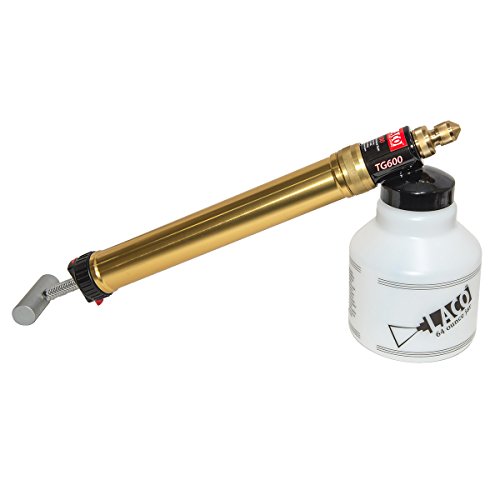
Laco TG600 Drywall Texture Gun - Professional Quality Texturing
Chosen because it specifies Professional Quality Texturing.
View on AmazonLaco builds professional drywall tools, and the TG600 is aimed at the trade rather than the homeowner. It is a professional-quality texturing gun with a heavy-duty hopper and valve train, designed to be rebuilt rather than replaced. It suits working drywall finishers and remodelers whose gun sees use most weeks and who need a tool that holds its pattern after a season of hard work.
Key specs
- Build class: professional-grade texturing gun
- Hopper: heavy-duty hopper sized for production work
- Valve train: durable air and material controls built for daily use
- Power source: compressed air; requires a high-CFM compressor
- Typical surfaces: production walls and ceilings, repair work, commercial interiors
- Price tier: premium
Strengths
The case for the TG600 is longevity, and longevity changes the economics. A budget gun that costs a fraction as much but is replaced every year or two costs more over five years than a professional gun that is serviced instead of discarded. Professional-grade guns are built with replaceable wear components — nozzle assemblies, seals, gaskets, springs — so a worn part is a repair rather than a replacement.
Durability also affects finish quality over time. As nozzle orifices erode, the spray pattern widens and the texture gets heavier; a gun with hardened, replaceable orifices holds its pattern far longer, which means the ceiling you spray in month twelve matches the one you sprayed in month one. For anyone doing repeat work in the same building or matching existing texture, that consistency is worth real money.
The heavier valve train gives the operator finer control at low flow rates, which matters when you are feathering a repair into an existing finish rather than blasting a whole ceiling. Trade-grade guns are also designed to be disassembled quickly on site, because cleaning between material batches is non-negotiable.
Pros
- Trade-grade construction with replaceable wear parts
- Holds pattern consistency over a long service life
- Fine control at low flow for blending repairs
- Designed for fast field disassembly and cleaning
Cons
- Premium price is difficult to justify for occasional use
- Heavier than homeowner-tier guns, which matters on ceilings
- Requires a high-CFM compressor to perform as intended
<




Write Your Review
No reviews yet. Be the first to share your experience!