
Our Top Picks
 VEVOR Deep Well Submersible Pump 1 HP 115V/60Hz31.5 x 4 in4 x 4 x 31.5 inches25 poundsCheck on Amazon
The best well pump for most households is the Acquaer Shallow/Deep Well Jet Pump with Ejector Kit, a convertible cast-iron jet pump that lifts from a 25 ft shallow well on its own or reaches roughly 90 ft once the included ejector kit is set in the well. That dual rating matters because well depth is the single most common thing buyers guess wrong, and a convertible pump means one purchase covers both answers. It suits a homeowner on a mid-range budget with a single-family house who needs roughly 8–12 GPM at 40–60 PSI. If your water sits deeper than about 90 ft, no jet pump will do the job and a submersible is the only correct answer — the VEVOR 1 HP submersible is the budget entry point there. If your water is shallower than 25 ft and you want the longest possible service life, the Goulds J5S is the premium pick.
Top 3 Picks
Best Overall: Acquaer Shallow/Deep Well Jet Pump with Ejector Kit
This is the pick that survives the most common buying mistake — not knowing your depth. Run it as a standard shallow-well jet pump for suction lifts up to 25 ft, or install the supplied ejector kit down the well and convert it to a deep-well configuration rated to about 90 ft. Cast-iron construction and dual-voltage capability make it a sensible long-term anchor for a mid-range budget, and it is the one pump here that can follow you if your water level drops in a dry year.
Best Budget: VEVOR 1.6 HP Shallow Well Pump with Pressure Tank
A complete shallow-well system in one box: pump, pressure tank, and pressure switch already assembled, so you are not separately sizing a tank or wiring a switch. At a budget price tier it delivers roughly 1320 GPH peak flow from a stainless-steel-bodied 120 V pump, which is plenty for a household on a well under 25 ft. It is the fastest path from “no water” to “water” for a buyer who does not want to engineer a system.
Best Premium: Goulds J5S Shallow Well Jet Pump
Goulds has built jet pumps for decades, and the J5S is the classic 1/2 HP shallow-well workhorse — a modest, unhurried pump that trades peak flow for a reputation for running for a very long time with little attention. It is the right premium answer for a shallow well serving a household that values longevity and serviceability over the highest GPM number on the box. Note that 1/2 HP is genuinely modest, so it suits steady domestic demand rather than heavy irrigation.
Quick Comparison
The table below covers every pump in this roundup. Price tiers are general market positioning — budget, mid-range, premium — rather than fixed prices, because listings change constantly.
| Product | Best For | Key Specs | Price Tier |
|---|---|---|---|
| VEVOR Deep Well Submersible Pump 1 HP | Deep wells on a tight budget | 1 HP, 115 V/60 Hz, 37 GPM peak flow, up to 207 ft head, submersible | Budget |
| Acquaer Shallow/Deep Well Jet Pump with Ejector Kit | Wells that could be shallow or deep | Cast iron, convertible, 25 ft shallow / up to 90 ft with ejector, jet pump | Mid-range |
| Aquastrong 115 V Shallow Well Garden Pump | Garden watering and light boosting | Stainless steel, 1320 GPH (~22 GPM), 115 V, automatic jet pump | Mid-range |
| Acquaer Shallow Well Jet Pump, Dual Voltage | Budget shallow-well household supply | Cast iron, up to 25 ft, 115/230 V dual voltage, automatic pressure switch | Budget |
| Red Lion RJS-75-PREM Shallow Well Jet Pump | Steady shallow-well household supply | 3/4 HP, 115/230 V, 16 GPM, shallow well jet | Mid-range |
| Goulds J5S Shallow Well Jet Pump | Long-term durability | 1/2 HP, 115/230 V, shallow well jet, cast-iron body | Premium |
| Red Lion RL12G07-2W2V Submersible | Deep wells, simplest wiring | 3/4 HP, 2-wire, 230 V, 12 GPM, submersible | Premium |
| AQUASTRONG 1.5 HP Shallow Well Jet/Centrifugal | High-flow irrigation | 1.5 HP, 4250 GPH (~71 GPM), 115/230 V, cast iron | Mid-range |
| VEVOR 1.6 HP Shallow Well Pump with Pressure Tank | Turnkey shallow-well system | 1.6 HP, 120 V, 1320 GPH, stainless steel, integrated pressure tank | Budget |
| Aquastrong Whole House Booster Pump 80 PSI | Constant household pressure | 115 V, variable speed, constant pressure, 80 PSI class | Premium |
| FOTING 1.5 HP Shallow Well Pump with Pressure Tank | Budget plug-and-play | 1.5 HP, 1340 GPH, automatic, integrated pressure tank | Budget |
| Red Lion RL12G05-3W2V Submersible | Low-yield deep wells | 1/2 HP, 3-wire, 230 V, 12 GPM, submersible | Premium |
How We Chose
This roundup is built from manufacturer specification sheets, published pump curves, brand documentation, and the physical realities of well hydraulics — not from any kind of testing or field trial. Every pump named here appears in current catalogs and is described only by what its own listing states or by well-established facts about its category.
The first filter was category fit. A pump is only “best” relative to a well depth, so we grouped candidates by the job they can physically do: shallow-well jet pumps for suction lifts up to about 25 ft, convertible jets for the 25–90 ft band, submersibles for anything deeper, and booster pumps for pressure problems rather than supply problems. A pump that cannot lift your water is not a value at any price.
The second filter was the specification mix that actually predicts satisfaction: flow at a realistic head rather than peak flow at zero head, voltage and wiring complexity, whether a pressure tank or switch is included, and body material as a proxy for corrosion resistance. The third was upgrade path and serviceability — whether a pump can be reconfigured as a well changes, and whether parts like pressure switches, ejector kits, and control boxes are commonly available. Finally, we kept the list spread across budget, mid-range, and premium tiers so there is a defensible answer at each level rather than a wall of premium recommendations.
1. VEVOR Deep Well Submersible Pump – Best for Deep Wells on a Budget
VEVOR Deep Well Submersible Pump 1 HP 115V/60Hz 37 GPM Flow 207 ft Head
Picked as a relevant option in this category.
View on AmazonThis is the pump for the buyer who has measured a water level deeper than 90 ft and has a budget that does not stretch to the premium submersibles. A 1 HP submersible sits down the well rather than at the top of it, so it pushes water up instead of pulling it, which is why submersibles are the only category that works in deep wells. Rated at 37 GPM peak flow and up to 207 ft of head, it covers a genuinely deep static water level plus household pressure. It suits a single-family home on a 4-inch or larger casing that needs whole-house supply, and it suits a DIY installer who prefers to stay on 115 V rather than run a new 230 V circuit.
Key specs
- Type: submersible well pump, installed in the well
- Motor: 1 HP, 115 V / 60 Hz, single phase
- Rated flow: up to 37 GPM at low head (peak, not the working point)
- Rated head: up to 207 ft
- Discharge: 1-1/4 in. class, typical for 1 HP submersibles
- Best well depth: roughly 100–200 ft, depending on static level and required pressure
The headline numbers deserve a caveat that most listings never print. A “37 GPM, 207 ft” rating describes the two ends of a pump curve, not a single operating point. You do not get 37 GPM at 207 ft — you get progressively less flow as head rises. If your static water level is 120 ft and you want 50 PSI at the house, your real head requirement is roughly 120 ft of lift plus about 116 ft of pressure head plus friction, which lands near 240 ft and is beyond this pump’s rating. Where this pump shines is a well in the 100–160 ft band with a moderate pressure target. Measure before you buy.
The 115 V decision is the other thing to weigh carefully. Running 1 HP on 115 V roughly doubles the current compared with the same pump on 230 V, which means heavier copper and a dedicated circuit — typically a 20 A circuit with nothing else on it, and wire sized generously to limit voltage drop over a long run. Submersible motors are sensitive to low voltage, and a long undersized run is one of the more common ways a budget submersible dies young. If your well is more than about 150 ft from the panel, price the wire before you price the pump.
Pros
- Submersible design is the only correct answer for genuinely deep wells
- Very low price tier for a 1 HP, 207 ft head rating
- 115 V operation avoids running a new 230 V circuit in some homes
- Quiet in operation because the pump is submerged
- No suction-lift limitation, so it handles deep static water levels
Cons
- Peak GPM rating is misleading without reading the pump curve
- 115 V at 1 HP means high current and heavier wire sizing
- Installation requires pulling the well — the hardest job in this roundup
- Requires a separate pressure tank, switch, and fittings, which add cost
- Servicing means pulling the pump again, so a failed unit is a real event
Compared with the Red Lion RL12G07-2W2V, the choice is depth versus refinement. The Red Lion is a 3/4 HP, 230 V, 12 GPM premium submersible with a lower peak flow but a stronger reputation for motor quality and a cleaner 2-wire install. If your well is shallower than about 100 ft and your household demand is ordinary, the Red Lion will likely outlast and out-perform the VEVOR. If your well is deep, your budget is tight, and you need raw lift, the VEVOR is the pragmatic pick.
2. Acquaer Shallow/Deep Well Jet Pump – Best for Wells That Could Go Either Way

Acquaer Shallow/Deep Well Jet Pump, Cast Iron Convertible Pump with Ejector Kit, Well Depth Up to 25ft or 90ft, 115V/230V Dual Voltage, Automatic Pressure Switch
Chosen because it specifies Cast Iron Convertible Pump with Ejector Kit and Well Depth Up to 25ft or 90ft.
View on AmazonThis is the most versatile pump in the roundup and the one we would recommend to a buyer who genuinely does not know their depth yet. Shipped as a cast-iron jet pump, it handles suction lifts up to 25 ft in its shallow configuration. Add the included ejector kit — a venturi assembly that goes down the well on a two-pipe run — and the same pump is rated to about 90 ft. It suits a household on a mid-range budget with a single-family home, ordinary domestic demand, and a well that is either shallow or moderately deep but not deep enough to require a submersible.
Key specs
- Type: convertible jet pump, shallow or deep configuration
- Body: cast iron
- Depth range: up to 25 ft shallow; up to about 90 ft with ejector kit installed in the well
- Ejector kit: included
- Above-ground installation: yes, pump sits at the wellhead or in a pump house
- Best use: whole-house supply where the water level is between roughly 20 and 85 ft
The convertible design is the whole point. A standard shallow-well jet pump has a hard physical ceiling around 25 ft of suction lift, because that is roughly the limit of what atmospheric pressure can push up a pipe at sea level — and that limit falls as you gain elevation. Buyers who ignore this and install a shallow jet on a 40 ft well get a pump that runs, heats up, and moves nothing. The ejector kit sidesteps the limit by pushing water up with a recirculating jet instead of pulling it, which is why the same cast-iron body can suddenly serve a well four times deeper.
Above-ground installation is the second advantage, and it is a bigger deal than it sounds. Because the pump sits at the wellhead rather than down the hole, a failed pressure switch, a leaking seal, or a frozen pipe is a job you can do standing up. Nothing in this roundup is easier to service than a jet pump, and for a homeowner who expects to be the one maintaining it, that matters more than a spec sheet number.
The trade-offs are real. A deep-well jet configuration needs two pipes running down the well — a pressure line and a suction line — which is more work to install than a single drop pipe for a submersible. Jet pumps are also noisier than submersibles, since the motor is running above ground, and they are less efficient at depth: you spend more energy moving the same water. Finally, at 90 ft you are at the edge of the category. If your water level is 85 ft today and the aquifer is declining, a submersible is the more future-proof answer.
Pros
- One pump covers both shallow and moderately deep wells
- Ejector kit is included, not a separate purchase
- Above-ground service access for switches, seals, and fittings
- Cast-iron body resists corrosion better than stamped alternatives
- No need to pull the well to service the pump itself
Cons
- Deep configuration requires a two-pipe run down the well
- Noisier than any submersible in this list
- Lower efficiency at depth than a submersible of similar output
- 90 ft ceiling means no headroom if the water table drops
- Peak flow figures are modest compared with the 1.5 HP centrifugal options
Compared with the Red Lion RJS-75-PREM, the Acquaer convertible wins on range and the Red Lion wins on polish and predictability. The RJS-75-PREM is a 3/4 HP, 16 GPM shallow-well-only jet pump with a well-known brand behind it — excellent if your water is comfortably under 25 ft. The Acquaer is the better buy if there is any chance your well is deeper than that, because it can be reconfigured rather than replaced.
3. Aquastrong 115 V Shallow Well Garden Pump – Best for Garden Watering and Light Boosting
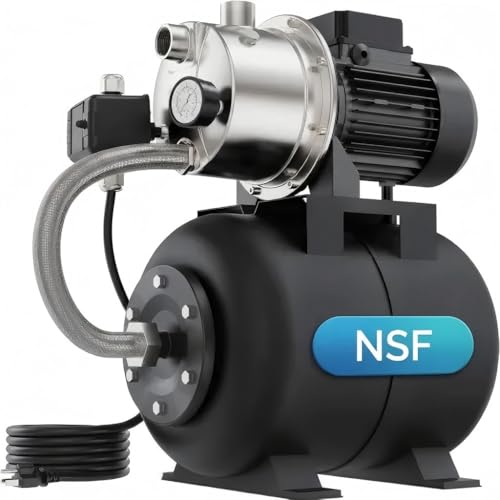
Aquastrong 115V Shallow Well Garden Pump, Stainless Steel, 1320 GPH, Automatic Water Booster Jet Pump for Home, Garden, Lawn,Irrigation,1.6 HP with Pressure Tank
Chosen because it specifies Stainless Steel and 1320 GPH.
View on AmazonThis is not a whole-house pump, and treating it as one is the most common mistake buyers make with it. It is a stainless-steel shallow-well jet pump rated at 1320 GPH — about 22 GPM at peak — with automatic operation, built for moving water to gardens, hose bibs, drip lines, and light household boosting. It suits a homeowner on a mid-range budget who has a shallow well, cistern, or storage tank and wants reliable pressure at the far end of the yard, or who wants to lift water from a shallow source into a pressure system without buying a full submersible setup.
Key specs
- Type: shallow well jet pump / booster
- Body: stainless steel
- Voltage: 115 V
- Rated flow: 1320 GPH (about 22 GPM) at peak, low head
- Operation: automatic
- Best use: irrigation, garden supply, shallow-well boosting
Stainless steel is the meaningful spec here. Jet pump bodies see constant moisture, and the wetted path is where cheap pumps fail first — typically at the impeller housing or the seal plate. A stainless body with a cast impeller resists that far better than painted cast iron in a damp pump house, and it looks after itself in a way that matters if the pump sits outdoors in a shed. If you are buying for a seasonal garden setup that will be drained and stored, that durability is worth the mid-range tier.
Automatic operation is the second useful feature. The pump starts on demand when a tap or valve opens and shuts off when flow stops, so you are not walking to the pump house to flip a switch every time you water. Combined with a small pressure tank or a pressure controller, that makes it behave like a miniature household system for outdoor use.
The limitation is depth and head. As a shallow-well pump it lives inside the 25 ft suction-lift rule, and its strength is volume at low head rather than pressure at high head. If your garden is 200 ft away and uphill, you will lose most of your pressure to friction and elevation before the water arrives — the flow rating tells you nothing about that. This pump is happiest with a short, generous-diameter run and modest elevation change.
Pros
- Stainless steel wetted parts resist corrosion in damp locations
- Roughly 22 GPM peak is generous for garden and irrigation duty
- Automatic start/stop means no manual switching
- Runs on ordinary 115 V household power
- Light and portable compared with a full well system
Cons
- Not a whole-house pump — do not expect 40–60 PSI at multiple fixtures
- Shallow-well only; the 25 ft suction limit applies
- Peak flow collapses as head and distance increase
- Needs a pressure tank or controller to behave like a household system
- Above-ground pump is exposed to freezing if not drained
Compared with the AQUASTRONG 1.5 HP jet/centrifugal pump, the garden pump is the smaller, quieter, more efficient sibling. The 1.5 HP unit moves roughly 4250 GPH — more than three times the volume — for irrigation systems with multiple zones or long mainlines. If you are watering a large property or running several sprinkler zones at once, step up. If you are filling a tank, running a hose, or boosting a single outdoor line, this one is the better match and costs less to run.
4. Acquaer Shallow Well Jet Pump, Dual Voltage – Best Budget Shallow-Well Workhorse
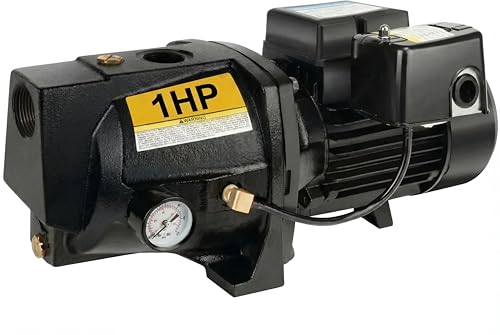
Acquaer Shallow Well Jet Pump,Cast Iron, Well Depth Up to 25ft, 115V/230V Dual Voltage, Automatic Pressure Switch
Chosen because it specifies Cast Iron and Well Depth Up to 25ft.
View on AmazonA straightforward cast-iron shallow-well jet pump with a 25 ft depth rating, dual 115/230 V capability, and an automatic pressure switch. It suits a budget-conscious household on a shallow well — a driven point, a dug well, a cistern, or a shallow bore — that wants whole-house supply without paying mid-range prices. It is also the natural pick for a workshop, barn, or outbuilding where the demand is intermittent and the priority is a dependable pump at a low entry price.
Key specs
- Type: shallow well jet pump
- Body: cast iron
- Depth rating: up to 25 ft suction lift
- Voltage: 115 V or 230 V, field-selectable
- Control: automatic pressure switch
- Best use: shallow wells, cisterns, light household and outbuilding supply
Dual voltage is the standout feature at this price tier, and it is worth understanding why. Wiring the pump for 230 V roughly halves the running current compared with 115 V, which lets you use smaller conductors over the same distance and reduces voltage drop. For a pump house 80 or 100 ft from the electrical panel, that can be the difference between a comfortable installation and one that browns out on every start. Because the motor is field-selectable, you can wire it either way depending on what is already at the wellhead — a genuine convenience for a retrofit.
The automatic pressure switch means the pump maintains system pressure on its own once a tank is in the loop. You set the cut-in and cut-out pressures, the pump starts when pressure falls and stops when it recovers, and the household experiences something close to municipal behaviour. Cast iron construction is the right material for this class: heavier than plastic-bodied imports, more resistant to the vibration and moisture of a pump house, and repairable.
What you give up at this tier is refinement rather than function. Expect a noisier motor, less efficient hydraulics than a premium jet pump of similar rating, and a pressure switch that may need adjusting or replacing sooner. Cast iron also rusts if the pump sits with standing water in a freezing shed, so winterizing matters more here than with a stainless body.
Pros
- Dual 115/230 V wiring is unusually flexible at a budget price
- Cast-iron body and volute are repairable and durable
- Automatic pressure switch handles routine cycling
- Simple, familiar shallow-well design with widely available parts
- Low entry price for whole-house-class supply
Cons
- Hard 25 ft depth ceiling — no ejector option
- Lower efficiency and more noise than premium jet pumps
- Requires a separate pressure tank
- Cast iron needs winterizing to avoid freeze damage
- Pressure switch is a wear item and the first thing to fail
Compared with the Red Lion RJS-75-PREM, this Acquaer is the value play and the Red Lion is the durability play. The RJS-75-PREM offers 3/4 HP and a 16 GPM rating from a brand with a long history in well pumps, and it generally holds pressure more steadily under household load. If your budget is the binding constraint, the Acquaer does the same job for less. If you plan to keep the house for twenty years, spend the difference.
5. Red Lion RJS-75-PREM Shallow Well Jet Pump – Best for Steady Shallow-Well Household Supply

Red Lion RJS-75-PREM 115/230V, 3/4 HP, 16 GPM, Shallow Well Jet Pump
Chosen because it specifies 3/4 HP and 16 GPM.
View on AmazonA 3/4 HP, 16 GPM shallow-well jet pump from a brand that has been making water pumps for a very long time. It suits the household on a well under 25 ft that wants steady, unremarkable, everyday water pressure and is willing to pay mid-range prices for a pump with a strong service record. It is the sensible middle answer: more capability than a budget jet, less money than a premium one, and a specification set that fits ordinary domestic demand almost exactly.
Key specs
- Type: shallow well jet pump
- Horsepower: 3/4 HP
- Voltage: 115/230 V
- Rated flow: 16 GPM
- Depth rating: shallow well, up to about 25 ft suction lift
- Best use: whole-house supply on a shallow well, 2–4 bathroom homes
Sixteen GPM is a well-chosen number for a household pump. Domestic peak demand in a typical home is driven by simultaneous fixtures: a shower (about 2.5 GPM), a running toilet or two, a kitchen tap, a washing machine fill. Realistic peaks land near 10–14 GPM, so a 16 GPM pump covers the peaks with a little margin without being wildly oversized. Oversizing a jet pump is not harmless — a pump that vastly exceeds demand short-cycles against the pressure switch, which wears the motor and the switch and can hammer the plumbing.
Dual voltage gives you the same installation flexibility described earlier: run it on 115 V for a short, simple circuit, or switch to 230 V when the run from the panel is long and voltage drop is a concern. On a 3/4 HP motor, either is workable, and having the choice at the wellhead is worth more than it sounds when you are retrofitting an older property.
Red Lion’s advantage at this price is consistency rather than any single dramatic specification. Jet pumps in this class share the same basic hydraulic design, and the differences show up in motor windings, seal quality, and how well the pressure switch holds its setting over years. Those are exactly the parts that determine whether a pump gives you ten years or four, and they are the parts a specification sheet does not show. Buying from an established pump manufacturer is a reasonable proxy for getting them right.
Pros
- 16 GPM is well matched to real household peak demand
- Established pump brand with broadly available replacement parts
- Dual 115/230 V wiring flexibility
- Above-ground service access for switch and seal work
- Quieter and more efficient than budget-tier jet pumps
Cons
- Shallow-well only — the 25 ft suction limit applies
- Mid-range price for a specification some budget pumps match on paper
- Requires a separate pressure tank and fittings
- 3/4 HP is modest for heavy irrigation alongside household use
- Cast-iron body needs winterizing in cold climates
Compared with the Goulds J5S, the Red Lion trades some long-term reputation for more horsepower at a lower price. The Goulds is 1/2 HP — genuinely modest — but it carries a premium reputation for longevity in shallow-well service. If your household demand is light and you want the pump you never think about, the Goulds is the premium pick. If you want the extra 1/4 HP and a lower price, the Red Lion is the more practical buy.
6. Goulds J5S Shallow Well Jet Pump – Best for Long-Term Durability
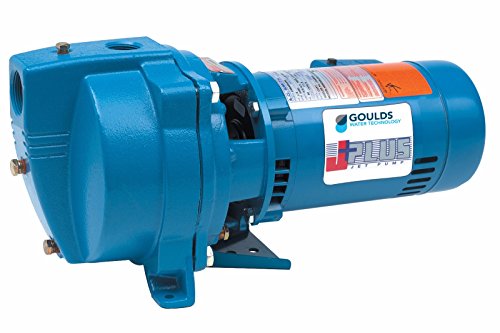
Goulds Pump J5S Shallow Well Jet Pump, 115/230 volt, 1/2 hp
Chosen because it specifies 115/230 volt and 1/2 hp.
View on AmazonGoulds has been building water pumps since the nineteenth century, and the J5S is the archetypal premium shallow-well jet pump: 1/2 HP, 115/230 V, cast-iron body, and a design philosophy that prioritizes running quietly for a very long time over winning a flow-rate argument. It suits a homeowner on a shallow well with modest, steady demand — a two- or three-bedroom house, one or two bathrooms, no irrigation — who wants to install a pump once and forget it. It also suits a buyer who values a brand with a deep parts and service network.
Key specs
- Type: shallow well jet pump
- Horsepower: 1/2 HP
- Voltage: 115/230 V
- Body: cast iron
- Depth rating: shallow well, up to about 25 ft suction lift
- Best use: steady domestic supply, small households, long service life
The 1/2 HP rating is the spec that surprises people, and it is worth being honest about. A half-horsepower jet pump delivers less flow and less pressure reserve than a 3/4 HP or 1 HP unit, and it will not comfortably run a shower while the washing machine fills and the garden tap is open. Where it earns its premium is in the parts that are not on the box: a heavier motor, better bearings, a robust impeller, and a cast volute that holds its tolerances for years. In a pump that runs for a few hours a day, that translates into a very long service life and fewer mid-life repairs.
For a small household, that is the right trade. A pump that runs slightly longer per cycle but starts fewer times and never needs a seal replacement is genuinely cheaper over fifteen years than a cheaper pump replaced twice. The Goulds also pairs well with a properly sized pressure tank, because a modest pump benefits more from tank drawdown — a bigger tank means fewer starts, and fewer starts means a longer motor life.
The practical caution is sizing. Buy the J5S for a modest, predictable demand and size your pressure tank generously. If you have four bathrooms, an irrigation system, or a large household, this pump is the wrong tool and you should look at the 3/4 HP Red Lion or the 1.5 HP AQUASTRONG instead.
Pros
- Premium build quality and a long-established pump brand
- Very long expected service life with routine maintenance
- Quiet, smooth operation for a jet pump
- Widely available parts and a deep service network
- Dual 115/230 V wiring
Cons
- 1/2 HP is modest — not suited to heavy or simultaneous demand
- Premium price for a low horsepower rating
- Shallow-well only, with the usual 25 ft suction limit
- Needs a separate pressure tank, sized generously for best results
- Cast iron requires winterizing in freezing climates
Compared with the Red Lion RJS-75-PREM, this is a philosophy choice rather than a specification one. The Red Lion gives you 3/4 HP and 16 GPM for less money; the Goulds gives you a half-horsepower pump built to a standard that tends to outlast it. If your demand is light and your horizon is long, buy the Goulds. If you want the extra capacity and the lower price, buy the Red Lion.
7. Red Lion RL12G07-2W2V Submersible Well Pump – Best for Deep Wells With Simple Wiring
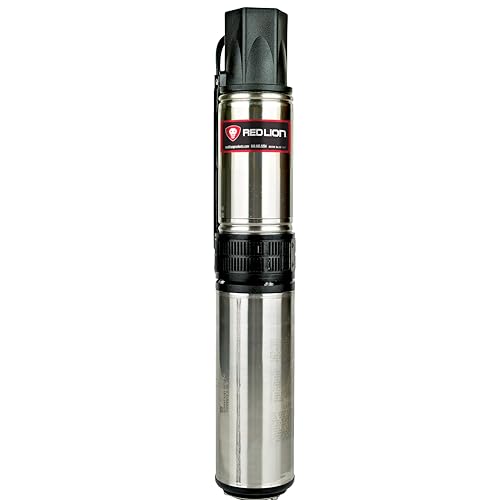
Red Lion RL12G07-2W2V Submersible Well Pump, 3/4 HP, 2-Wire, 230V, 12 GPM
Chosen because it specifies 3/4 HP and 2-Wire.
View on AmazonA 3/4 HP, 2-wire, 230 V submersible rated at 12 GPM. This is the pump for a deep well where the priority is a clean, simple installation and dependable motor quality rather than maximum flow. The 2-wire design is the key feature: there is no separate control box to mount and wire at the wellhead, because the starting components live inside the motor. It suits a household on a well deeper than 90 ft with ordinary domestic demand, and it suits an installer who wants to minimize the number of above-ground failure points.
Key specs
- Type: submersible well pump, 4-inch class
- Horsepower: 3/4 HP
- Motor wiring: 2-wire (no external control box)
- Voltage: 230 V
- Rated flow: 12 GPM
- Best use: deep wells with steady household demand
Twelve GPM is a deliberate specification. For a household that is not running irrigation, 12 GPM at working pressure is comfortable — it covers a shower, a tap, and a washing machine fill without drama. Submersible pumps are rated at peak flow near zero head, so the working number at your actual depth will be lower; a 12 GPM pump at 150 ft of head might deliver 9 or 10 GPM at 40 PSI, which is still adequate for most homes. Choosing a lower-flow pump and letting it run longer is generally gentler on the motor than a high-flow pump that short-cycles.
The 2-wire versus 3-wire distinction trips up a lot of buyers, so here is the practical version. A 3-wire pump requires a control box at the surface containing the start capacitor and relay; a 2-wire pump has those components built into the motor. Two-wire is simpler to install, has fewer surface components to fail, and generally costs less to put in. Three-wire gives you the ability to replace a failed start component without pulling the well. On a deep well, where pulling the pump is a major job, that argument cuts both ways — some installers prefer 3-wire for exactly that reason, others prefer 2-wire for fewer failure points.
230 V is standard at this class and is the right choice. A 3/4 HP submersible on 230 V draws a modest current, which keeps conductor sizing reasonable even on a long run from the panel to the wellhead, and submersible motors are sensitive to voltage drop. Size the wire generously and check the drop calculation rather than eyeballing it.
Pros
- 2-wire design eliminates the surface control box
- Established submersible pump brand with good parts availability
- Quiet operation — the pump is submerged
- 230 V motor keeps running current and wire size sensible
- Handles wells deeper than any jet pump in this roundup
Cons
- 12 GPM limits simultaneous heavy demand and irrigation
- Requires a 230 V circuit — not a plug-in job
- Servicing requires pulling the well
- Needs a separate pressure tank and switch
- Premium price tier
Compared with the VEVOR 1 HP submersible, the Red Lion gives up raw flow and lift but gains motor quality and a simpler 2-wire installation. The VEVOR is the budget choice for a deep well; the Red Lion is the choice for a deep well you do not want to think about again. Compared with the Red Lion RL12G05-3W2V, the difference is horsepower and wiring: that model is 1/2 HP and 3-wire, suited to lower-yield wells and to installations where a replaceable surface control box is preferred.
8. AQUASTRONG 1.5 HP Shallow Well Jet/Centrifugal Pump – Best for High-Flow Irrigation

AQUASTRONG 1.5 HP Shallow Well Jet/Centrifugal Pump, 4250 GPH, 115/230V, Durable Cast Iron Booster Pump for Lawn Sprinkler, Garden Irrigation
Chosen because it specifies 4250 GPH and 115/230V.
View on AmazonAt roughly 4250 GPH — about 71 GPM at peak — this is the highest-volume pump in the roundup. It is a 1.5 HP cast-iron jet/centrifugal pump with 115/230 V capability, built for moving large volumes of water at modest pressure. It suits a property with a shallow well, pond, or cistern feeding an irrigation system with multiple zones, a long mainline, or a large garden. It also suits filling large tanks and running frost-free hydrants where the priority is volume rather than household pressure.
Key specs
- Type: shallow well jet / centrifugal pump
- Horsepower: 1.5 HP
- Body: cast iron
- Voltage: 115/230 V
- Rated flow: 4250 GPH (about 71 GPM) at peak, low head
- Best use: multi-zone irrigation, large gardens, tank filling
The distinction between this pump and a household booster is important. A centrifugal pump produces high flow at low head and its output falls off quickly as pressure rises. That makes it excellent for sprinklers, drip manifolds, and filling tanks — all jobs where you want volume at 20–40 PSI — and mediocre for maintaining 50–60 PSI at a shower head. Buying a 71 GPM pump to run a house is a classic mismatch: you pay for volume you cannot use, and the pump cycles hard against the pressure switch.
Where it earns its keep is a system with real hydraulic demand. A 200 ft mainline to a set of sprinkler zones will eat pressure through friction alone; a high-volume pump has the reserve to push through it. Pair it with an irrigation controller and a properly sized pressure tank or cycle stop valve, and you get zone-by-zone watering without starving the last head on the line.
Dual voltage matters more here than on a smaller pump. At 1.5 HP, 115 V operation draws a heavy current — enough to require a dedicated circuit and thick conductors — so most installations will be happier on 230 V if the panel can supply it. Cast iron construction is appropriate for a pump that runs long irrigation cycles in a damp pump house, though it still needs draining before freezing weather.
Pros
- Very high flow — about 71 GPM peak — for large irrigation systems
- Cast-iron body suited to long run times
- Dual 115/230 V wiring flexibility
- Handles long mainlines and multiple zones
- Above-ground service access
Cons
- High flow at low head — not a household pressure pump
- 1.5 HP draws significant current, especially at 115 V
- Needs a substantial pressure tank or cycle control to avoid short cycling
- Shallow-well suction limit still applies
- Noisy compared with a submersible
Compared with the Aquastrong garden pump, this is the same family of design scaled up roughly threefold in flow. The garden pump is the right call for a hose, a drip line, or a single zone; the 1.5 HP unit is the right call when you are running several zones, a long main, or filling tanks fast. If you are unsure, count your simultaneous zones and multiply their flow requirements — if the total is under 20 GPM, the garden pump is enough.
9. VEVOR 1.6 HP Shallow Well Pump with Pressure Tank – Best Turnkey Shallow-Well System
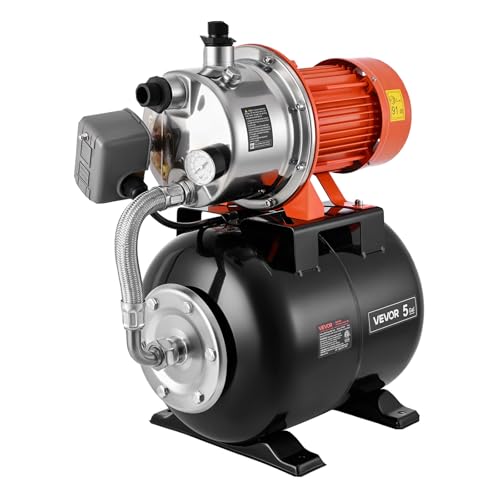
VEVOR 1.6 HP Shallow Well Pump with Pressure Tank, 120V 1320 GPH, Stainless Steel Irrigation Jet Pump with 5-Gal Tank, Automatic Water Booster System, 20/40 PSI Pressure Switch, for Home Garden Lawn
Chosen because it specifies 120V 1320 GPH and Stainless Steel Irrigation Jet Pump with 5-Gal Tank.
View on AmazonA complete shallow-well package: a 1.6 HP stainless-steel pump, an integrated pressure tank, and the switch and fittings already assembled at a budget price. It suits the buyer who wants a working shallow-well system without sizing a tank separately, sourcing a pressure switch, or figuring out how the pieces connect. It is the fastest route from an unpressurized well to running taps for a household, garden, or outbuilding on water under 25 ft.
Key specs
- Type: shallow well jet pump with integrated pressure tank
- Horsepower: 1.6 HP
- Voltage: 120 V
- Rated flow: 1320 GPH (about 22 GPM) at peak
- Body: stainless steel
- Best use: shallow wells, irrigation, outbuildings, plug-and-play setups
The integrated pressure tank is the feature that matters most, and it is worth explaining why a tank is not optional. Without a tank, a pump with an automatic switch starts and stops the instant a tap opens or closes — dozens of cycles an hour, which destroys motors and switches. The tank provides drawdown: a reservoir of pressurized water that lets the pump run for a reasonable cycle and then rest, and it smooths pressure at the tap so the shower does not pulse. A pre-assembled package removes the most common DIY sizing error, which is buying a tank far too small for the pump.
Stainless steel construction is the other meaningful specification. The wetted path is where budget pumps corrode, and a stainless housing resists that better than painted cast iron in a damp shed. Combined with a 1.6 HP motor and roughly 22 GPM peak flow, it is a genuinely capable shallow-well pump for the price tier.
The limitation is the familiar one: shallow well only, with the standard suction-lift ceiling. The integrated tank is also, by necessity, modest — enough to stop destructive short cycling, but not a substitute for a large standalone tank if you want long, gentle run cycles. If your pump house has room, a bigger tank and a cycle control valve will extend the life of any pump in this list.
Pros
- Complete system — pump, tank, switch, and fittings in one purchase
- Stainless steel body resists corrosion
- Roughly 22 GPM peak flow is strong for a budget package
- Plug-and-play simplicity for first-time installers
- Runs on ordinary 120 V household power
Cons
- Shallow-well only — 25 ft suction limit
- Integrated tank is small, so cycles are shorter than ideal
- 1.6 HP on 120 V draws high current; check circuit capacity
- Less serviceable than separate components in some layouts
- Stainless housing still needs draining before freezing weather
Compared with the FOTING 1.5 HP shallow well pump with pressure tank, the two are close competitors in the same budget tier — similar horsepower, similar flow around 1320–1340 GPH, and the same integrated-tank convenience. The VEVOR edges ahead on the stainless body, which is the more corrosion-resistant choice in a damp pump house. If you prefer a cast-iron pump or find the FOTING better value on the day, the performance difference is not large.
10. Aquastrong Whole House Water Pressure Booster Pump – Best for Constant Household Pressure

Aquastrong Whole House Water Pressure Booster Pump 80 PSI, 115V Automatic Variable Speed, Constant Pressure, Integrated Design, Self-Priming, for Home, Apartment, Shower, Garden, Shallow Well,Smart 45
Chosen because it specifies 115V Automatic Variable Speed and Constant Pressure.
View on AmazonThis pump solves a different problem from everything else in this roundup. It is not a well pump — it is a 115 V variable-speed booster that maintains constant pressure up to an 80 PSI class, designed to sit on the household plumbing and fix weak or fluctuating pressure. It suits a home that already has a water source but suffers from low pressure at upstairs fixtures, long runs to a distant bathroom, or pressure that sags whenever two taps run at once.
Key specs
- Type: whole-house pressure booster, variable speed
- Voltage: 115 V
- Control: automatic, constant pressure
- Pressure class: up to 80 PSI
- Operation: variable speed — motor ramps to match demand
- Best use: boosting existing supply, not lifting from a well
Variable speed is the technical heart of it, and it is a genuine improvement over a fixed-speed booster. A conventional booster runs at one speed and cycles on and off against a pressure switch; a variable-speed unit ramps its motor up and down to hold a target pressure as demand changes. The result is steadier pressure at the tap, fewer hard starts, and less energy wasted pushing more water than you are using. For a household where the shower temperature swings every time someone opens a tap, that is the fix.
Where this pump does not help is a well with insufficient supply. If your well cannot deliver the water in the first place, boosting pressure downstream will not create it — you will simply pull the well down faster. Boosters address pressure, not volume or supply depth. Confirm you have adequate flow and a working pressure tank before adding a booster.
Installation is a plumbing job rather than a well job: the unit goes on the incoming main, needs a 115 V outlet nearby, and should be installed with isolation valves and a bypass so you can service it without shutting off the house. It also needs protection from freezing, since it is typically installed indoors in a basement or utility room.
Pros
- Constant pressure rather than on/off cycling
- Variable speed matches output to demand, saving energy
- Runs on standard 115 V power
- Quieter operation than a fixed-speed booster
- Up to an 80 PSI class, which is ample for domestic plumbing
Cons
- Does not lift water from a well — it is a booster, not a source pump
- Premium price tier
- Requires an indoor, freeze-protected installation
- Cannot fix a well that lacks adequate yield
- Adds a component that needs its own maintenance and bypass valves
Compared with the Aquastrong 1.5 HP jet/centrifugal pump, the difference is purpose, not power. The 1.5 HP unit moves enormous volumes at low pressure for irrigation; the booster holds a steady household pressure with modest flow. If your problem is “the far bathroom trickles,” buy the booster. If your problem is “the sprinklers starve,” buy the high-flow pump.
11. FOTING 1.5 HP Shallow Well Pump with Pressure Tank – Best Budget Plug-and-Play
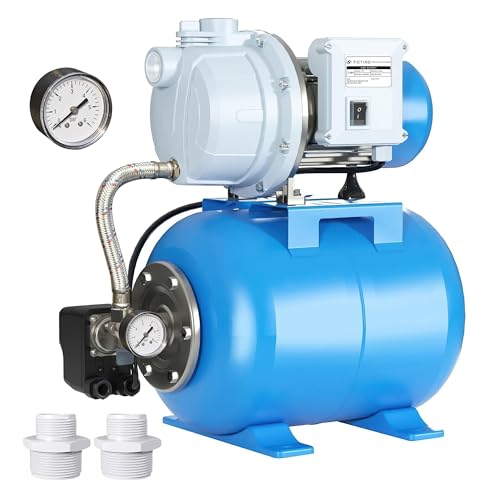
FOTING 1.5HP Shallow Well Pump with Pressure Tank, 1340GPH Automatic Irrigation Water Booster Jet Pump, Water Pumps Booster System 164FT 115V for Home Garden Lawn Farm, Blue
Chosen because it specifies 1340GPH Automatic Irrigation Water Booster Jet Pump and Blue.
View on AmazonA 1.5 HP shallow-well pump with an integrated pressure tank, automatic operation, and roughly 1340 GPH peak flow at a budget price. It suits the same buyer as the VEVOR package: someone with a shallow well, cistern, or storage tank who wants a complete, working system with minimal assembly and no separate tank sizing. It is equally at home as an irrigation pump for a large garden or as a water supply for a workshop or outbuilding.
Key specs
- Type: shallow well jet pump with integrated pressure tank
- Horsepower: 1.5 HP
- Rated flow: 1340 GPH (about 22
Affiliate disclosure. As an Amazon Associate we earn from qualifying purchases at no extra cost to you. Prices accurate as of the date shown.Best Well Pumps for Reliable Water FlowCheck price on Amazon








Write Your Review
No reviews yet. Be the first to share your experience!