
Our Top Picks
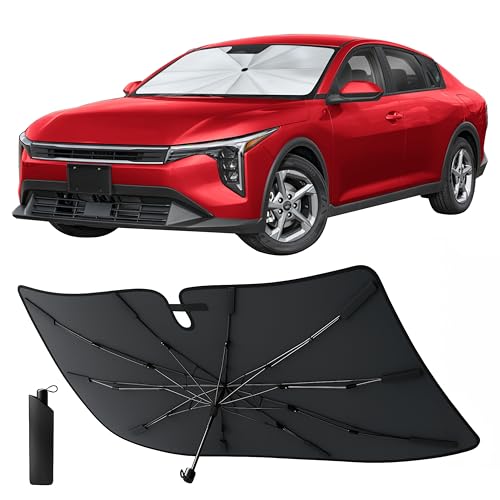
 Nmoiss 2026 Windshield Sun Shade UmbrellaMedium(56"L x 33"W)56 x 33 x 0 inches1 poundsCheck on Amazon
 EzyShade Car Windshield Sun Shade. See Vehicle Size-Chart.Medium11.93 x 11.3 x 1.34 inches0.4 PoundsCheck on Amazon
If you want the short answer, the best windshield sun shade for SUVs in 2026 for most owners is the Magnelex Double-Layer Windshield Sunshade: its two-layer foil-and-foam construction reflects radiant heat instead of soaking it up, and the larger of its two sizes covers the glass on most crossovers and mid-size SUVs without the sagging center that plagues one-size-fits-all screens. It suits a daily driver parked outdoors at work, and it folds into a pouch small enough for a door pocket. If you want the cheapest screen that still covers a full-size windshield, the EcoNour Front Window Sun Blocker is the value pick. If you drive a 2020–2026 Mercedes-Benz GLE or GLS and want a factory-look fit with no gaps at the mirror pod, the Pigenius AstraGuard is the premium answer. Everything below compares SUV-specific fit, shade coverage, reflective materials, folding designs, storage size and realistic heat reduction so you can match a shade to your windshield rather than to a marketing claim.
Top 3 Picks
Best overall: Magnelex Double-Layer Windshield Sunshade. The double-layer build is the reason it wins — a reflective outer film bonded to a foam core holds its shape against the glass and blocks both radiant heat and glare, and the two available widths mean most SUV owners can get within an inch or two of a true edge-to-edge fit. It is the safest default if you do not want to think hard about sizing.
Best budget: EcoNour Front Window Sun Blocker. A single-layer reflective screen at a budget-tier price, sold in a large size aimed at SUVs and trucks. It will not hold a crisp shape the way a laminated shade does, but it covers a big windshield, stores flat, and costs little enough to buy one for each vehicle you own.
Best premium: Pigenius AstraGuard for Mercedes-Benz GLE/GLS (2020–2026). Vehicle-specific tooling means no trimming, no folding over the mirror, and no gaps at the A-pillars or the sensor housing. If your SUV has a camera and radar pod behind the glass, a model-specific cut is the difference between a shade that sits flat and one that slides down every afternoon.
Quick Comparison
Coverage figures below describe the size class each product is engineered for; exact dimensions vary by variant, and where a measurement appears in the product name (for example, Autoamerics 64 × 33.5 in) it is the stated size. Price tiers reflect general market positioning, not current listings — those change constantly.
| Product | Best for | Coverage class (W × H, in) | Material / layers | Fold design | Packed size class | Price tier |
|---|---|---|---|---|---|---|
| Magnelex Double-Layer | Most SUV owners; daily outdoor parking | Two sizes, roughly 59–64 × 31–32 | Reflective foil + foam, double layer | Folds flat, pouch included | ~10–11 in disc | Mid-range |
| Autovir 280T Foldable | Budget buyers and backup vehicles | Universal, roughly 55–64 × 28–32 | 280T polyester with reflective face | Accordion folds, elastic strap | ~12 in bundle | Budget |
| EcoNour Front Window Sun Blocker | Budget coverage for large windshields | SUV size, roughly 64 × 32 | Single-layer reflective polyester | Accordion folds | ~13 in bundle | Budget |
| EcoNour Foldable for SUVs | Crossover and mid-size SUVs | Roughly 59–64 × 31–32 | Reflective laminate, single body | Accordion folds, storage pouch | ~12 in bundle | Mid-range |
| Nmoiss 2026 Umbrella Shade | Fast one-handed daily setup | Umbrella ribs, roughly 55–65 × 30–33 | Vinyl-coated heat shield | Umbrella opening, no folding | ~13–15 in shaft | Premium |
| EzyShade Medium (M) | Buyers who want a published size chart | Size M, roughly 57–61 × 28–30 | Multi-layer reflective laminate | Accordion folds, strap | ~12–14 in bundle | Mid-range |
| SINGARO 300T Universal | Windshield plus side-window coverage | Roughly 57–64 × 30–32, overlapping edges | 300T reflective fabric | Folds flat, overlap panels | ~13 in bundle | Budget |
| EcoNour 2-Piece Foldable | Odd windshield shapes; adjustable overlap | Two panels, ~60 in combined width | Single-layer reflective polyester | Two independent folds | ~12 in bundle | Budget |
| EcoNour Shade + Window Tint | Buyers who want a shade and tint film together | Roughly 59–64 × 30–32 | Reflective laminate plus tint film | Accordion folds | ~12–13 in bundle | Mid-range |
| Autoamerics American Flag, 64 × 33.5 in | Full-size trucks and three-row SUVs | 64 × 33.5 (stated) | Multi-layer reflective with printed graphic | Accordion folds | ~14 in bundle | Premium |
| Pigenius AstraGuard GLE/GLS | Exact fit on Mercedes-Benz GLE/GLS 2020–2026 | Vehicle-specific, no trimming | Multi-layer AstraGuard laminate | Folds into supplied sleeve | ~14 in bundle | Premium |
| BDK Iridescent Accordion | Rigid accordion coverage, low-profile look | Roughly 58–64 × 28–32 | Iridescent matte finish over rigid panels | Accordion, rigid panels | ~14 in bundle | Premium |
How We Chose
This roundup is built from published product specifications, manufacturer size charts, and the physical constraints that actually determine whether a windshield shade works on an SUV: glass width at the widest point, glass height at the centerline, the presence of a mirror-mounted sensor or camera pod, and how much room the folded shade takes up when it is not in use. We grouped products by the job they are built to do — universal coverage, budget replacement, model-specific fit, one-handed daily setup, or windshield-plus-window kits — rather than ranking them on a single scale, because a 64-inch screen that is perfect for a Suburban is a loose, flapping nuisance on a compact crossover.
Priority went to four things. First, coverage class: a shade should come within roughly one to three inches of the windshield width it is sold for, since every inch of uncovered glass is a direct path for radiant heat onto the dash. Second, material construction, from single-layer reflective polyester through 280T and 300T woven fabrics to laminated foil-and-foam and vinyl-coated heat shields. Third, fold design and packed size, because the best shade is the one you actually deploy every day. Fourth, upgrade path: whether the product is a first purchase, a replacement for a shade that tore at the wire hoop, or a precision fit for a specific SUV. We did not test these products in person, and nothing here is based on hands-on evaluation — the comparisons are spec-based and category-based, which is why the sizing guidance matters more than any single recommendation.
1. Magnelex Double-Layer Windshield Sunshade – Best for Most SUV Owners

Magnelex Car Windshield Sunshade – Double-Layer Design for 2X Heat Blocking, Blocks UV Rays, Foldable Sun Shade for Cars, Trucks & SUVs, Keeps Interior Cooler, Large (63 x 33.8 in)
Chosen because it specifies Double-Layer Design for 2X Heat Blocking and Blocks UV Rays.
View on AmazonThe Magnelex is the pick for the owner who parks outside every day and wants a shade that behaves the same on day one and day three hundred. It suits mid-size and full-size SUVs where a single-layer screen would bow inward at the center and leave a crescent of uncovered glass along the top edge. It is also the right choice if you have been burned by cheap shades that shed their reflective coating after one summer.
Key specs (as listed):
- Double-layer construction: a reflective outer film bonded to a foam-type core, so the panel holds its shape against the glass instead of collapsing
- Two size options spanning roughly 59–64 in wide by 31–32 in tall — the compact size for crossovers, the larger for mid-size and full-size SUVs
- Folds down into a compact disc roughly the size of a dinner plate, with a storage pouch
- Silver reflective face with a darker inner surface that limits glare bouncing back at the driver
- Friction fit behind the sun visors — no suction cups, no adhesive
Why it earns the top spot. The double layer is not marketing padding. A single-layer reflective screen reflects radiant energy, but it also conducts heat through to the cabin side within minutes, and it wrinkles at the fold lines until it no longer sits flush. Bonding the reflective film to a foam core creates a small insulating air gap and, more importantly, gives the panel enough stiffness to stay pressed against the glass across a 60-inch span. That stiffness is what keeps the top edge tucked under the visors and the bottom edge anchored on the dash.
The two-size approach is the second reason. SUV windshields are not one size, and a shade that is two inches narrow leaves a strip of glass that radiates straight onto the dashboard and the top of the steering wheel. Buyers who measure before ordering — width at the widest point, height at the centerline — usually land within an inch of a flush fit.
Pros
- Double-layer build resists the sagging and creasing that kills cheap single-layer screens
- Two widths cover most crossover through full-size SUV windshields
- Folds flat into a pouch small enough for a door pocket or under-seat bin
- No suction cups to fail in summer heat
Cons
- Mid-range pricing is meaningfully above budget single-layer options
- Folding a stiff panel takes two hands until the creases set in
- Not cut for a specific model, so SUVs with large mirror-mounted sensor pods may need the shade nudged around the housing
Compared with the nearest alternative: the EcoNour Foldable Front Windshield Shade sits in the same mid-range tier and folds similarly, but its laminate is a single reflective body rather than a bonded foam sandwich, so it is lighter to handle and slightly less rigid at full extension. On a compact crossover that difference is negligible; on a 62-inch-wide three-row windshield the Magnelex holds the top edge more reliably.
2. Autovir 280T Foldable Windshield Sun Shade – Best for Tight Budgets and Backup Cars

Autovir Windshield Sun Shade, Foldable Car Window Shades, 280T Visor Shade
Chosen because it specifies Foldable Car Window Shades and 280T Visor Shade.
View on AmazonThe Autovir is the shade you buy three of — one per vehicle, one for the trunk, one for the spouse’s car — without thinking about the cost. It suits second cars, work vans, teenage drivers, and anyone who wants heat protection now and is willing to accept a shorter service life in exchange for a budget-tier price. It is also a reasonable first shade if you have never measured a windshield and do not want to spend much while you learn what size you actually need.
Key specs (as listed):
- 280T polyester fabric with a reflective outer face — the “280T” designation refers to the thread-density class of the woven polyester, with higher numbers generally meaning a denser, slightly heavier weave
- Universal sizing in the roughly 55–64 in wide by 28–32 in tall range, intended to fit most cars, SUVs and light trucks
- Foldable accordion design that collapses into a flat bundle secured with an elastic strap
- Friction fit behind the visors; no mounting hardware
- Sold as a single windshield shade, not a kit
Where it works and where it does not. A 280T woven polyester shade reflects a good share of the sun’s radiant energy, and because the fabric is thin, it folds into a smaller bundle than a laminated panel of the same coverage. That makes it easy to stash in a seat-back pocket, which in practice is the difference between using a shade daily and leaving it in the garage.
The trade-off is rigidity. Thin fabric drapes rather than stands, so on a wide SUV windshield the middle of the panel tends to bow away from the glass. The result is a shade that still cuts a large amount of direct sun on the dash and the seats, but leaves a soft-edged gap at the top center where the fabric sags below the roofline. On narrower crossover windshields, and on any windshield where the rear-view mirror sits low, that gap is small enough to ignore.
The elastic strap is another budget-tier detail. It works, but on thin woven shades the strap tends to be the first thing to stretch out or fray after a season of daily folding.
Pros
- Budget-tier price makes multi-vehicle coverage practical
- 280T fabric folds very small — easier to store than laminated panels
- Universal sizing means it will fit something in almost any driveway
- Light enough to shake out and refold one-handed
Cons
- Thin fabric sags at the center of wide SUV windshields
- No foam layer, so the cabin-side surface warms faster than a laminated shade
- Elastic retention strap is the likely first failure point
- Universal sizing means a loose fit on both small and very large windshields
Compared with the nearest alternative: the EcoNour Front Window Sun Blocker is the other budget entry here, and it is the better choice if your SUV has a genuinely wide windshield — its large size is aimed squarely at SUVs and trucks, while the Autovir’s universal cut is a compromise across every vehicle class. If your windshield is under about 58 inches wide, the Autovir’s smaller folded bundle wins.
3. EcoNour Front Window Sun Blocker – Best Budget Pick for Full-Size SUVs

EcoNour Car Windshield Sun Shade, Front Window Sun Blocker for SUVs,Sedan
Chosen because it specifies Front Window Sun Blocker for SUVs and Sedan.
View on AmazonThis is the budget shade to buy when your windshield is big. EcoNour sells it in sizes intended for SUVs and sedans, and the large option is aimed at the wide, tall glass you find on full-size SUVs, three-row crossovers, and light trucks. It suits the owner who wants maximum covered area for minimum money and is willing to accept a simpler, single-layer build to get it.
Key specs (as listed):
- Single-layer reflective polyester with a bright reflective face and a contrasting inner surface
- Sized for SUVs and sedans, with the largest option in the roughly 64 × 32 in class
- Accordion folding into a flat bundle
- Friction fit behind the sun visors
- Budget-tier positioning, sold as a single windshield shade
What you get for the money. The value case here is coverage per dollar. A 64-inch-wide panel covers nearly the full width of a Tahoe-class windshield, and a single-layer reflective screen at that size still blocks the direct solar load that turns a dashboard into a hot plate. For a vehicle that sits in an open lot all day, that is the majority of the benefit.
The single-layer construction is where the compromises show. Without a foam core, the panel has no real stiffness, so it relies on being pinched between the visors and the dash to stay upright. On a steeply raked SUV windshield — most modern crossovers are raked well past 30 degrees from vertical — a floppy panel can creep downward over a long hot afternoon. Owners often solve this by tucking the bottom edge behind a dash mat or letting the wipers rest on top of the lower edge when parked.
Durability is the second consideration. Single-layer reflective coatings on budget shades tend to develop crease lines along the fold pattern, and those creases are where the reflective layer eventually separates. Fold it the same way every time, along the factory creases, and a budget shade of this type commonly lasts one to two full summers of daily use before coverage starts to degrade.
Pros
- Large size class genuinely covers wide SUV and truck windshields
- Lowest-cost way to protect a big windshield
- Folds flat for storage behind a seat
- Bright reflective face is easy to spot in a cluttered trunk
Cons
- No foam layer — less heat resistance on the cabin side and no structural rigidity
- Can slide down a steeply raked windshield over a long day
- Reflective coating wears at the fold lines faster than laminated alternatives
- Universal SUV sizing still leaves small gaps at the A-pillar corners on some models
Compared with the nearest alternative: the Magnelex Double-Layer is the direct upgrade — same coverage class, roughly a tier higher in price, but with a bonded foam core that solves the sliding and creasing problems. If you are buying for a vehicle you plan to keep five years, the Magnelex pays for itself in avoided replacements. If you are buying for a car you will sell next spring, this one is the smarter spend.
4. EcoNour Foldable Front Windshield Shade for SUVs – Best for Crossover and Mid-Size SUVs

EcoNour Car Front Windshield Sun Shade, Foldable Window Shade for SUVs
Chosen because it specifies Foldable Window Shade for SUVs.
View on AmazonThis is the mid-range EcoNour, and it is aimed at the most common SUV on the road: the two-row crossover with a windshield in the 59–62 inch range. It suits daily commuters who park in a surface lot, parents who want the cabin survivable at school pickup, and anyone who wants a laminated reflective panel without stepping up to premium pricing.
Key specs (as listed):
- Foldable reflective laminate sized for SUVs, in the roughly 59–64 × 31–32 in class
- Single-body construction that folds along pre-set creases into a compact bundle
- Storage pouch or strap for keeping the folded shade tidy
- Friction fit behind the visors
- Mid-range positioning, sold as a single windshield shade
The mid-range argument. The step up from budget to mid-range buys two things: a denser reflective layer and better fold memory. Fold memory matters more than most buyers expect. A shade that returns to a flat panel every time you unfold it sits flush against the glass; a shade that stays creased develops channels where hot air and radiant energy pass through, and the crease lines are the first places the reflective surface fails.
Because the panel is a single laminated body rather than a two-piece set, deployment is quick: unfold, tuck the top edge under both visors, drop the bottom onto the dash. Total time is typically under fifteen seconds once you have the fold pattern memorized. The trade-off is that a single rigid panel cannot adapt to a windshield with an unusual profile — a strongly curved header, a large sensor pod, or an asymmetric mirror position.
On a typical crossover with a mirror-mounted camera, the shade will need to be pushed up around the housing rather than sitting perfectly flat behind it. That is a small gap, and in practice the heat difference is negligible; the reason to note it is that a shade pressed against a sensor housing can leave a mark on the housing over years of use. A piece of felt tape on the shade’s upper edge solves it.
Pros
- Best coverage-to-price balance for two-row crossovers
- Better fold memory than budget single-layer screens
- Fast daily deployment — under fifteen seconds with practice
- Folds small enough for a door pocket or seat-back sleeve
Cons
- Single panel cannot be adjusted for odd windshield profiles the way a two-piece set can
- Contact with a mirror-mounted sensor housing needs a felt-tape fix
- Mid-range price for coverage that a budget shade roughly matches on smaller windshields
- Still not a model-specific cut, so A-pillar corner gaps persist on some SUVs
Compared with the nearest alternative: against the Magnelex Double-Layer, this EcoNour is lighter and slightly quicker to fold, but it lacks the bonded foam layer that gives the Magnelex its rigidity at full width. Against the EcoNour 2-Piece Foldable, it is faster to deploy but less adaptable — the two-piece set can be spread or overlapped to fit an unusual windshield, which this one cannot.
5. Nmoiss 2026 Windshield Sun Shade Umbrella (Vinyl Coating Heat Shield) – Best for Fast Daily Setup
Nmoiss 2026 Windshield Sun Shade Umbrella [Vinyl Coating Heat Shield]
Picked as a relevant option in this category.
View on AmazonThe Nmoiss is the shade for people who never used a folding screen because folding screens are annoying. It opens like an umbrella, braces against the windshield with the handle acting as a prop, and collapses into a slim shaft you can drop in a door pocket. It suits commuters who park and re-park several times a day, ride-share and delivery drivers, and anyone with a shoulder or wrist issue that makes wrestling a stiff 60-inch panel unpleasant.
Key specs (as listed):
- Umbrella-style deployment on a ribbed frame, opening in a couple of seconds rather than folding along creases
- Vinyl-coated heat shield surface — a coated face rather than a bare woven polyester or laminated foil
- Sized to span typical SUV and crossover windshields in the roughly 55–65 in wide class, with the ribs conforming to the glass curve
- Collapses to a narrow shaft, roughly the length of a compact umbrella, with a storage sleeve
- Handle doubles as a prop against the dash to hold the canopy against the glass
- Premium-tier positioning
Why the design matters. The umbrella format solves the single biggest reason windshield shades fail in real use: friction. A folding screen only works if you are willing to unfold it, position it, and tuck it behind the visors every time you park. The Nmoiss removes two of those steps. You open it inside the cabin, angle it against the glass, and let the handle brace on the dash. There is no folding pattern to memorize and no crease to keep aligned.
The ribbed canopy also conforms better to a curved windshield than a flat panel does, which reduces the edge gaps that let low-angle afternoon sun sneak past. And because it does not fold along hard creases, the reflective surface has fewer stress lines — a real durability advantage over accordion screens, where the fold lines are the first place the coating separates.
The vinyl coating is the second differentiator. Coated surfaces tend to be more resistant to the humidity cycling that degrades bare reflective films over repeated summers, and they wipe clean rather than trapping dust in a woven texture.
The caveats are honest ones. An umbrella canopy has a center hub and a handle, and on some SUVs that assembly lands exactly where a mirror-mounted sensor pod sits, forcing you to angle the shade slightly and accept a small gap at the top. The ribs also create a scalloped edge, so coverage is not a perfect rectangle — on a very wide windshield you may see thin triangular gaps at the corners.
Pros
- Two-second setup — the highest daily-use compliance of any design here
- Collapses to a slim shaft instead of a bulky folded panel
- Ribbed canopy follows the windshield curve, reducing edge gaps
- Vinyl coating resists humidity cycling and wipes clean
- No fold creases, so the reflective surface lasts longer
Cons
- Premium-tier price for coverage that budget flat panels roughly match
- Center hub can conflict with a mirror-mounted camera or sensor pod
- Scalloped rib edges leave small corner gaps on very wide windshields
- Rib mechanisms are a wear item — a bent rib ends the product’s life
Compared with the nearest alternative: the EzyShade Medium is the opposite philosophy — a flat, size-charted, accordion-folding panel that costs less and packs flatter, but demands a proper fold every time. If you will actually fold a shade daily, the EzyShade is the better value. If you know you will not, the Nmoiss is the one you will still be using in August.
6. EzyShade Car Windshield Sun Shade, Medium (M) – Best for Buyers Who Want a Size Chart They Can Follow
EzyShade Car Windshield Sun Shade. See Vehicle Size-Chart. Medium (M) Size
Picked as a relevant option in this category.
View on AmazonEzyShade’s selling point is that it publishes a vehicle size chart and asks you to match your SUV to a lettered size before ordering. That makes it the right choice for the careful buyer — the person who has already been burned by a universal shade that was two inches too narrow and wants to pick a size from a table rather than a guess. The Medium size targets the compact and mid-size crossover class.
Key specs (as listed):
- Lettered sizing (including Medium) matched to a published vehicle size chart rather than a single universal fit
- Medium covers windshields in the roughly 57–61 in wide by 28–30 in tall class
- Multi-layer reflective laminate construction
- Accordion folding with a retention strap
- Mid-range positioning
The case for sizing by chart. Windshield dimensions vary more than most buyers expect. Two crossovers that look identical in a parking lot can differ by three inches of glass width, and three inches of uncovered windshield is a meaningful radiant path onto the dashboard. A size chart removes that variable. You look up your model year, you order the matching letter, and the shade arrives with the correct coverage instead of a compromise.
The Medium size is the sweet spot for the largest group of SUV owners: two-row crossovers from the mid-2010s onward. If your windshield measures in the high fifties to low sixties across, Medium is likely correct. If you drive a three-row or a body-on-frame SUV, you will want to check the chart for a larger letter — buying Medium for a 64-inch windshield means roughly three inches of exposed glass on each side.
Construction is a multi-layer reflective laminate, which puts it a step above single-layer budget screens in stiffness and heat resistance without reaching the rigidity of a bonded foam sandwich. In daily use, that means it holds its shape well enough to stay put behind the visors on a moderately raked windshield, and folds into a bundle that fits a seat-back pocket.
Pros
- Published size chart makes fit predictable instead of a guess
- Multi-layer laminate offers better stiffness than single-layer budget shades
- Accordion fold with retention strap stores flat
- Medium size matches the most common crossover windshield class
Cons
- You must look up your vehicle before ordering — buying blind defeats the product’s main advantage
- Medium will be too narrow for full-size and three-row SUVs
- Not as rigid as a bonded foam double-layer shade at full extension
- Letter sizing is brand-specific; an EzyShade M does not translate to another brand’s M
Compared with the nearest alternative: the Magnelex Double-Layer beats it on rigidity thanks to the foam core, but Magnelex asks you to choose between two broad sizes while EzyShade asks you to match a chart. If your SUV sits at the edge of a size bracket, the chart-driven approach is the safer buy. Against the Nmoiss umbrella, the EzyShade costs less and packs flatter but requires a daily folding routine.
7. SINGARO 300T Universal Windshield Sun Shade – Best for Windshield Plus Window Coverage on a Budget

SINGARO 300T Universal Car Windshield Sun Shade, Foldable Reflective for Windshield & Window Shades with Overlapping Design, Car Interior Accessories (58" L x 32" W)
Chosen because it specifies Car Interior Accessories (58" L x 32" W).
View on AmazonThe SINGARO is a budget-tier shade built around a 300T reflective fabric and an overlapping-edge design, sold with window shades as well as a windshield screen. It suits the owner who wants to knock down heat from more than one direction without buying separate products — a windshield screen for the front, side panels for the front door glass — and who is happy to do that at a budget price.
Key specs (as listed):
- 300T reflective fabric — the highest thread-density class among the budget entries here, generally denser and slightly heavier than 280T
- Universal sizing in the roughly 57–64 × 30–32 in class for the windshield screen
- Overlapping edges designed so panels can be layered for fuller coverage
- Foldable construction for both windshield and window pieces
- Budget-tier positioning
Why the window pieces matter. A windshield shade addresses the largest single glass area, but it is not the only one. On a typical SUV, the front door glass and the rear side windows together present a comparable amount of glazing, and side glass is where low-angle morning and late-afternoon sun enters — the exact light that hits a child seat, a steering wheel, or a driver’s left arm. Adding side panels changes the cabin heat equation more than most buyers expect for a small extra cost.
The 300T fabric designation is worth understanding. Thread-density numbers describe how tightly the polyester is woven; a denser weave generally reflects a bit more and resists tearing a bit better than a looser one. It does not make a fabric rigid, so this remains a drape-and-tuck shade rather than a stiff panel. The overlapping-edge design compensates by letting you layer panels where coverage is thin.
Storage is the practical limitation. A multi-piece kit takes more space than a single folded screen — realistically a seat-back pocket or a small cargo bin rather than a door pocket. If you routinely carry passengers in the second row, budget for where the side panels live when they are not in use, or they will end up loose in the cargo area.
Pros
- 300T fabric is the densest weave among the budget picks
- Includes window panels, addressing side-glass heat that a windshield screen alone misses
- Overlapping edges let you extend coverage where a single panel falls short
- Budget-tier pricing for a multi-piece kit
Cons
- Multi-piece kit takes more storage space than a single screen
- Universal fit means loose coverage on both small and very large windshields
- Fabric drapes rather than stands — no structural rigidity
- More pieces to keep track of and to lose behind a seat
Compared with the nearest alternative: the EcoNour 2-Piece Foldable is also a multi-panel budget option, but its panels are designed to overlap across the windshield itself, while the SINGARO set extends coverage to the side glass. If your complaint is a hot steering wheel and a hot driver’s-side arm, the SINGARO addresses the cause more directly. If your complaint is an oddly shaped windshield, the two-piece windshield set is the better tool.
8. EcoNour 2 Piece Foldable Windshield Sun Shade – Best for Odd Windshield Shapes and Adjustable Overlap

EcoNour 2 Piece Foldable Car Windshield Sun Shade, UV & Heat Protection
Chosen because it specifies UV & Heat Protection.
View on AmazonTwo separate panels instead of one rigid screen is an old idea that still solves a specific problem: windshields that are not rectangles. If your SUV has a strongly curved header, an off-center mirror, a large sensor pod, or a windshield that measures oddly against every published size chart, a two-piece set lets you spread, overlap, or offset the panels until the glass is covered. It is a budget-tier product, and it suits owners who would rather adjust than measure.
Key specs (as listed):
- Two independent foldable reflective panels, each sized to cover roughly half a windshield
- Combined coverage in the roughly 60 in wide class when the panels overlap in the center
- Single-layer reflective polyester construction
- Each panel folds independently for storage
- Budget-tier positioning
The adjustable-coverage argument. A one-piece shade is a fixed rectangle. A two-piece set is a variable one. You can slide the panels apart to cover a 62-inch windshield, overlap them tightly to fit a 54-inch one, or stagger them so one panel sits higher than the other to clear a mirror pod. That flexibility is worth more than raw coverage on vehicles where nothing off the shelf fits cleanly.
The cost of that flexibility is twofold. First, the center seam is a coverage weak point: if the panels are not overlapped by at least a couple of inches, a strip of glass shows through the middle, and the dashboard below that strip gets direct sun. Second, there are two panels to unfold, position, and store, which adds maybe ten seconds to the daily routine and doubles the number of pieces that can be left behind at a parking lot.
Construction is single-layer reflective polyester, so this sits at the same durability level as the other budget entries: expect the reflective face to develop crease wear after a couple of seasons of daily folding, and expect the panels to drape rather than stand. On a raked windshield, tucking the lower edges behind a dash mat or under the wiper arms helps them stay put.
Pros
- Adjustable overlap fits windshields that no single size covers cleanly
- Each panel is small and easy to handle one-handed
- Can be staggered around a mirror-mounted sensor or camera pod
- Budget-tier price for full-width coverage
Cons
- Center seam leaks sun if the panels are not overlapped generously
- Two pieces to deploy and store instead of one
- Single-layer fabric drapes and can creep down a steeply raked windshield
- More pieces to lose or leave behind
Compared with the nearest alternative: the EcoNour Foldable Front Windshield Shade for SUVs is the one-piece version of the same idea, and it deploys faster with no center seam. The two-piece set wins only when fit is the problem — a mirror pod, an odd header curve, or a windshield that falls between published sizes. In every other case, buy the single panel.
9. EcoNour Windshields Sun Shade for Car with Window Tint – Best for Buyers Who Want a Shade and Tint Film Together
Econour Windshields Sun Shade for Car, Foldable Car Sunshade & Window Tint
Chosen because it specifies Foldable Car Sunshade & Window Tint.
View on AmazonThis mid-range EcoNour pairs a foldable windshield shade with window tint film in one purchase. It suits the owner taking a two-step approach to cabin heat: block the largest glass area with a removable shade, and reduce the solar load that gets through the rest of the glass with a permanent film. It is a reasonable bundle for someone who has just bought an SUV with untinted side glass and wants to address heat in one order.
Key specs (as listed):
- Foldable reflective windshield shade in the roughly 59–64 × 30–32 in class
- Reflective laminate construction with accordion folding
- Window tint film included for side or rear glass
- Mid-range positioning as a combined kit
How the two parts work together. A windshield shade is a temporary barrier: it goes up when you park and comes down when you drive. Tint is a permanent filter that reduces the solar energy entering through the glass all day, including while you are driving. Together they cover both the parked and the moving case, which is why bundling them makes sense.
The practical caveat is that tint film is a job, not an accessory. Applying it well requires a clean surface, a slip solution, a squeegee, and patience; bubbles and lifted corners are the standard outcome of a rushed first attempt. Tint laws also vary by state and province — many jurisdictions cap how dark front side glass can be, and some restrict reflective films entirely. Check your local rules before cutting film for the front doors, and consider that a professional installation is often the difference between tint that looks factory and tint that peels at the edges within a year.
The shade half of the kit is a standard mid-range reflective laminate: denser than budget single-layer screens, less rigid than a bonded foam double-layer, and folds into a bundle that fits a seat-back sleeve. If you already have tinted glass, the shade is still the piece that does the most work when the vehicle is parked in direct sun.
Pros
- Combines a mid-range reflective shade with tint film in a single purchase
- Addresses both parked heat (shade) and driving heat (tint)
- Reflective laminate shade is a step up from single-layer budget screens
- Folds flat for everyday storage
Cons
- Tint installation is skilled work; a rushed DIY job bubbles and peels
- Tint darkness is legally restricted in many jurisdictions — check before applying
- The shade alone is not the most rigid option in this mid-range group
- Bundled kits rarely match the best standalone product in either category
Compared with the nearest alternative: the EcoNour Foldable Front Windshield Shade for SUVs is essentially the shade half of this kit without the film, so if you already have tinted glass or plan to have tint professionally installed, buy that one and skip the bundle. Choose this kit if you specifically want film included and are comfortable installing it yourself.
10. Autoamerics Truck Windshield Sun Shade, American Flag, 64 x 33.5 in – Best for Full-Size Trucks and Large SUVs
The Autoamerics is the largest stated size in this roundup at 64 by 33.5 inches, and it is aimed at the vehicles that need it: full-size trucks, body-on-frame SUVs, and three-row crossovers with tall, wide windshields. The American flag graphic is the styling hook, and it suits an owner who wants a shade that looks deliberate rather than utilitarian — a truck, a work vehicle, or a weekend tow rig.
Key specs (as listed):
- Stated dimensions of 64 × 33.5 in — the tallest and among the widest coverage here
- Multi-layer reflective construction with a printed graphic outer face
- Accordion folding for storage
- Friction fit behind the sun visors
- Premium-tier positioning
Why the 33.5-inch height matters. Height is the spec most buyers ignore, and it is the one that decides whether the bottom of the windshield is protected. SUV and truck windshields are tall: on a full-size truck, the distance from the dashboard to the top of the glass commonly runs 32 to 34 inches at the centerline. A shade that is 30 inches tall leaves a two-to-four-inch strip of exposed glass at the bottom, and that strip is directly above the dashboard and the top of the steering wheel. Over a long park, that is where the heat concentrates. A 33.5-inch panel covers it.
The width is equally deliberate. At 64 inches across, this panel covers the full glass width of most full-size trucks and three-row SUVs without leaving meaningful A-pillar gaps. On a compact crossover, that same width is too much: the panel will bunch at the corners and the fold lines will sit awkwardly against the glass. Size matters in both directions, and this product is unapologetically built for the large end of the market.
Multi-layer construction gives it enough body to stay pressed against a tall windshield rather than bowing away at the center. As with any large flat panel, the sensor pod behind the mirror is the one spot that may need a nudge, and a tall windshield means more leverage on the top edge, so make sure both visors clamp the upper corners.
Pros
- 64 × 33.5 in covers full-size truck and three-row SUV windshields edge to edge
- Extra height protects the lower glass strip above the dashboard
- Multi-layer build holds shape across a tall, wide panel
- Printed graphic gives it a finished look rather than a bare foil appearance
Cons
- Too large for compact and mid-size crossovers — it will bunch at the corners
- Premium-tier price for a single-purpose size
- Large panels are heavier and take both hands to position
- Folded bundle is bulkier than compact-size shades
Compared with the nearest alternative: the Pigenius AstraGuard is also premium, but it is cut for one vehicle family rather than sized to a class. If you drive a GLE or GLS, Pigenius fits better. If you drive a Silverado, an F-150, a Tahoe, or a Suburban, the Autoamerics is the correct size class, and the Pigenius would not fit at all.
11. Pigenius AstraGuard for Mercedes-Benz GLE/GLS 2020-2026 – Best for Exact Fit on a Specific SUV

Pigenius Windshield Sunshade for Mercedes-Benz GLE/GLS SUV 2020-2026 Front Window Shade - AstraGuard
Chosen because it specifies AstraGuard.
View on AmazonThis is a model-specific shade, tooled for the Mercedes-Benz GLE and GLS from 2020 through 2026. It suits the owner of one of those vehicles who is tired of universal screens that leave gaps at the mirror pod, ride up over the sensor housing, or slide down the glass because they were cut for an average windshield that does not exist. It is the premium answer to a fit problem, not a heat problem.
Key specs (as listed):
- Vehicle-specific fitment for Mercedes-Benz GLE and GLS, model years 2020–2026
- AstraGuard multi-layer construction
- Cut to clear the mirror pod, camera, and sensor housing without trimming
- Folds into a supplied storage sleeve
- Premium-tier positioning
What exact fit actually buys you. Modern SUVs have hardware behind the glass. A camera for lane-keeping, a rain sensor, a radar unit for adaptive cruise, and sometimes a head-up display projector all sit in the upper center of the windshield. A universal shade has to be pushed up and around that cluster, which typically leaves a small gap and puts pressure on the housing. A model-specific cut is shaped to sit flat behind the pod and to reach the A-pillars on both sides.
That produces three practical benefits. Coverage is more complete because there is no gap around the mirror area. The shade stays put, because a panel that fits the glass geometry has more contact area and less leverage to slide. And there is no pressure on the sensor housing, which matters on a vehicle where that housing is expensive and cosmetically prominent.
The trade-off is narrow applicability. This shade is correct for one vehicle family and one model-year window. It will not fit a BMW X5, an Audi Q7, or a GLE from an earlier generation, and the price reflects the tooling rather than the material. For a GLE or GLS owner, though, the difference between a shade that fits and one that almost fits is visible every single day — and it is the difference between deploying the shade reliably and giving up on it by July.
Pros
- Vehicle-specific cut for GLE and GLS, 2020–2026, with no trimming
- Clears the mirror pod, camera, and sensor housing without pressure
- Better coverage and less sliding than a universal screen
- Multi-layer construction with a fitted storage sleeve
Cons
- Fits only the GLE and GLS within the stated model years
- Premium-tier pricing driven by model-specific tooling
- No use if you change vehicles outside the GLE/G
Affiliate disclosure. As an Amazon Associate we earn from qualifying purchases at no extra cost to you. Prices accurate as of the date shown.Best Windshield Sun Shades for SUVsCheck price on Amazon


Write Your Review
No reviews yet. Be the first to share your experience!