
Our Top Picks
 DREO TurboCool Outdoor Misting Fan 711AS42 Inches12.99 x 12.99 x 42.24 inches13.16 PoundsCheck on Amazon
Best Outdoor Misting Fans: The Right Pick for Patios, Campsites, and Open Spaces
The best outdoor misting fan for a small patio is usually a hose-connected pedestal or wall-mount model; for camping or places without a tap, choose a portable fan with a refillable tank or battery power. Match airflow and water supply to the space first—misting distance and runtime matter more than a long feature list.
Quick comparison by setup
Outdoor misting fans vary widely, and manufacturers do not measure airflow, misting range, or runtime under the same conditions. The figures below are practical selection targets, not claims for a particular model. Check the exact manual before buying, especially for battery runtime and water-pressure requirements.

Etholzon 40000mAh Misting Fans for Outside, 15L Portable Outdoor Cooling Fan with Auto Oscillation, LED Light, Timer, Rechargeable Battery Powered Mister Fan for Camping, Beach, Patio
Chosen because it specifies 15L Portable Outdoor Cooling Fan with Auto Oscillation and LED Light.
View on AmazonDREO TurboCool Outdoor Misting Fan 711AS, 33 ft/s High Velocity, 20dB Quiet
Chosen because it specifies 33 ft/s High Velocity and 20dB Quiet.
View on Amazon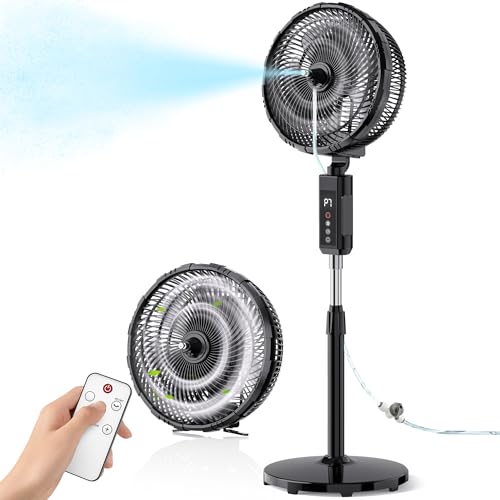
Outdoor Misting Fan for Outside, 12-Inch 20000mAh Portable Water Cooling Fan for Patios Bedroom, 2 In 1 Standing & Tabletop Oscillating Fans with Mister Kit, Mist Fans with Remote/Spray/7 Gear/Timer
Chosen because it specifies 2 In 1 Standing & Tabletop Oscillating Fans with Mister Kit and Mist Fans with Remote/Spray/7 Gear/Timer.
View on Amazon
Etholzon 40000mAh Misting Fans for Outside, 15L Large Tank Portable Misting Fan, Battery Powered Outdoor Mister Fan with Remote & LED Light, Wide 270° Coverage for Camping Patio Backyard
Chosen because it specifies 15L Large Tank Portable Misting Fan and Battery Powered Outdoor Mister Fan with Remote & LED Light.
View on Amazon| Type | Typical fan size | Water setup | Power | Best use | Main trade-off |
|---|---|---|---|---|---|
| Hose-connected patio fan | 18–24 in | Garden hose; continuous supply | 120 V outlet | Regular use near a house | Needs an outlet, hose, and drainage plan |
| Portable tank fan | 10–18 in | Refillable tank, commonly 1–5 gal | Outlet or rechargeable battery, depending on model | Small patios, tailgates, and flexible setups | Tank refills limit uninterrupted misting |
| Battery camping fan with misting | 6–12 in | Small reservoir or separate water bottle | Rechargeable battery, often USB charging | Tent-side use and remote locations | Less airflow and shorter misting runtime |
| High-output shop-style misting fan | 20–30 in | Hose or larger external tank | 120 V outlet | Large, open gathering areas | Bulky, louder, and less convenient to store |
These size and tank ranges describe common product categories, not guaranteed specifications. A 20-inch fan is not automatically more effective than a smaller one: blade design, motor speed, placement, and wind all affect the air that reaches you.
Choose by where and how you’ll use it
For a patio used most days: hose-connected pedestal or wall mount
If your seating area is within reach of a faucet and outdoor-rated electrical outlet, a hose-connected fan is the simplest choice for long sessions. It avoids repeated tank refills and can be positioned to send airflow across the seating area. A pedestal version is easier to move; a wall-mounted unit saves floor space but requires a suitable mounting surface and a safe, weather-protected power connection.
Before buying, check whether the fan needs a minimum water pressure, includes a pressure regulator, and has a shutoff valve. A hose connection does not guarantee that the mist will be fine enough to avoid wet furniture.
For camping or tailgating: battery-powered, compact, and easy to refill
At a campsite, a small battery fan is more useful if it can run as a fan without misting. That gives you airflow when water is scarce, the air is already humid, or you want to keep bedding dry. Look for a stable base or hanging points, a protected charging port, and a reservoir that can be filled without taking the whole unit apart.
Battery runtime depends on fan speed and whether the misting pump is running. Treat a manufacturer’s maximum runtime as a best-case figure; use the manual’s runtime chart, if available, and bring a power bank or spare battery for overnight or multi-day trips.
For a large open area: prioritize airflow and water delivery
For a wide patio, outdoor work area, or gathering space, a larger fan can move more air, but it also needs a stable footprint, a nearby outlet, and room for its spray pattern. Compare airflow figures in cubic feet per minute (CFM) when manufacturers provide them, but note that airflow is not a direct measure of how far mist will travel. Wind can carry droplets away or blow them back onto people and surfaces.
Three checks that prevent the wrong purchase
- Separate fan reach from mist reach. A misting fan may circulate air beyond the area where droplets are noticeable. Ask whether the stated misting distance is measured indoors, in still air, or outdoors; those conditions are not interchangeable.
- Estimate water use from the actual nozzles. If a product lists nozzle flow but not total water use, multiply flow per nozzle by the number of nozzles. For example, six nozzles rated at 0.02 gallons per minute each would use about 0.12 gallons per minute, or 7.2 gallons per hour, while all are running. This is a calculation from the stated rating, not a typical rate for every fan.
- Check what “portable” means. A fan may have a handle yet still be awkward when filled. Look for the empty and filled weight, tank capacity, cord length, and whether the base folds or comes apart for storage.
Setup and upkeep: keep the mist fine and the fan dependable
- Place it upwind of the seating area. Start several feet away and angle the fan across—not directly at—people. Adjust based on wind so droplets do not soak cushions, electronics, or tent fabric.
- Use the water source specified by the manufacturer. Hard water can leave mineral deposits in small nozzles. If the manual permits it, filtered or softened water may reduce buildup; do not add fragrance, oils, or cleaning chemicals to a tank unless the manufacturer explicitly allows them.
- Flush the line after use. Turn off misting and follow the manual’s instructions for draining or running clean water through the system. Empty portable reservoirs rather than storing water in them between uses.
- Clean nozzles gently. Mineral scale and debris are common causes of uneven spray. Use the supplied cleaning tool or the method in the manual; forcing a pin into a nozzle can widen or damage its opening.
- Protect electrical parts. Outdoor-rated does not mean safe to leave exposed indefinitely. Keep plugs and charging ports dry, use a suitable outdoor outlet, and store the unit as directed when not in use.
Nozzles and small pumps are often the first parts to need attention because they handle water and fine openings. A replaceable nozzle set and a clearly available cleaning procedure can matter more over several seasons than extra fan-speed settings. Before purchase, check whether the manufacturer sells replacement parts and whether the fan can operate normally if the misting system is switched off.
Bottom line
Choose a hose-connected fan for frequent patio use when water and power are close by. Choose a battery-powered model for camping only if its fan mode, charging method, and refill capacity fit your trip. For broad outdoor coverage, buy for airflow and stable placement—not a headline misting distance—and plan for wind, water use, and routine nozzle cleaning.


Write Your Review
No reviews yet. Be the first to share your experience!