
Our Top Picks
 Sauder 5 Tier Book Shelf Wooden Bookcase Multipurpose13.23 x 35.28 x 69.76 inches83.38 poundsCheck on Amazon
Best Office Bookcases for Every Workspace
The best office bookcases depend on what your room can hold and how much weight your books and equipment will add: choose a compact, shallow unit for a tight office, a tall bookcase for vertical storage, or a wide, low model when easy reach and stability matter more than maximum shelf count. Before buying, compare usable shelf dimensions, load limits, material, and whether assembly and wall anchoring suit your setup.
Compare common office bookcase sizes
The figures below are practical size ranges for shopping, not specifications for a particular model. Individual products vary, so confirm the manufacturer’s measurements and load limits before ordering.
Sauder 5 Tier Book Shelf Wooden Bookcase Multipurpose Bookshelf for Home Office, Living Room, in Grand Walnut
Chosen because it specifies Living Room and in Grand Walnut.
View on Amazon
Shintenchi 6 Tier Bookshelf with Doors, Tall Standing Bookcase
Chosen because it specifies Tall Standing Bookcase.
View on Amazon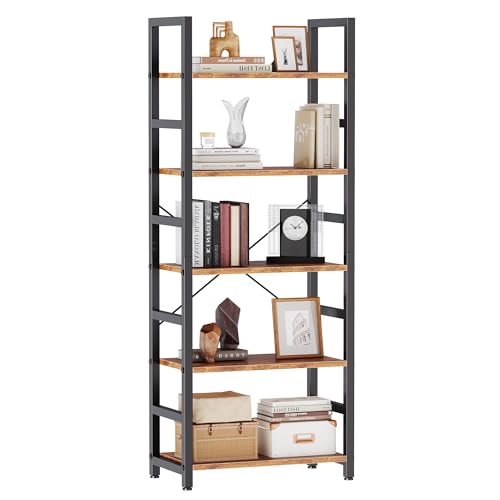
DUMOS 5-Tier Bookshelf, Modern Tall Bookcase Book Shelf Storage Organizer
Chosen because it specifies Modern Tall Bookcase Book Shelf Storage Organizer.
View on Amazon
Sauder Miscellaneous Storage 5-Shelf Bookcase/ Book shelf, Select Cherry finish
Chosen because it specifies Select Cherry finish.
View on Amazon| Bookcase type | Typical height × width × depth | Typical shelf spacing | Typical capacity per shelf | Best fit |
|---|---|---|---|---|
| Compact, 2–3 shelf | 30–48 × 24–36 × 10–14 in | 10–14 in | 15–35 lb | Small offices, printer supplies, and reference books |
| Standard, 4–5 shelf | 60–72 × 24–36 × 11–16 in | 10–14 in | 20–50 lb | Everyday office storage with a moderate book collection |
| Tall, 5–6 shelf | 72–84 × 24–36 × 11–16 in | 10–14 in | 20–50 lb | Making use of vertical space in a narrow room |
| Wide, low, 2–4 shelf | 30–48 × 36–60 × 12–18 in | 10–16 in | 25–60 lb | Large binders, shared storage, and frequently used materials |
Capacity ranges are illustrative, not interchangeable guarantees. A shelf’s safe load depends on its material, span, support, and installation. Look for a stated per-shelf limit and total-unit limit; don’t assume that a sturdy-looking shelf can carry a heavy printer or a full row of books.
Choose by workspace and storage load
| Your situation | A sensible choice | What to check |
|---|---|---|
| Small room or narrow walkway | Compact bookcase, about 10–12 in deep | Door and drawer clearance; measure the route into the room, too |
| High ceiling, limited floor area | Tall, narrow unit, roughly 72–84 in high | Ceiling clearance, reachable upper shelves, and wall-anchoring hardware |
| Heavy manuals, binders, or archival boxes | Sturdy wood or metal construction with a published load limit | Capacity per shelf, shelf support, and whether weight is evenly distributed |
| Shared office or frequently accessed supplies | Wide, low bookcase with open access | Floor space, aisle width, and whether the top can safely hold equipment |
| Minimal budget or temporary setup | Basic engineered-wood or metal shelving | Included back panel, fasteners, assembly requirements, and replacement-part support |
For a small office: favor shallow shelves
A compact bookcase can store paperbacks, notebooks, and small organizers without consuming much floor area. Depth is especially important: a unit that projects into a walkway can make a room feel cramped, even if its width looks modest on a product page. Measure the available footprint and leave room to open nearby doors and drawers.
Check shelf clearance against what you own. A shelf with 10 inches of vertical space may fit books but not a tall binder or storage box. Adjustable shelves are useful when your storage mix changes, though they may have fewer positions or lower limits than fixed shelves.
For a narrow room: go tall, but plan for stability
A tall bookcase adds storage without taking up much more floor space. Its trade-off is access: items on upper shelves may be inconvenient, and a tall, loaded unit needs careful placement. Anchor it to a suitable wall using the hardware and instructions supplied or recommended by the manufacturer. Confirm that the anchor is compatible with your wall type; don’t rely on a bookcase’s weight alone to prevent tipping.
Place heavier items on lower shelves and lighter items higher up. This helps keep the load distributed sensibly and puts frequently used materials within easy reach.
For heavy storage: compare construction, not just appearance
Solid wood, engineered wood, and metal can all work well, but each has different ownership considerations:
- Solid wood: Often repairable and visually warm, but heavier and potentially more expensive. Finish can scratch, and the unit still needs a stated load rating.
- Engineered wood: Commonly more affordable and available in many finishes. Protect it from prolonged moisture, which can damage edges or surfaces; check whether the back panel contributes to stability.
- Metal: Often a practical choice for utility storage and adjustable shelving. Inspect the shelf’s rated capacity and support design; thin shelves can flex under concentrated loads.
Paper is deceptively heavy. If you’re storing dense binders or large reference books, distribute them across shelves rather than placing the heaviest collection in the middle of one long span. For a printer, check the equipment’s weight and footprint against the shelf’s rating and usable dimensions.
Estimate whether a shelf will fit your collection
Use a quick measurement rather than relying on the total number of shelves. Measure the width of the items you want to store, then allow a little extra room for removing them without scraping adjacent objects. For example, if a row of binders occupies 29 inches and the bookcase’s usable shelf width is 30 inches, that shelf may be too tight for comfortable access. A wider shelf—or splitting the binders across two shelves—will be more practical.
For a rough load estimate, weigh a representative group of books or use the weight printed on a box of paper. Add the weights you expect to place on each shelf and compare the result with the manufacturer’s per-shelf limit. Leave a margin rather than loading right to the maximum, especially if the shelf is wide, adjustable, or made from a thinner panel.
Assembly and long-term care
Assembly needs range from connecting a few metal components to building a multi-shelf flat-pack unit. Before purchasing, check whether assembly requires two people, what tools are needed, and whether the package includes wall anchors. Assemble the unit on a level surface and follow the sequence in the instructions; tightening everything unevenly can leave the frame out of square and make shelves fit poorly.
After assembly, check that the bookcase is level and all fasteners are secure. Recheck them after moving the unit or adding a heavy load. Clean with a soft cloth and a cleaner suitable for the finish, avoiding excess moisture on wood-based panels. Common problems include overloading one shelf, dragging a full unit across the floor, and placing a tall bookcase where its anchor cannot attach securely.
What to confirm before buying
- Measure height, width, depth, ceiling clearance, and delivery access.
- Compare usable shelf dimensions with your books, binders, boxes, or equipment.
- Look for both per-shelf and total weight limits.
- Choose adjustable shelves if your storage needs vary; fixed shelves may suit a consistent load.
- Check assembly steps, included hardware, wall-anchor guidance, and care instructions.
In short, the best office bookcases aren’t necessarily the tallest or widest: they’re the ones whose shelf dimensions and rated capacity match your actual storage, while leaving enough room to move and use the office comfortably.






Write Your Review
No reviews yet. Be the first to share your experience!