
Our Top Picks
 Electro-Harmonix Op Amp Big Muff Pi Fuzz PedalEinheitsgröße4.5 x 2.75 x 2.1 inches0.7 PoundsCheck on Amazon
 Behringer Super Fuzz Sf300 3-Mode Fuzz Distortion Effects2.76 x 2.13 x 4.84 inches0.9 PoundsCheck on Amazon
The best fuzz pedals depend on whether you want vintage cleanup, thick high-gain sustain, or one pedal that can cover several fuzz voices: choose a germanium-style Fuzz Face for touch-sensitive classic tones, a Big Muff-style circuit for saturated sustain, and a versatile multi-voice fuzz such as the Keeley Fuzz Bender or EarthQuaker Devices Hoof when flexibility matters most.
Best fuzz pedals by playing situation
| Best for | Recommended pedal | Fuzz character | Key controls | Approx. footprint | Typical market range |
|---|---|---|---|---|---|
| Vintage cleanup and blues-rock | Dunlop Fuzz Face Mini Germanium | Responsive, woolly, amp-like | Fuzz, Volume | Approx. 111 × 63 mm | $130–$180 |
| Classic heavy sustain | Electro-Harmonix Big Muff Pi | Compressed, thick, singing | Volume, Tone, Sustain | Approx. 146 × 121 mm | $90–$120 |
| Small board and low cost | JHS 3 Series Fuzz | Modernized vintage fuzz | Volume, Bias, Fuzz | Approx. 111 × 60 mm | $100–$120 |
| Many fuzz textures | Keeley Fuzz Bender | From gated to thick and smooth | Fuzz, Level, Tone, Bias, EQ | Approx. 121 × 98 mm | $190–$220 |
| Experimental and unstable sounds | ZVEX Fuzz Factory | Gated, oscillating, unpredictable | Volume, Gate, Comp, Drive, Stability | Approx. 119 × 94 mm | $230–$300 |
| Germanium-style tone with modern control | EarthQuaker Devices Hoof | Sustaining, articulate, mid-adjustable | Fuzz, Tone, Level, Shift | Approx. 121 × 64 mm | $180–$220 |
Dimensions are approximate pedal-body figures and exclude cable clearance. Check the current manufacturer specification before planning a tightly packed board.
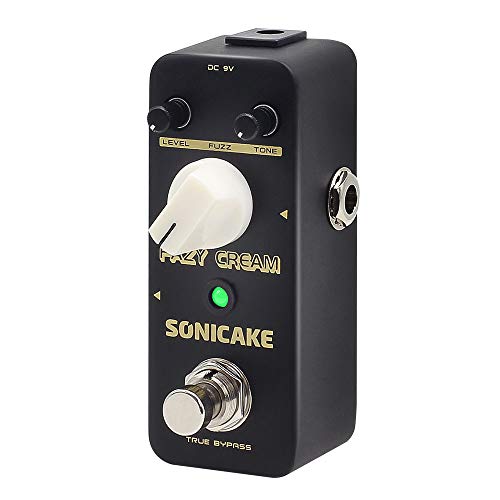
SONICAKE Fuzz Guitar Effect Pedal, Mini Vintage Fuzz Pedal - Fazy Cream
Chosen because it specifies Mini Vintage Fuzz Pedal and Fazy Cream.
View on Amazon
Donner Fuzz Guitar Pedal - Classic Stylish Fuzz Mini Effect Pedal for Electric Guitar/Bass, True Bypass
Chosen because it specifies True Bypass.
View on AmazonElectro-Harmonix Op Amp Big Muff Pi Fuzz Pedal
Picked as a relevant option in this category.
View on AmazonBehringer Super Fuzz Sf300 3-Mode Fuzz Distortion Effects Pedal
Picked as a relevant option in this category.
View on AmazonHow to choose the right fuzz circuit
Vintage-style fuzz: best for cleaning up with the guitar volume
Fuzz Face-style pedals are the clearest choice if you want a sound that changes substantially when you roll the guitar volume down. With the guitar volume fully open, they can be woolly and aggressive; at roughly 5–7 on the guitar, many become brighter and more overdrive-like. That interaction is a feature, not a fault.
These circuits are often sensitive to pickup level, cable capacitance, and pedal order. A traditional germanium-style fuzz usually behaves best early in the chain, directly after the guitar or before buffered pedals. A bridge humbucker can push the circuit into a denser, darker sound, while lower-output single coils often produce more cleanup and note separation.
The trade-off is limited control. A two-knob fuzz and volume layout is fast to use, but it cannot compensate easily for a bright amplifier, a dark guitar, or a band mix that needs more midrange.
Big Muff-style fuzz: best for sustain, wall-of-sound chords, and lead lines
Big Muff-type circuits produce more compression and sustain than most Fuzz Face designs. They are particularly effective for octave-like lead sustain, large chord textures, and heavily driven amplifier settings. The tone control usually moves between bass-heavy and treble-forward voicings, while the sustain control determines how compressed and saturated the signal becomes.
This circuit is less dependent on picking dynamics, which makes it easier to use for consistent high-gain sounds. It can also sound scooped in the middle position of its tone control. If your amplifier and guitar already have restrained mids, consider a version with a mids control or place an EQ or mid-focused overdrive after it.
The standard Big Muff enclosure is wide and deep compared with a compact mini pedal. That extra board space is the practical cost of its familiar, powerful sound.
Versatile fuzz: best when one pedal must cover several jobs
A versatile fuzz is the safer purchase when you play different guitars, share amplifiers, or need both vintage and modern sounds. The Keeley Fuzz Bender adds bias and equalization controls to a fuzz circuit that can move from sputtery, gated textures to thick sustain. The EarthQuaker Devices Hoof offers a useful balance between fuzz intensity and midrange shaping, making it easier to keep the sound audible with a full band.
More controls mean more opportunities to create an unusable setting. Start with the tone or EQ controls near noon, set the level slightly above unity, and change one control at a time. A versatile fuzz earns its larger price and footprint only if you will use those controls regularly.
Head-to-head: vintage fuzz versus high-gain fuzz
Choose vintage-style fuzz if your priority is touch response, guitar-volume cleanup, and early rock, blues, garage, or psychedelic tones. It rewards players who control gain from the instrument and do not mind placing the pedal carefully in the signal chain.
Choose high-gain fuzz if you want immediate sustain, compressed chords, and a sound that remains relatively consistent across different picking strengths. Big Muff-style pedals are usually easier for a first fuzz purchase because their controls are predictable and their output is less dependent on pedal order.
Choose a versatile circuit if you use both single-coil and humbucker guitars, switch between clean and dirty amplifiers, or want one fuzz to cover rhythm, lead, and experimental settings. The additional controls are most valuable when your rig changes often.
Guitar compatibility and signal-chain behavior
- Single-coil pickups: commonly provide more edge, articulation, and cleanup. If the result is too thin, try a fuzz with a tone, mids, or EQ control.
- Humbuckers: deliver more level and low-mid energy. A darker fuzz may become congested, so a tone control or post-fuzz EQ is useful.
- Active pickups: can overload some vintage-style circuits quickly. A modern fuzz with a wider input range may be easier to control.
- Buffered bypass: can improve signal consistency over a long pedalboard, but some traditional fuzzes react differently when a buffer is placed before them.
- True bypass: generally removes the pedal circuit from the signal when off, but many true-bypass pedals in a long chain can increase cable-related high-frequency loss.
If a vintage-style fuzz sounds harsh or refuses to clean up, first move it directly after the guitar. If it works there but not in the original position, the issue is probably interaction with a buffer, tuner, wireless receiver, or another always-on pedal rather than a defective fuzz.
Decision matrix for buying
| Your situation | Best direction | Why | What to avoid |
|---|---|---|---|
| Under about $120 and new to fuzz | JHS 3 Series Fuzz or a standard Big Muff variant | Simple controls and familiar operating behavior | Highly oscillating or noisemaker-style designs |
| Small board with limited power and space | Compact mini Fuzz Face or JHS 3 Series Fuzz | About 60–63 mm wide and usually easy to power | Large-format enclosures unless the sound is essential |
| Several guitars and one amplifier | Hoof or Fuzz Bender | Tone-shaping controls compensate for pickup differences | Two-knob fuzzes if you cannot adjust the amp |
| Vintage cleanup is the main goal | Germanium-style Fuzz Face | Strong response to guitar-volume changes | Maximum-compression Big Muff-style circuits |
| Recording or live use where noise matters | Stable, modern fuzz with a level and tone control | Easier to keep noise and frequency buildup manageable | Unstable designs with high noise-floor settings |
Noise, bypass, and pedalboard space
Fuzz naturally generates more hiss than a clean boost because its gain stages amplify noise along with the guitar signal. High sustain, bias, and compression settings usually increase the noise floor. A noise gate placed after the fuzz can help between phrases, but an aggressive gate may cut off sustained notes or make a gated fuzz sound abrupt.
Measure more than the pedal body. A compact pedal may be approximately 60 mm wide, but right-angle plugs, side-mounted jacks, and footswitch clearance can require 85–110 mm of practical width. For a board calculation, reserve about 100 mm of usable length for a compact pedal and 140–170 mm for a large Big Muff-style enclosure, including cable space.
Power requirements also affect planning. Many analog fuzz pedals use a standard 9-volt center-negative supply and draw roughly 5–30 mA, but certain germanium designs are polarity-sensitive or work best from a battery. Never assume that a power adapter is compatible solely because its plug fits. Confirm voltage, polarity, and current requirements first.
Ownership realities and maintenance
The parts most likely to cause inconvenience are footswitches, input and output jacks, pots, battery clips, and patch cables—not the fuzz transistors themselves. Germanium components can also vary with temperature, so a pedal may sound slightly different in a cold rehearsal room than in a warm studio.
- Remove the battery when the pedal will be stored for an extended period.
- Keep liquid, dust, and loose metal objects away from open jacks and the enclosure.
- Clean noisy plugs with an appropriate contact cleaner rather than spraying household lubricant into the pedal.
- Do not repeatedly turn bias or internal trim controls without recording their original positions.
- Use a short, reliable patch cable before blaming the pedal for intermittent noise.
For a first purchase, the safest all-purpose choice is a Big Muff-style pedal if you want thick sustain, or a compact Fuzz Face-style pedal if you specifically want guitar-volume cleanup. Spend more on a multi-control fuzz only when pickup compatibility, midrange shaping, or multiple distinct sounds will save you from buying a second pedal later.










Write Your Review
No reviews yet. Be the first to share your experience!