
Our Top Picks
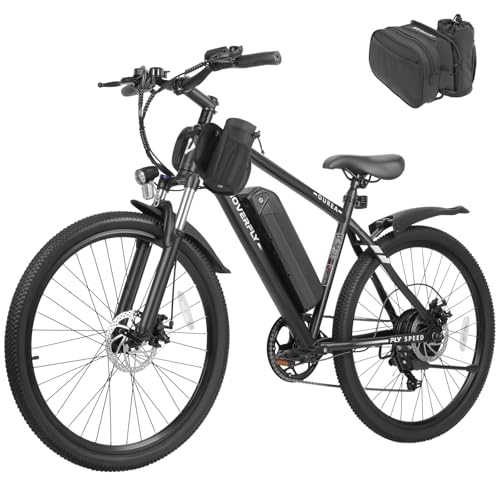 Hoverfly OUREA 26" Electric Bike for Adults26 inch66.93 x 27.56 x 42.52 Inches53.4 poundsCheck on Amazon
The best electric mountain bikes for trail riding are the Specialized Turbo Levo for balanced all-round performance, the Trek Rail or Orbea Wild for steep and technical terrain, the Santa Cruz Heckler for a refined mixed-trail ride, and a short-travel trail e-bike such as the Trek Fuel EXe when natural handling and low weight matter more than maximum range.
Quick picks by riding situation
- Best all-rounder: Specialized Turbo Levo. Its adjustable geometry, full-power motor options, and commonly available 700–750 Wh batteries suit everything from rolling singletrack to long climbs.
- Best for steep, rocky trails: Orbea Wild or Trek Rail. Their roughly 160 mm rear and 160–170 mm front suspension, high-torque motors, and large batteries favor sustained climbing and rough descents.
- Best handling on technical singletrack: Santa Cruz Heckler. It combines a low center of gravity, a mixed-wheel option on some builds, and suspension that remains composed without feeling like a downhill bike.
- Best lightweight trail feel: Trek Fuel EXe. Its lower-output motor and smaller battery make it quieter and easier to maneuver, but it gives up climbing force and range compared with full-power e-bikes.
- Best value approach: Look for an aluminum full-suspension e-MTB with a 600–750 Wh battery, a Bosch Performance Line CX or Shimano EP801 motor, four-piston brakes, and an air fork. Spending less on cosmetic upgrades while retaining those fundamentals usually produces the strongest trail package.
Head-to-head: what the major specifications mean on trail
The figures below describe common 2025–2026 configurations and are useful for comparison, not a guarantee for every frame size or build. Components, battery sizes, and regional specifications can change.

Electric Bike for Adults, Mountain E-bike for Off-Road & Trail Riding.
Chosen because it specifies Mountain E-bike for Off-Road & Trail Riding..
View on Amazon
Canyon Torque:ON 7, Burned Sand, Medium
Chosen because it specifies Burned Sand and Medium.
View on AmazonHoverfly OUREA 26" Electric Bike for Adults, Max 40 Miles Range&20Mph Speed
Chosen because it specifies Max 40 Miles Range&20Mph Speed.
View on Amazon
Askmy Electric Bike for Adults,750W Peak Moto Mountain Ebike
Chosen because it specifies 750W Peak Moto Mountain Ebike.
View on Amazon| Bike family | Motor output and torque | Typical battery | Suspension travel | Typical weight | Best terrain |
|---|---|---|---|---|---|
| Specialized Turbo Levo | Full-power system, up to about 90 Nm | 600–750 Wh | 150 mm rear / 160 mm front | About 23–25 kg | Mixed singletrack, long climbs, technical descents |
| Trek Rail | Typically Bosch Performance Line CX, up to 85 Nm | 625–800 Wh | 160 mm rear / 160 mm front | About 24–26 kg | Rock gardens, steep alpine trails, bike-park-adjacent riding |
| Orbea Wild | Typically Bosch Performance Line CX, up to 85 Nm | 625–750 Wh | 160 mm rear / 170 mm front | About 23–25 kg | Steep climbs and aggressive enduro-style trails |
| Santa Cruz Heckler | Often Shimano EP801, up to 85 Nm | 600–720 Wh | 150 mm rear / 160 mm front | About 22–25 kg | Technical trail riding and varied descending |
| Trek Fuel EXe | Light-assist motor, about 50 Nm | 360 Wh, with optional range extender on compatible builds | 140 mm rear / 150 mm front | About 18–21 kg | Flow trails, tight singletrack, shorter rides |
Motor torque and climbing ability
Torque is the most noticeable specification when a trail points upward. A full-power motor producing approximately 80–90 Nm can maintain momentum on loose, steep climbs where a 50 Nm lightweight system may require more rider effort and careful line choice. It is particularly useful for riders carrying gear, tackling repeated climbs, or riding at higher altitude.
Torque does not automatically make a bike climb well. Low-speed motor control, traction, wheelbase, seat-tube angle, tire compound, and weight distribution matter just as much. A powerful motor can spin the rear tire if the rider applies assistance abruptly. Eco or Trail modes, steady pedaling, and a tire with a soft rear compound often improve traction more than selecting the highest support mode.
For rolling woodland trails, a lightweight motor is often more enjoyable. It reduces mass, produces less drivetrain load, and makes tight switchbacks easier. For a two-hour ride with 1,000 meters of climbing, however, a full-power system with a 625 Wh or larger battery gives a much larger energy margin.
Battery range: use elevation, not marketing miles
Range varies with rider weight, temperature, tire pressure, elevation, assistance mode, and stop-and-go riding. A practical planning estimate for a full-power e-MTB is roughly 8–15 vertical meters of climbing per usable watt-hour in mixed conditions. A 750 Wh battery therefore provides approximately 6,000–11,000 vertical meters of theoretical climbing energy before accounting for reserve, descents, and inefficiency. Real rides will not match one simple number.
As a worked example, assume a 90 kg combined rider-and-gear system, a 750 Wh battery, and a ride containing 1,200 meters of ascent. At a conservative 10 vertical meters per Wh, the climb uses about 120 Wh. The remaining energy is ample for rolling terrain, but repeated Boost-mode acceleration, cold weather, soft tires, and muddy surfaces can reduce that margin substantially. Avoid planning to finish at zero; keeping 15–20 percent reserve is sensible when the route has no charging option.
Choose 600–750 Wh for long rides, remote routes, or high assistance. Choose 360–500 Wh when rides are shorter, storage and carrying weight matter, or you can charge between outings. A removable battery is valuable in an apartment or office, while an integrated battery is cleaner but may require more effort to remove.
Suspension travel, tires, and frame geometry
For general trail riding, 140–160 mm of rear travel and 150–160 mm up front is the useful middle ground. It absorbs roots and rock edges without making every easy trail feel slow. Bikes with 160–170 mm forks and more progressive rear suspension are better for repeated high-speed impacts, but they usually weigh more and can feel excessive on smooth local paths.
Tire width around 2.4–2.5 inches is the versatile choice. It provides grip and rim protection without as much rolling resistance as a 2.6-inch tire. A 2.6-inch rear tire helps on wet roots, sand, and loose rock, but the frame and rim must have sufficient clearance. For rocky terrain, prioritize tough downhill or enduro casings over an extra-large battery: repairing a sidewall far from the trailhead is a greater inconvenience than arriving home with unused capacity.
Modern trail e-MTBs generally use slack head angles around 64–65 degrees, long reach dimensions, and steep effective seat-tube angles around 76–78 degrees. Slack steering improves stability downhill; a steep seat angle keeps the rider positioned over the cranks during climbs. Very long reach can feel stable at speed but awkward on tight switchbacks, so compare the reach and stack measurements rather than choosing by wheel size alone.
Component quality and durability by terrain
- Flow trails and hardpack: Two-piston brakes, trail tires, and 12-speed drivetrains can be adequate, although four-piston brakes offer better control for heavier e-bikes.
- Wet roots and mud: Choose aggressive tread, a softer rear compound, sealed bearings, and a dropper post with enough travel to lower the saddle completely.
- Rocky and alpine trails: Look for four-piston hydraulic brakes with 200–220 mm rotors, an e-bike-rated rear wheel, thick tire casings, and a suspension fork with 35–38 mm stanchions.
- Bike-park-style riding: Strong wheels, metal-backed brake pads, a robust chain, and a serviceable air shock matter more than electronic shifting or carbon finishing details.
Aluminum frames usually offer the better value and tolerate the inevitable scratches of trail use. Carbon can reduce frame weight and improve stiffness, but it is not automatically more durable, and replacement costs are generally higher. On any material, inspect the downtube, chainstay, motor housing, and battery cover after rock strikes.
Ownership costs and maintenance that buyers overlook
The motor and battery are only part of the ownership cost. E-MTBs put greater force through chains, cassettes, brake pads, tires, and rear wheels than comparable non-electric bikes. A high-mileage rider may replace a chain several times per season, especially when riding in grit or using high assistance. Chain wear is inexpensive to measure and can prevent premature cassette wear.
After muddy rides, rinse the bike with low-pressure water, wipe the drivetrain, and dry the suspension stanchions. Do not aim a pressure washer at bearings, motor seals, battery contacts, or pivots. Check spoke tension and axle tightness periodically, maintain the recommended suspension pressures, and have pivots and bearings inspected annually if the bike sees wet or high-mileage use.
One common mistake is fitting soft, thin tires to save weight. On a 24–26 kg bike, that can lead to rim dents and punctures. Another is storing the battery completely full or empty for months. For extended storage, follow the manufacturer’s guidance and use a cool, dry location; many batteries are best stored partly charged rather than at either extreme.
How to choose your size and final specification
Start with the manufacturer’s height and inseam chart, then compare reach. If you are between sizes, choose the smaller frame for tight, slow, technical trails and the larger frame for stability, high-speed riding, or a longer torso. A dropper post, four-piston brakes, tough tires, and a 625 Wh or larger battery are usually more valuable trail upgrades than premium carbon parts.
Finally, confirm the bike’s legal assistance class for your area, charger requirements, maximum system weight, and whether replacement batteries and service are available locally. The right electric mountain bike is not the one with the largest motor or battery; it is the one whose geometry, suspension, tires, and support network match the terrain you ride most often.








Write Your Review
No reviews yet. Be the first to share your experience!