
Our Top Picks
 SEESII 40V Electric Chainsaw Cordless 18-Inch with 240V 18 INCH16.9 x 13.2 x 4.3 inches8.6 PoundsCheck on Amazon
 SEESII 12-Inch Electric Chainsaw Cordless16.54"L x 14.96"W x 10.24"H16.54 x 14.96 x 10.24 inches9.9 poundsCheck on Amazon
The best battery chainsaws for homeowners are usually a 14- to 16-inch model on a 40V to 60V platform: choose a compact 40V saw for pruning and occasional firewood, or a higher-voltage 16-inch saw for storm cleanup and larger logs.
Quick picks by yard job
| Homeowner situation | Best fit | Useful specification | Why it makes sense |
|---|---|---|---|
| Pruning limbs and cutting small firewood | Compact battery saw | 18V–24V, 10–12-inch bar, 2.0–5.0Ah battery | Light, easy to control, and inexpensive if you already own compatible batteries |
| Routine homeowner cutting | Midrange battery saw | 40V–48V, 14–16-inch bar, 4.0–5.0Ah battery | The best balance of power, runtime, weight, and price for most properties |
| Storm debris and hardwood logs | High-output battery saw | 56V–60V, 16-inch bar, 5.0–6.0Ah battery | More sustained chain speed and torque, with enough capacity for repeated cuts |
| Frequent cutting or large rural property | Professional-grade battery saw | 36V–50V system, 14–16-inch bar, 5.0–10.0Ah battery | Better controls, cooling, chain adjustment, and durability for demanding use |
Best battery chainsaws for homeowners: the leading choices
Best overall: EGO Power+ 56V 16-inch chainsaw
EGO’s 56V platform is a strong all-around choice when cutting performance matters more than minimum weight. Its 16-inch bar gives useful reach for fallen branches and medium-sized logs, while the brushless motor and high-capacity battery options provide substantially more reserve than small 18V or 24V saws.
SEESII 40V Electric Chainsaw Cordless 18-Inch with 2 x 5.0Ah Batteries
Picked as a relevant option in this category.
View on AmazonSEESII 12-Inch Electric Chainsaw Cordless, Brushless Motor
Chosen because it specifies Brushless Motor.
View on Amazon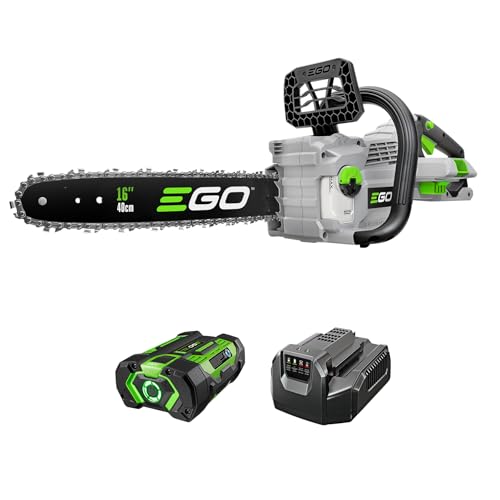
EGO POWER+ Chain Saw, 16” Battery Powered Chainsaw, Electric Cordless, Includes 56V 2.5Ah Battery and Charger – CS1611
Chosen because it specifies 16” Battery Powered Chainsaw and Electric Cordless.
View on Amazon
SEESII 40V Eectric Chainsaw Cordless 16 Inch, Battery Powered Chain Saw
Chosen because it specifies Battery Powered Chain Saw.
View on AmazonExpect a complete tool with battery and charger to occupy the upper end of the homeowner price range, commonly around $350 to $600 depending on battery capacity and bundle. A 5.0Ah battery is a practical starting point; larger batteries extend runtime but add noticeable weight. This is the pick for homeowners who may cut storm debris several times each year rather than only prune a few branches.
Best for a shared tool battery: Milwaukee M18 FUEL 16-inch chainsaw
The Milwaukee M18 FUEL 16-inch chainsaw is appealing when you already own several M18 batteries. It is more convenient for moderate yard work than buying into a new battery ecosystem, although a single compact M18 battery is not an ideal match for extended cutting. A high-capacity battery, such as a 12.0Ah pack, is better suited to the saw’s demands.
This type of 18V saw can handle limbs and ordinary firewood effectively, but voltage alone does not tell the whole story: motor design, chain speed, battery output, and electronic power management matter just as much. It is a sensible choice for a Milwaukee-equipped homeowner who values platform compatibility and expects intermittent use.
Best for lower-cost routine work: Greenworks 40V 14-inch chainsaw
A Greenworks 40V 14-inch chainsaw is a practical middleweight for pruning, trimming fallen limbs, and cutting smaller logs. The 14-inch bar is easier to control than a 16-inch bar and generally reduces weight and battery demand. Greenworks also offers a broad 40V outdoor-tool platform, which can make the initial battery purchase easier to justify.
Choose this class of saw for logs roughly 6 to 10 inches in diameter and occasional larger cuts, rather than repeated work at the upper end of the bar’s capacity. Typical complete-kit pricing is often about $180 to $350. Look for a brushless version if you expect frequent use; brushed models can be adequate for light seasonal work but are less attractive for long ownership.
Best for professional-style controls: STIHL MSA 220 C-B
The STIHL MSA 220 C-B is a higher-end battery saw aimed at users who want strong cutting performance, refined balance, and durable controls. Its 16-inch bar and 36V battery system make it suitable for demanding homeowner cleanup, although the battery and charger can push the complete purchase well beyond the cost of a basic 40V saw.
STIHL’s battery ecosystem is especially worth considering if you already use its outdoor equipment or have access to local servicing. This is less about getting the lowest cost per cut and more about buying a well-supported tool for repeated seasonal use.
Bar length, power, and cutting performance
A longer bar is not automatically better. A 10- or 12-inch bar is nimble for overhead-free pruning and branches under about 8 inches. A 14-inch bar is a versatile homeowner size, while a 16-inch bar provides more reach and lets you work through thicker material without cutting from both sides.
- 10–12 inches: best for pruning and small branches; usually lightest.
- 14 inches: best general-purpose size for suburban yards.
- 16 inches: better for storm cleanup, firewood, and medium logs.
- More than 16 inches: generally unnecessary for ordinary homeowner work and increases weight and battery demand.
Battery runtime is better described in cuts than in minutes because wood diameter, species, chain sharpness, and operator technique change the result. As a practical planning estimate, a healthy 4.0Ah mid-voltage battery may provide roughly 40 to 100 moderate branch cuts, while a 5.0Ah high-voltage pack may provide approximately 60 to 140. These are planning ranges, not guarantees.
For example, suppose one battery gives you 80 moderate cuts and your cleanup requires 120. You need either a second charged battery or a charging break before the final 40 cuts. Buying a second battery is often more useful than upgrading from a 14-inch to a 16-inch bar.
Charging time and battery ownership
Charging time depends on both capacity and charger output. A 2.0Ah pack may charge in about 30 to 60 minutes on a fast charger, a 5.0Ah pack commonly takes 60 to 120 minutes, and a 10.0Ah pack may require roughly 90 minutes to several hours. Check the manufacturer’s charger specification rather than assuming every charger is “rapid.”
Battery capacity is measured in amp-hours, but watt-hours are more useful for comparing systems:
Watt-hours = nominal volts × amp-hours.
A 40V 5.0Ah battery stores about 200Wh, while a 56V 5.0Ah battery stores about 280Wh. The higher-voltage pack can therefore offer more energy at the same amp-hour rating, although the saw’s motor and efficiency determine how much work reaches the chain.
Safety features that matter
- Chain brake: should stop the chain quickly when activated by the front hand guard or kickback event.
- Trigger lockout: helps prevent accidental startup while carrying or handling the saw.
- Tool-free chain adjustment: convenient, provided the tension mechanism holds securely.
- Low-kickback chain and guide bar: reduce risk but do not eliminate kickback.
- Battery interlock: prevents operation unless the battery is seated correctly.
- Clear oil reservoir: makes it easier to verify lubrication before cutting.
Wear eye and hearing protection, chainsaw chaps or protective legwear, gloves, and sturdy boots. Keep both hands on the saw, avoid cutting above shoulder height, and never cut a branch that is under tension unless you understand how it may move when released. Battery power makes starting easier; it does not make chainsaw work harmless.
Maintenance that determines service life
The chain is normally the first consumable to affect performance. A dull chain produces fine dust, requires force, wanders in the cut, and drains the battery quickly. Sharpen it when the saw begins producing dust instead of consistent chips, or have it professionally sharpened if you do not have the correct file and depth-gauge tools.
- Remove the battery before cleaning, adjusting, or transporting the saw.
- Brush chips from the sprocket cover, bar groove, and cooling vents after each session.
- Check chain tension while the chain is cool; it should sit in the bar groove but still pull around the bar by hand with gloves.
- Fill the reservoir with appropriate bar-and-chain oil before cutting.
- Inspect the guide bar for a damaged rail or burrs and rotate it periodically if the manual permits.
- Store the battery indoors, dry, and partly charged according to the battery maker’s storage guidance.
Common mistakes include running with too little chain oil, using the wrong replacement chain pitch or gauge, overtightening the chain, and leaving a battery in a hot shed or direct sun. If a saw cuts crooked after sharpening, the cutters may be uneven or the bar may be worn.
Final buying advice
For most homeowners, a brushless 40V to 60V saw with a 14- or 16-inch bar is the best balance. Choose the 14-inch option when low weight and easy handling matter most; choose 16 inches when you regularly deal with storm debris or firewood. Before comparing motor claims, price the complete system with battery, charger, a replacement chain, and protective equipment. The best battery chainsaw is the one whose battery platform you will keep charged, whose bar size matches your actual logs, and whose safety and maintenance features you will use every time.










Write Your Review
No reviews yet. Be the first to share your experience!