
Choosing fractional dumbbell plates for small spaces starts with the weights you already own and the room you need to move them. A plate can fit in a shallow drawer and still crowd your hand, hit your bench, or keep a dumbbell from docking. Measure the setup in use and in storage before you pick a plate.
Measure the smallest space the dumbbell has to fit
Look at the route from storage to your first rep. A dumbbell may have to clear a shelf lip, pass a bench leg, and turn beside your body during a set. The limiting space can be different at each point, so measure the bare dumbbell and the place where the add-on would sit separately.
Check drawer, shelf, and rack clearance
Take the inside measurements of your storage space with the shelf rails, drawer lip, or rack dividers in place. Measure the dumbbell from end to end, then record the gap around the handle or heads. A rack that already fits snugly can require you to remove plates every time you put your weights away.
Suppose your fixed dumbbell is 13 inches from end to end. A matched magnetic plate that projects 1 inch from each end makes the assembly about 15 inches long if both plates sit on the outer faces. A 14-inch cubby will still fit the original dumbbell. With the adders in use, you will need another spot for the weights or a tray where the adders can go after the workout. That small handling step becomes part of every session.
Storage shape matters as much as the number of cubic inches. A round plate can sit upright in a divided tray or flat in a shallow drawer. Upright storage saves surface area at the cost of height. A four-piece set is especially easy to keep organized in two matching compartments, each holding the plates for one handle. Keep heavy items within easy reach and use a shelf or drawer rated for the combined load.
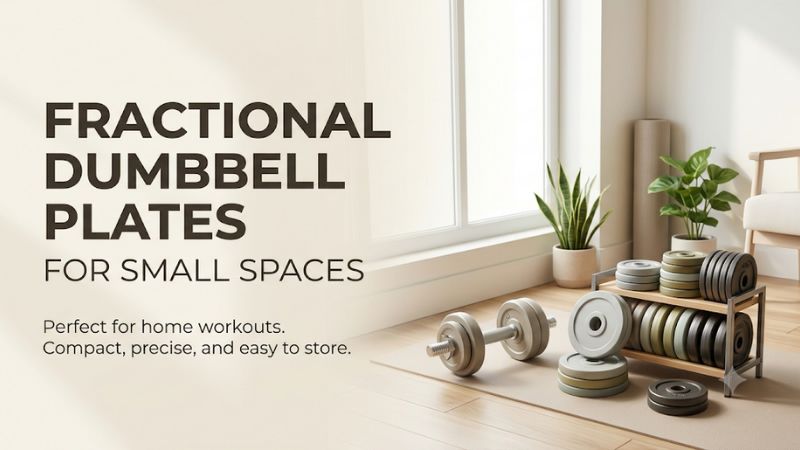
Think about return-to-storage clearance too. A dumbbell may fit on a shelf once it is in place, but you still have to lift it above the lip and angle it past the opening. Measure the entry dimensions at the front, where a head or an attached plate is most likely to catch. Keeping the gear close to the lifting area often saves more time than putting it deeper into the smallest available cabinet.
Leave room for your usual grip
Measure the width you use across the handle while holding the dumbbell in the position you normally train with. On some fixed dumbbells, a contoured grip lets a clip close in one spot only. The plate still has to leave room for a secure grip and for your hand to turn through the exercise.
A quick check is to mark the edges of your hand position with removable tape on the unloaded handle. Look at the usable shaft left between each mark and the head. That is the space to compare with the manufacturer’s attachment diagram. A product listing might show only the width of the disk, which helps you evaluate outward projection. You also need the thickness and usable attachment span along the grip.
Run the check for your widest grip posture. During a hammer curl, the dumbbells can pass close to your thighs. A neutral-grip press rotates the hand relative to the bench and the body. A thin plate can still be wider than the surface around it, so evaluate the shape along the entire path. Use an unloaded setup or a dimensional mock-up for the clearance check before installing metal adders and attempting a loaded set.
If loose grip space varies across your fixed dumbbell set, check the specific pairs you want to microload. The 35-pound dumbbell can have a grip and head shape that differs from the 15-pound dumbbell, even when the same brand name is marked on both. One accessory is a space-saving purchase only if it fits the weights you intended to use with it.
Measure the movement you actually train
A plate that clears your storage rack can still interfere with a lift in a tight room. Check your position for seated presses, rows beside a bench, and curls near a wall. The ends of the dumbbell may need the most clearance as you move into the starting position or put the weight back down.
Plan from the narrowest repeatable part of the exercise. If you set the end of a dumbbell on your thigh before a press, an end-mounted adder can change the contact surface. If your row pulls the end of the dumbbell past a bench leg, extra length or outside diameter can change the path. An adder near the handle can be more compact at the ends, yet still crowd the hand during the same movement.
Map the floor where the dumbbells go between sets. An open area wide enough to stand in may have limited room to place down two loaded weights with plates attached. A rack beside that area can also put a corner or steel upright directly in the travel path. Use the unloaded shape test in the direction you approach the bench and rack. Leave enough space to move with control around the loaded equipment.
The measurements help distinguish a purchase issue from a layout issue. If the ends only run close to a wall during setup, moving the bench a few inches may be enough. If a particular attachment always meets your forearm or blocks the selector, the issue follows the weight wherever it goes. Choose a different mounting position or keep the weights in their original configuration.
Choose fractional dumbbell plates for small spaces by attachment
The same advertised weight can come in a slim sleeve disc, a grip clamp, or a protruding end magnet. Where the attachment adds bulk tells you more about small-room fit than its overall size on the shelf. Start with the equipment’s usable mounting points, then compare where each product places the extra mass.
Thin sleeve plates for loadable dumbbells
Loadable handles often offer the easiest way to add weight without expanding the room’s storage footprint. Slim fractional discs fit with the plates you already own and can sit in a small tray when removed. Their limiting dimension is usually the sleeve and collar space on the heaviest configuration you use.
Measure the usable length from the inner stop or existing plate stack to the last point where the collar can fully engage in its correct position. For a spinlock design, use the handle manufacturer’s instructions to check how much usable thread remains. For a smooth Olympic sleeve, check the collar’s seating area. The full exposed length past the last plate can include a rounded end or a section the collar cannot use.
For example, assume your current configuration leaves room for just over an extra quarter inch on each sleeve after allowing for proper collar engagement. A 0.16-inch plate may fit. A 0.35-inch plate will exceed that space. Both could have the same weight and a compatible center hole. In this setup the thinner product solves the real problem without changing the training footprint, and the thicker product would force you to change the rest of the stack.
Diameter is a separate purchase criterion. A slim but wide disc still reaches farther outward. When a new plate is wider than the discs already on the handle, compare its radius with where your forearm passes during a curl or where you need a comfortable thigh contact point. If the plate sits within the outline of an existing disc, the most noticeable change may be the added thickness along the sleeve.
Handle clips for fixed rubber dumbbells
A handle clip is worth checking when you have fixed dumbbells with rubber-covered heads and limited wall space for a new rack. The clip puts the extra weight on the grip area, where a compatible mounting surface may already exist. Its fit depends on the handle’s dimensions and the clearance around your fingers.
Use the exact instructions for the clip’s approved placement. A contoured or tapered handle can make the jaws sit differently at two positions that look nearly identical in a photo. Some fixed dumbbells also have very short handles. A clip occupying even a small strip of the shaft can move your hand off center or bring the outer disk into the path of your wrist.
The storage advantage is that all the plates can usually fit in one small container after a session. If you share your space, a low tray next to the rack can prevent the accessory from ending up mixed with collars, exercise bands, or general household items. Match pieces by weight and model. If you often change weight between exercises, check how many times the setup requires you to move the clips. A pair you can use across several dumbbells can be handy in a small room when the attachments actually fit each handle you plan to use.
If your grip fills the available space, keep it clear. Look for an approved alternative at a compatible end surface or use a progression change on the pair you already own. A new attachment should preserve a natural hand position for the intended lift.
Magnetic end plates for compatible exposed heads
Exposed, flat ferrous dumbbell heads can provide a contact surface for an end-mounted magnetic plate. The main advantage in a tight setup is an open grip. The trade-off is extra overall length. Check the maker’s minimum dumbbell size, required contact surface, placement, and movement limits for the exact product.
A useful comparison is roughly 1 inch of extension at each end versus a smaller projection near the grip. On a narrow press, two extra inches per dumbbell can bring the heads closer together. On a row, the same change can matter mostly at the outside edge as the dumbbell passes the bench. Pick the configuration based on the lift you actually use. Design the storage routine around whether the manufacturer expects the weights to be detached between uses.
The head’s flat face needs enough contact area for the accessory to seat properly. A hex outline alone tells you little about the finished end. A painted logo is different from a raised badge, and a flat image in a catalog can hide a recessed center. Check each end directly and compare with the product instructions. Rubber or urethane over the intended surface makes standard face magnets unsuitable unless the specific accessory system is designed for a different point.
Store magnetic units where they will not collect nearby loose steel hardware. A compartment with enough finger room makes them easier to remove and helps you keep matching pieces together. Follow the maker’s storage guidance for magnets and protect the contact faces from debris before use.
Dedicated adders for adjustable dumbbell stands
An adjustable pair can replace several fixed weights in a small room. An accessory only preserves that convenience if the selector, frame, and cradle still work normally. Identify whether the unit uses internal adders, an external slot, or a separate mounting point before choosing how to get smaller jumps.
Start with the lowest and highest dial settings you use. An addon might go onto the dumbbell in one weight configuration and get in the way of exposed parts in another, depending on the manufacturer’s design. Learn where the product is meant to be installed and whether it should come off before changing the weight or docking. Check access to that spot when the dumbbells are sitting on the stand.
A garage stand usually has a permanent place for both cradles, so a small adjacent tray can hold occasional external adders. In a shared room, the dumbbells may live under a bench and slide forward for use. That layout makes extra thickness or a taller tray more consequential. An approved internal setting or dedicated slot can reduce the number of loose parts you handle. Confirm whether the system already includes that option before buying new equipment.
If an adjustable pair can only be used by removing and reinstalling accessories for almost every set, weigh that routine against how often you need the small increase. A dedicated accessory is most convenient when it fits the way you already train in that space.
Build a small-room setup around one useful increment
Buying several microplate sizes at once can create more loose hardware than the room needs. Pick the dumbbell, exercise, and next working load first. A matched set that solves one recurring gap gives you a base for evaluating future additions without expanding your storage before you need to.
Use one step across your most similar lifts
Start with two movements that already share the same equipment. For example, a lifter using 20-pound dumbbells for both curls and triceps work might find a 2.5-pound step useful for the curl and a smaller step necessary for the triceps movement. Choose the add-on size around the lift you want to progress first.
When both movements work with the same half-pound increase on loadable handles, four 0.25-pound plates can serve both sessions. One plate goes on each of the four sleeves, leaving the original base stack in place. If each movement uses a different starting weight, log the assembled totals separately. The kit stays small even when it is used across several exercises.
A small-room plan works best when unloading is part of the setup. Decide where the four plates go before you switch to a different size or put the dumbbells away. Labeling a compartment with the amount added per dumbbell can be more useful than labeling it with each individual plate’s weight. A little organization also reduces the chance of attaching one size to one handle and a different size to the other during a quick workout.
Choose storage that fits your changeovers
Put the plates where you can count and grab them while the dumbbells rest on a stable surface. A shallow tray gives you access from above. Divided bins help keep similar pieces separate. The storage choice should leave enough room to retrieve the heavy dumbbells and load each end without working around loose parts.
For a foldaway room, measure the floor space taken up by your bench when open as well as when stored. A tray below the bench may be inaccessible between sets when the frame is in use. An easy-to-reach shelf can keep the plates closer to the loading point. If you use magnetic adders, follow the maker’s handling instructions and keep the pieces away from loose fasteners and other items they could pick up.
On a tiny rack, a low tray whose sides are visible avoids the need to pull several similar metal discs out of a deep container. Thin sleeve plates can lie flat with one set divided from another. If you use a vertical peg, match the bore and keep the peg low enough to lift the discs on and off with room for your hand. The layout should support an orderly reset between sets even at your busiest workout time.
Account for the full set before rearranging your room
A small kit’s footprint depends on how many pieces you need and how you use them. Four discs of one size fit differently from two mixed pairs in a package. Before you add organizers or move a rack, map the number of pieces you will use for your normal exercises and where the remaining pieces will go.
For two equal adjustments on two-ended handles, count four matching plates. For a dedicated adjustable kit, follow its instructions for the number and placement of adders. A four-piece package whose instructions call for two per handle can fill the same training need as a system with one internal adder per hand, but it takes twice the number of small objects to store.
Compare handling time during your routine. A lifter who starts with one pair and sticks with it can tolerate a multi-step installation at the start of the session. Someone moving repeatedly from a press to a row may prefer a setup that is quicker to restore and less likely to interfere with the cradle. Decide using the routine you already follow. Compact fitness equipment is easier to keep using when it fits both the room and the pace of a workout.
Conclusion
Buy the smallest compatible set that creates the step you need on both dumbbells. Measure grip room, collar engagement, movement clearance, and the way each weight goes back into storage. A foldaway gym gains the most from thin sleeve plates or confirmed adders that let you keep using your existing equipment.
More from Amazon
Programs that pair well with the guide above. Offers and eligibility are set by Amazon and may change.
Free shipping on eligible items, Prime Video and more. Eligible new members can start with a free trial.
Start a Prime free trialA Prime membership for ages 18-24 with a trial period. Eligibility is set by Amazon.
See Prime for Young AdultsAudiobooks and podcasts to listen to on the go. Eligible new members can start with a free trial.
Try Audible freeAd-free music streaming. Eligible new subscribers can start with a free trial.
Try Music Unlimited freeAs an Amazon Associate we earn from qualifying purchases.


Write Your Review
No reviews yet. Be the first to share your experience!