
Comparing weight lifting chains vs alternatives starts with how you want the load to change during the lift. Chains add supported weight as links rise. Bands add tension as they stretch, while plates keep the same mass on the bar. Your choice also depends on floor space, available anchors, and setup time.
Weight lifting chains vs alternatives at a glance
Choose chains when you want a barbell lift to gain load as links leave the floor and your gym can handle the chain path. Bands create a different force profile and need an appropriate attachment or anchor arrangement. Straight plates, pauses, and cables serve different goals with their own setup requirements.
| Option | How the resistance behaves | Best reason to choose it | Main setup requirement |
|---|---|---|---|
| Barbell chains | More mass becomes suspended as links rise | Measurable increase through a barbell lift | Clear floor paths and compatible attachments |
| Barbell bands | Elastic tension generally rises with stretch | Variable load without loose steel on the floor | Suitable bands, approved anchors, and clear tension paths |
| Straight plates | The same plate mass stays on the bar | Simple tracking and small, repeatable increases | A compatible plate and collar setup |
| Paused or tempo work | Same external mass with a different rep pattern | Target position or time under load | A suitable barbell load and consistent timing |
| Cable resistance | Force direction follows the cable and pulley arrangement | Adjustable direction for a specific exercise | Space and mounting for a station |
| Cam-based machine | The machine’s lever or cam can alter how resistance feels | Guided motion with a designed resistance profile | A machine that fits your room and movement |
| Partial-range barbell work | Same plate mass over a shorter movement | Practice or load a specific part of a lift | A properly configured rack or supports |
Chains and bands are the closest comparisons when you want variable loading on the same barbell movement. Other options become relevant when the actual goal is a quieter setup, a more reproducible training log, or focused work at one part of the lift. Compare the setup and desired effect together.
Compare weight lifting chains vs alternatives by resistance
Resistance changes for several reasons. A chain adds supported mass when links leave the floor. A band pulls along its line of tension as it stretches. A cable changes force direction through its routing. Even a straight plate-loaded bar can feel harder in one position because lifter leverage changes through the movement.
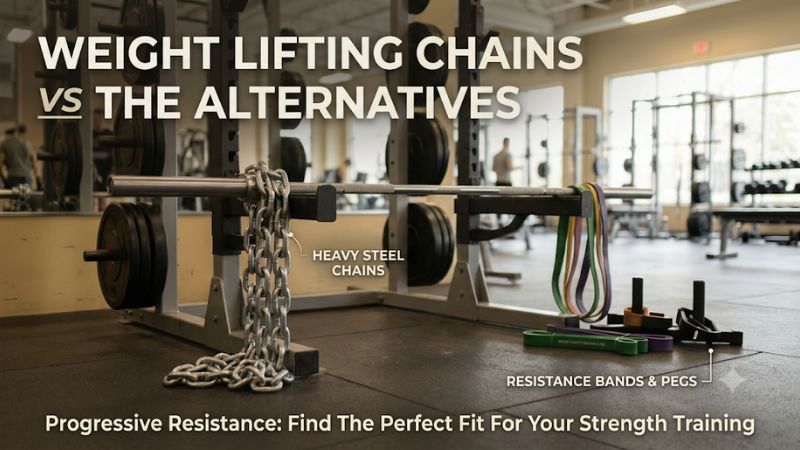
Chains versus bands for a variable barbell load
Chains add the mass of the links lifted from the floor. Bands attached according to a suitable system add elastic tension according to their stretch and setup. Both can make the top heavier in a traditional loading arrangement, while producing different changes between positions and different effects during the descent.
On a bench press, chains may pick up gradually from two floor piles beneath the sleeves. The result depends on chain density, height, and attachment geometry. Bands develop force according to the specific band and its starting stretch, length, and line of pull. Two bands with the same color can differ by manufacturer and model.
Compare bottom and top loads in the exact configuration you intend to use. A chain rated at 30 pounds per pair and a band advertised with a weight range do not necessarily produce the same resistance change. A useful comparison measures both systems at the same positions with suitable equipment and a stable, approved setup.
Bands are convenient to store and avoid the sound of steel links coming together. Chains can be easier to understand when you measure how much of the assembly rises. Choose according to your approved anchors, floor access, and the type of loading you want to reproduce.
Chains versus straight plates for progression
Straight plates keep the same mass on the bar throughout the rep. The point that feels hardest can still change as body position and leverage change. Chains add a different kind of progression within the movement. More chain can become suspended as the rep moves upward from the floor-supported portion.
Straight loading makes weekly tracking simple. If you add a matched 2.5-pound pair total, you know how much extra mass you placed on the bar. Fractional plates make it possible to plan even smaller changes. Chains require you to log the bar and plates, the suspension setup, and the approximate weight added at key positions.
Choose plain plates when you want to increase a full-range barbell lift in a straightforward, repeatable way. Choose chains for sessions where a measured difference between bottom and top is part of the program. A training week can use both, provided you record them as different configurations.
Chains versus pauses and slower repetitions
A paused rep holds a position under load. A slower rep changes the time spent moving. Both alter the training pattern while keeping the same plate mass. Chains change the amount of load the bar supports. Decide whether you want extra work at a chosen position, a slower movement, or a heavier upper part of the lift.
For example, a lifter who wants to practice a consistent bench pause can use the same bar and plates at the normal station. A chain setup might be useful in another session intended to bring more load into the press as it rises. The two approaches can have different effects on the timing and feel of the same movement.
In a small room, tempo or pause work requires little extra space. It can be a particularly practical choice when the main issue is repetition control or consistency. Chains are relevant when the variable load itself is the goal and the floor and attachments are available for a repeatable setup.
Chains versus partial-range barbell work
A partial-range setup limits the range using appropriate equipment and training instructions. It can let a lifter focus on a specific part of a movement. Chains can increase loading as you move through a longer range. Compare whether you want to shorten the exercise or keep the full pattern with a changing load.
A rack pull from suitable supports starts higher than a floor deadlift, so the start and leverage change. A chain deadlift from the floor can preserve that floor start while adding load as links rise. These are different training choices. Use the one that matches what you want to practice and can be set up correctly.
Partial-range training still needs a rack or supports rated and configured for the intended use. Chain training needs enough floor room under both ends. If both options fit, consider whether the exercise variation or the specific loading profile is more useful for the program you follow.
Compare chains with cables and machines
Cables and machines can change the direction of the force or the leverage you encounter at different positions. Chains usually change the mass supported by a straight bar in its usual path. Choose among these options by how closely you want to keep the original lift, and how much equipment the room can support.
Choose cables when the direction of resistance matters
A cable follows the line from the pulley to the handle. Adjusting the pulley position or your stance can change the line of pull. That is useful for rows, presses, and accessory movements that benefit from a force direction different from gravity on a barbell. A chain pair keeps the main load directed downward.
A cable station can be useful if you want more accessory options in one room. It can require wall or floor space, suitable mounting, and room for the handle to travel. A chain set takes less permanent space if you already own a barbell and rack and can store both sides securely between sessions.
If you are trying to practice a barbell squat or bench in the form you already use, compare chains and bands first. If you want to train a movement from different directions or make a particular row easier to set up, a cable station may address more of your routine.
Choose a machine for a guided path and a specific profile
A machine can guide the movement through a path defined by its frame or linkage. Some designs use cams or lever geometry to alter resistance through the range. The actual profile varies with the equipment and settings. A barbell with chains preserves the free bar path you move and support yourself.
A guided machine may make a particular accessory exercise quick to repeat, especially where setup and changing loads are simple. It costs floor space and introduces different contact points and adjustments. Compare how the machine fits the people using it and whether the movement it provides matches the exercises you want.
If the goal is specifically to progress barbell lifts, chains can keep more of the existing setup familiar. If you want a dedicated movement and have space for it, the machine can replace part of the program. Measure the station in use, including how you get in and out and how far the moving parts extend.
Compare a light adjustable setup for general home strength
Dumbbells or other adjustable equipment can be a better fit for a room that cannot keep a large platform clear. If your priority is building a routine across rows, split squats, and presses, independent weights can serve several exercises without a barbell suspension system or floor piles beside both ends.
The mechanical change matters. A pair of dumbbells allows the hands to move independently, whereas a chain-loaded bar still couples both hands through a single shaft. A dumbbell workout can support progression while having a different load setup, starting position, and technique from a barbell workout.
If you already own a rack and want variable load on the straight-bar lifts performed there, chains or bands are closer choices. If the room is shared and your exercises are flexible, price the entire equipment setup. A smaller accessory can still require more supporting hardware than a self-contained adjustable pair.
Choose based on the training problem you have
Start with one reason for changing your setup, such as a heavier top, a quieter station, or easier tracking. Compare the equipment options on that same requirement. That makes it possible to choose between similar accessories without paying for one feature and discovering that a different part of the session is still difficult.
You want more load near lockout while keeping a full rep
Chains can be useful if more links are supported by the bar near the top and the lower position stays at your planned load. Bands can also increase resistance as they stretch. Compare the exact changes at the bottom and top, and see when during the rep each setup reaches most of its additional load.
For illustration, a bar-and-plate load of 185 pounds with chains adding 6 pounds at the bottom and 24 at the top creates roughly 191 and 209 pounds at those points. A band configuration measured at another pair of values gives a different progression even if its heaviest point matches 209 pounds.
If you need to preserve a particular total at the bottom, adjust the fixed plates in an appropriate starting setup before comparing the accessories. If the only thing you want is to spend more time practicing the finish, a permitted partial-range exercise can be a simpler fit. Choose based on whether the complete repetition matters.
You want quieter sessions in a shared room
Chains can create floor contact, link noise, and vibration. A cover and appropriate flooring may change that experience. Bands avoid the metal-link contact but still require a permitted anchoring setup and enough clear area for tensioned equipment. Straight plates with controlled handling are another useful comparison.
Compare the room you share and what the noise comes from. If the problem is steel links collecting on the floor, changing the resistance method may help. If it is the bar or plates coming into contact with the floor, chains may contribute only part of the sound. Check the complete routine and the room’s permitted uses.
When you can already train the movement with ordinary loading, a quiet straight-weight or paused variation may suit more sessions than redesigning the gym around anchors. When variable loading is central, consider a band arrangement only if the rack and other components are designed to support it.
You want the easiest load to log and reproduce
Straight plates make the setup simple to repeat, particularly when you own small matching increments. Chain settings require a record of hardware, attachment position, bar height, and actual pickup. Bands require a record of the exact pair, attachment geometry, and the measured stretch or resistance at selected positions.
A chain setup can still be consistent if you train the same lift in the same place and record the feeder positions. A dedicated rack station makes this easier. Frequent changes to flooring, plate height, or rack hardware make it more important to repeat the measurement before comparing session totals.
For athletes who use detailed training logs, write the straight load and variable contribution as different fields. A description such as 185 pounds in bar and plates, plus 6 pounds at the bottom and 24 at the top, gives you more information than recording the main pair’s retail weight alone.
You want a change supported by training evidence
Research on variable resistance includes different exercises, loading proportions, populations, and equipment. Some studies and reviews report benefits in particular strength or power outcomes. Those results do not provide a universal chain weight or establish that one device improves every routine. Start from the question your program is trying to answer.
Use a consistent lift and record what you change. If you want to evaluate how chains feel through a repeated block, keep your equipment and measurement method stable. If you switch to bands, record their actual resistance position by position. Avoid comparing a headline chain weight with the strongest tension advertised on a band.
For someone whose main goal is reliable progression, well-planned straight-weight training remains a practical option. Variable resistance can be useful when the change in loading serves a specific exercise and you have the equipment, space, and technique to apply it consistently.
Use a one-session comparison before buying more equipment
Pick one lift, identify the change you want, and map the space available for each option. Write down the initial and top loads you can reasonably reproduce. Compare setup time, storage, and how closely each choice keeps the original movement. Then decide whether a different accessory solves a real limitation.
Compare the load and room together
Set a working configuration using the equipment and guidance you already have. Record the bar and plate mass, then consider what a chain or band arrangement would add at two positions. Check where the chains land or where the approved band anchors sit. Give clearances equal weight with the resistance numbers.
A chain might produce your preferred loading profile and still be a poor fit if every repetition gathers links near a bench foot or walkway. A band may have a smaller stored footprint and require clear space for a stable tension path. A plate-only setup often avoids both issues and still permits simple progressions.
If you introduce a new setup, begin with a manageable controlled load and check that the movement remains consistent. Adjust one detail at a time. This makes it easier to see whether a difference comes from the equipment or from the changed exercise.
Consider how often you will use the new setup
A dedicated chain system can justify its cost when you can train with it regularly and preserve a consistent configuration. If the original problem occurs once in a while, a temporary change in programming or an exercise you can already perform may serve the same purpose. Compare the full purchase cost with expected use.
For one rack shared by multiple lifters, consider whether the same settings suit everyone. A taller or shorter lifter may pick up a different amount of chain through the usual range. Document each setting or choose a simpler loading system if the need for repeated adjustment exceeds the training benefit.
Use the following comparison if two options still look similar.
| Priority | Option to compare first |
|---|---|
| More supported mass as the bar rises | Chains |
| Variable loading with an elastic tension profile | Bands on an approved setup |
| Easy progression and logging | Straight plates |
| More practice at a specific bar position | Pauses or approved partial-range work |
| A different line of pull | Cables |
| Guided exercise in a dedicated station | Suitable machine |
Conclusion
Choose chains when you want the bar to pick up load as links leave the floor and you can repeat that setup. Use bands for a suitable elastic loading arrangement and straight plates for straightforward progression. Pauses, partial ranges, and cables make more sense when the real goal is changing the movement, its timing, or the direction of resistance.
More from Amazon
Programs that pair well with the guide above. Offers and eligibility are set by Amazon and may change.
Free shipping on eligible items, Prime Video and more. Eligible new members can start with a free trial.
Start a Prime free trialA Prime membership for ages 18-24 with a trial period. Eligibility is set by Amazon.
See Prime for Young AdultsAudiobooks and podcasts to listen to on the go. Eligible new members can start with a free trial.
Try Audible freeAd-free music streaming. Eligible new subscribers can start with a free trial.
Try Music Unlimited freeAs an Amazon Associate we earn from qualifying purchases.


Write Your Review
No reviews yet. Be the first to share your experience!