
A barbell pad for small spaces should fit the shaft and leave enough room for you to get into position. Measure the loaded bar, bench, and entry path before comparing pad sizes. A thick cylinder can fit in a bag and still reduce the clearance you need to roll the bar into place for hip thrusts at home.
Measure the entire area you need to use
Start by drawing three positions. Mark where you load the bar, where it sits at the beginning of the exercise, and where the equipment goes after the workout. Include the plates, bench, and the path you use to reach each sleeve. A pad changes only part of the area, so check the whole setup first.
The tight point can be anywhere in that sequence. A garage may have enough width for the bar and too little room to load one plate. A bedroom may have enough space beside the bench and too little vertical clearance to get under the padded shaft. Once you know the real limit, the choice between a slimmer cylinder, thicker wrap, or pad placed over the hips gets easier.
Measure the space beyond both sleeve tips
Find the narrowest usable width where you load. Measure at plate and sleeve height, including walls, shelf legs, skirting boards, and other equipment that extends into the lane. Find where the plate will enter from and how your hand clears adjacent objects. A bar that fits wall to wall still needs room at its tips.
If a clear lane measures 108 inches and an 86.75-inch bar sits in the middle, there are about 10.6 inches beyond each tip. A 79.13-inch bar leaves about 14.4 inches. These are geometric estimates. Try the loading movement using the outline of your widest plate and check whether your hands have space to slide the plate inward and secure the collar as directed.
If one end is open and the other sits beside a cabinet, turn the station or shift it only after checking both sides. The extra gap must remain usable with the bench and plate storage in place. Moving a plate tree can free more room than changing the bar. Choosing a shorter pad cannot move the sleeve tips.
Check the floor-to-pad opening with your lightest plates
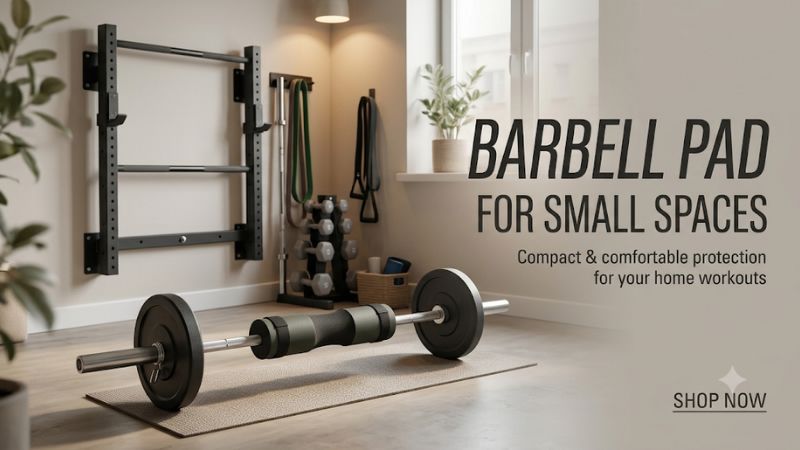
For a wraparound pad, measure from the floor to the lowest part of the mounted cushion with the bar resting as it will before the exercise. The lightest planned setup can be the most restrictive if it uses smaller-diameter plates. Record the gap with the pad installed and before trying to move beneath the bar.
A simple estimate helps with planning. If a bar is supported by two 450 mm plates on a level floor, the center of the shaft sits about 8.86 inches up. A four-inch round pad centered around the shaft has a nominal outer radius of two inches. That leaves about 6.86 inches below the pad. A 3.5-inch pad leaves about 7.11 inches in the same simplified setup.
This calculation assumes round plates are the contact points, the cushion is roughly centered around the shaft, and the listed diameter represents the part that passes over you. Measure the actual equipment. A 12-inch outer-diameter plate has a center height of six inches, and the same 3.5-inch pad would leave about 4.25 inches in a simplified estimate. The plate diameter change has a larger effect than switching between two similarly sized pads.
Map where your bench, hips, and feet will be
A bench-supported hip thrust uses space behind the bar, at your feet, and around both sleeve ends. Put the bench in its intended position and check the manufacturer’s instructions for stable use. Mark where your shoulders contact it and where your feet go. Trace the route you use to move into and out of position.
Leave enough room beside the bench to reposition yourself without running into the bar, weights, or a rack foot. Check how the bar moves into place before adding a working load. If the bench moves during a light rehearsal, address bench stability and the surface before changing the pad. A securely fitting pad does not secure the bench.
For a room that also has a squat rack, try positioning the bench so its storage spot does not block one end of the bar. Check that a rack crossmember, supports, or equipment stored on the upright stay out of the bar’s path. If those objects make floor hip thrusts difficult, consider the alternatives for that specific room before paying for a thicker cushion.
Mark the vertical space for the lift you intend to do
The bars and pads you compare sit at different heights once loaded. For a hip thrust, check nearby shelves and equipment with the bar at the intended highest position. For a squat, use the height of your J-cups and spotter equipment as reference points. Take the measurements with the pad attached where it actually sits.
A squat pad can add distance between the shaft and its usual contact point on your back. Set up with a light bar and check whether you need to change the hook height or stance to rerack smoothly. In a compact area, you may have little room to walk the bar back and reset. A slim squat pad can be useful when only a small amount of cushioning is needed.
If part of the station folds or moves away, check both operating and stored layouts. A folding bench or rack saves space after training. During training its feet, arms, or attachment points may still project into the path where you set down plates or step under the bar.
Choose a pad shape that fits the limiting dimension
A low-profile cylinder, thick wrap, and flat pad occupy space differently. Match the shape to the part of your setup that limits you. A narrow storage slot may favor a flat pad, while an already tight roll-in path can make the outside diameter of a cylindrical pad more important than its advertised foam thickness.
| Pad design | Useful when | Dimension to verify | Practical trade-off |
|---|---|---|---|
| Low-profile squat wrap | You want some cushioning and a familiar bar position | Actual outside profile and usable shaft fit | Less cushioning than a thick hip thrust wrap |
| General cylindrical pad | You swap one pad between squats and hip thrusts | Outer diameter, length, and grip around the shaft | Extends below the bar as you move into position |
| Thick cylindrical hip thrust pad | You prefer continuous coverage around the shaft | Actual lower edge above the floor and supported shaft range | More bulk in the loaded starting position |
| Flat hip thrust pad | You want wider coverage across the hips or flat storage | Overall width, depth, thickness, and placement sequence | Positioned separately from the bar |
Choose a slim profile when squat position is the priority
A slim pad makes sense if the rack and bar already work and you want to add modest cushioning. It changes the point of contact less than a thicker cylinder of similar shape. Confirm that the cover or fastening stays centered on your bar and that it gives you enough working area across your upper back.
Read the foam thickness and the overall dimensions separately. A 15 mm core describes how much foam the brand specifies. The finished profile also includes the shaft opening and cover. Use the actual outer shape if the pad needs to pass close to a rack feature or fit in a storage slot. At the rack, try an unloaded or appropriately light setup before deciding if the new position feels repeatable.
You may already have space for the length of a thicker pad and still prefer a slimmer option for handling. The aim is a comfortable contact area and a setup you can recreate in every set. The smallest product is useful only if it stays in the right location and covers the part of the bar you actually use.
Choose a thick cylinder when the entry path is clear
A thick wrap suits a hip thrust station where the bar can be rolled or positioned with room for the padding and the lifter. Measure the gap before deciding between a 3.5-inch and four-inch outside diameter. On centered round pads those dimensions differ by about a quarter-inch below the shaft.
That difference can matter at a tight point, but it rarely fixes a setup with much smaller plates. In an example with 18-inch plates, the center sits about nine inches above the floor. Switching to 12-inch plates loses three inches of center height before you consider the cushion. If the lighter setup is the awkward one, check the compatible plates you have before choosing a thinner pad solely for entry.
On a narrow bench lane, consider how the closure is accessed. A full wrap can be practical when you can reach around the shaft to fasten it. A molded snap-on pad can simplify installation if it fits securely. A pad that takes extra time to fit where you train may be less useful than one you can set up consistently.
Choose a flat pad when its placement solves the problem
A flat hip thrust pad can fit on a low shelf and cover a broader area across the hips. A design such as the 18-by-9-by-1.75-inch AbMat sits on your body and takes the bar on its top surface. Follow the placement sequence for the model and check whether it leaves you enough room to set up in your station.
When mounted foam is the obstruction during entry, a separately placed pad may be worth comparing. Test both the order of placement and how you reposition the bar during a light rehearsal. The pad still has thickness under the shaft during the lift, and there must be room to get it into position. Its flat storage shape does not tell you whether the exercise setup will feel convenient.
A flat pad also competes for a different kind of storage space. A shelf under a bench might accept the 1.75-inch thickness but be too shallow for the full nine-inch depth. A narrow vertical gear bin may suit a shorter cylinder better. Measure the spot and compare the face dimensions with how the pad can actually go in and out.
Organize the station to keep the pad useful
A workout station feels smaller when loading and cleanup require repeated trips around a bench. Put the pad and collars where you can reach them before loading, and place the plates where they can leave storage freely. Use the floor area you already have for the exercises you repeat most often during the week.
Store the bar, pad, and plates near their next use
Remove the pad after training if that is how the manufacturer recommends storing or drying it. Put it somewhere it can dry between sessions and keep the slit, wrap, or pad face in its intended shape. A cylinder compressed into an overloaded drawer can distort and become harder to fit evenly.
The plate stand should sit near the loading spot without occupying the clearing beyond a sleeve. Check a real plate coming off the stand and moving toward the bar. Put lighter change plates where you can reach both sides quickly. Keep the bench free to move from its storage position without requiring you to clear a path through the bar and plates first.
If the gym doubles as a living room, make cleanup part of the equipment decision. Plan one short sequence for unloading, returning the pad to its place, and storing the empty shaft. The equipment you can reset by yourself is easier to keep in regular use than gear that looks compact only when packed away.
Compare one-pad and two-pad setups
One general-purpose pad can cover squats and hip thrusts if its shape works for both. It also gives you fewer parts and one open place in your bag or on your shelf. Try to choose it around the more demanding fit check, then confirm it still suits the other exercise at a light load.
A thin squat pad plus a flat or thick hip thrust pad may be more practical if both exercises are prominent and use very different contact positions. A second pad usually adds less space than another bar or bench, but account for how you use the room and where each piece lives. A thick general pad purchased for hip thrusts may stay unused during your squats if it changes the setup more than you want.
Think about shared use as well. If two people use different bars and bench positions, one pad may fit both and still be inconvenient to change between workouts. A visible storage spot and one clear attachment method can be more helpful than buying duplicates of a model that is loose on one shaft.
Try the lightest and widest setups before committing
A useful dry run starts with your lightest practical hip thrust position and your widest loaded bar configuration. Check the gap from the floor beneath the pad, the side clearance for the largest plates, and the route to get under the bar. Then check the highest position around the bench and rack.
If you buy online, use the product dimensions to cut a lightweight template for the pad’s footprint. Measure the outside profile for a cylinder and both thickness and face size for a flat pad. The template can show where the equipment overlaps. Use it to help choose which exact fit measurements to confirm with the seller.
When the pad arrives, follow the maker’s setup and check that it stays in the intended position during a light rehearsal. If your limiting problem was a bench shift or a narrow loading lane, repeat that part of the check first. The goal is consistent room to move, load, and put the equipment away.
Frequently asked questions
Most small gym questions reduce to which dimension is tight. Check whether that dimension belongs to the pad, the bar, the plates, the bench, or the space around them. That distinction keeps you from buying a different style of cushion when the actual obstacle is a wall or the position of another piece of equipment.
Do I need a shorter bar just because a thicker pad feels bulky?
Check the source of the problem. A shorter bar increases the clearance beyond the tips if you keep it centered in the same lane. It does little to increase the gap under the pad with the same plates. Compare the floor-to-pad opening, bench position, and access path before changing the bar.
Can I fit a barbell pad in a narrow drawer?
Measure the drawer’s internal height, width, depth, and opening. Compare those with the pad in its normal shape and any closure that projects. A flat pad may work under a shelf where a cylinder is too tall. A short cylinder can fit a deeper bin with a small opening.
Will a pad fit a short Olympic bar or a compact training bar?
Check the center shaft diameter and the length of the usable straight portion. Nominal Olympic plate compatibility refers to the sleeves. It does not establish pad fit. A short training bar can have a different shaft size or shape from your main bar.
Is a floor glute bridge easier to fit than a bench hip thrust?
A floor bridge removes the bench from the setup and may reduce front-to-back space. A barbell bridge still needs enough clearance for both sleeves, pad placement, plates, and entry. If side clearance is the main limit, a dumbbell or another supported alternative may fit better.
Conclusion
Measure the space at both sleeve ends, under the padded shaft, and around the bench before buying. A slim wrap suits a squat-focused setup, a thick cylinder works when the bar has entry clearance, and a flat pad can help when broad hip coverage and flat storage matter. Choose around the tightest point in your actual room.
More from Amazon
Programs that pair well with the guide above. Offers and eligibility are set by Amazon and may change.
Free shipping on eligible items, Prime Video and more. Eligible new members can start with a free trial.
Start a Prime free trialA Prime membership for ages 18-24 with a trial period. Eligibility is set by Amazon.
See Prime for Young AdultsAudiobooks and podcasts to listen to on the go. Eligible new members can start with a free trial.
Try Audible freeAd-free music streaming. Eligible new subscribers can start with a free trial.
Try Music Unlimited freeAs an Amazon Associate we earn from qualifying purchases.


Write Your Review
No reviews yet. Be the first to share your experience!