
This EZ curl bar buying guide starts with the grip you want for curls and extensions. Check where your hands land on the bends, then match the sleeves to your plates and collars. Empty weight, loadable sleeve length, and the width of your rack supports narrow the choice before you compare finish or price.
Choose the grip from the exercises you train
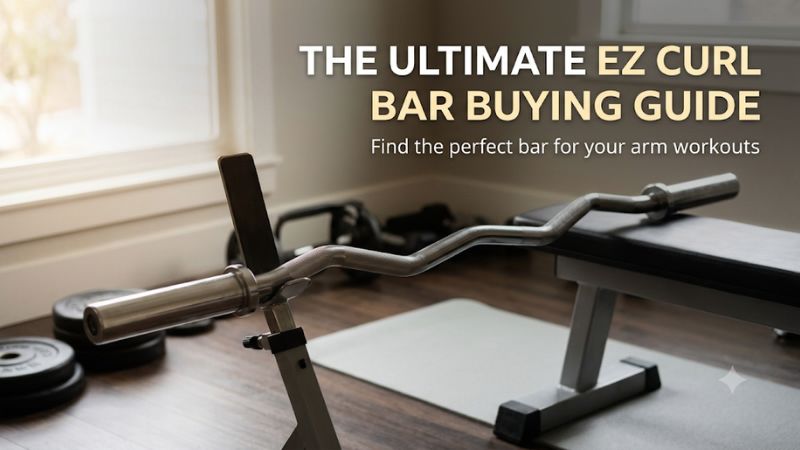
An EZ curl bar uses bends to give both hands an angled grip on one shared shaft. Different models place those angles at different widths and use different shaft diameters. Decide which sections you will grip in your most frequent exercises, then work out where both hands will sit on the bar and how you will load it.
Start with your two main uses, such as standing curls and lying triceps extensions. Record the load, the hand spacing, and the way you begin and finish each exercise. Then identify what your current equipment makes difficult. You may need a lighter start, a narrower grip, a more useful inner bend, or a better way to place the bar on hooks. The relevant product feature follows from that specific need.
Compare the bends where each hand actually rests
Some bars use mild angled sections with broad intervals between bends. Others have sharper slopes or tighter inner grips. Compare where the middle of each hand lands and whether the entire hand stays on a comfortable section. A strong visual bend does not tell you which positions are useful for your grip width.
For a first check, raise your forearms as you would for a light curl. Find a palm angle and hand spacing that feel natural for that exercise. Compare those positions with a front-view photo or drawing of the candidate bar. On a model you can try, hold the unloaded bar at both regular and close grip widths. Check whether the bends allow both hands to land symmetrically.
Think about the triceps exercise separately. The hand spacing you use for an extension can be closer, which moves your grip onto a different slope. A bar that works well for a shoulder-width curl can leave your hands crowded on the inner bend. Look for room across the full width of each hand, particularly when the knurl ends near a transition.
Compare grip diameter and texture independently
Grip diameter is the thickness of the shaft you hold. Knurl is the textured surface that affects grip contact. A bar with a 25.5 mm grip can feel noticeably different from one with a 30 mm grip even when both have comparable bends. Select the diameter and texture that suit your hands and the pace of your training.
For shorter light sets, a fuller grip may feel comfortable in the palm. For someone with smaller hands, the same shaft can cause the fingers to wrap less fully. A rougher knurl can improve purchase for some lifters, while a smoother texture may suit high-volume sets. Compare the whole feel where you intend to put your hands. Marketing terms such as “medium” or “aggressive” are manufacturer descriptions rather than standardized grip measurements.
Check where the texture starts and stops. If you use the inner angled grip, some knurl patterns leave part of that section smooth. If you use a wider grip, check for a bend, ring, or sleeve shoulder that could put your hands at the edge of the textured area. Choose a consistent contact area before paying more for a coating or a faster sleeve.
Use wrist feel to identify a useful position
A cambered position can put your hands somewhere between a fully palm-up grip and a more neutral angle. The exact angle depends on the segment you use and the way you hold the bar. Try the motion at a light load to decide which grip lets you repeat your usual range comfortably for that lift.
An EZ bar still links the hands. Both sides move together, and each grip is fixed at the bend you choose. If you need each hand to rotate independently, dumbbells may serve that exercise differently. This is a useful way to think about grip design when your current bar feels restrictive only in one part of the movement.
Avoid buying entirely from claims about particular biceps heads or universal wrist comfort. The useful equipment question is whether the handle position lets you perform the planned exercise consistently at a load you can control. A familiar grip and repeatable setup are easier to compare across sessions than broad promises about how the bar will feel for everyone.
Match the bar to your plates and routine loads
The shaft is what you hold, and the sleeves are what the plates fit over. These can have very different diameters on the same bar. Identify the plate bore, measure the thickness of your working stack, and include collars. Then check both the lightest weight you can use and your expected heavier sets.
| Specification | What to look up | How it affects your decision |
|---|---|---|
| Shaft diameter | Diameter at the grip | Changes how fully your hand wraps around the shaft |
| Sleeve diameter | Actual sleeve measurement and plate format | Determines which plates and collars fit |
| Loadable sleeve length | Usable portion per end | Sets a limit on the thickness of the plate-and-collar stack |
| Empty weight | Weight for the exact model and its built-in parts | Sets the lightest available load and changes plate arithmetic |
| Shoulder span | Distance between the inside sleeve shoulders | Helps screen compatibility with the installed rack supports |
| Overall length | Tip-to-tip measurement | Determines loading clearance, transport, and storage room |
| Knurl placement | Which grip sections are textured | Affects where both hands can grip during different exercises |
Choose standard or Olympic sleeves on purpose
A standard bar typically takes plates with approximately 1-inch center holes. A bar sold as Olympic usually uses sleeves around 50 mm, often described as 2-inch. Verify which format your plates use. A 25.4 mm shaft can be the grip on an Olympic bar, so read the sleeve field rather than judging plate fit by what your hands hold.
If you own a standard threaded system, check the collar threads and how much of the sleeve the spin lock needs to engage. If you own Olympic plates, check the sleeve’s actual diameter and collar recommendations. A plate can slide over a small variation in sleeve diameter while a clamp collar feels loose. Follow the manufacturers’ compatibility guidance for the exact combination.
The cost difference becomes clearer when you price the bar with the weights you already have. A cheap standard bar is attractive if your plates match. An Olympic bar may be cheaper as a complete addition when you have a set of compatible plates and collars ready to use. Choose the system you expect to keep across your regular lifts.
Calculate sleeve room using a single real stack
Write down what goes on one side at your heaviest planned load and measure each plate across its thickest part. Account for hub flanges, molded rims, and the collar as installed. Then compare the total with the published loadable length, which can be shorter than the total sleeve dimension.
Suppose a bar has 7.5 inches of loadable sleeve and a collar needs 1.25 inches. That leaves a theoretical 6.25 inches for plates. Two plates measuring 2.8 inches each plus a 0.75-inch change plate take 6.35 inches. The combination is over by a tenth of an inch before allowing for variation. A thinner plate or a longer sleeve solves the mismatch. A higher load rating would not change the available room.
With integrated locks, use the length the manufacturer gives with the lock engaged. That figure is more useful than the uncovered sleeve length. Check that the largest proposed stack ends at a position where the locking component can work properly with those plates.
Calculate the lowest working weight before the highest
Check the empty bar against your lightest planned set. A 35 lb rackable bar starts at a substantially higher load than a 15.4 lb compact model. If your useful training range begins below 35 lb, the starting weight may rule out the rackable bar before its knurling and sleeves become relevant.
For a target around 30 lb, a 20 lb bar and two 5 lb plates reach 30 lb before collars. A 30 lb bar reaches it empty. The lighter bar gives you additional options below that target, while the heavier bar may have more features you want for sets above it. Choose the load range based on what you will do more often.
Also check your progression steps. Adding one 2.5 lb plate on each side increases the total by 5 lb. Adding one 1.25 lb plate each side raises it by 2.5 lb. If you already own weights that make the right jumps, count them when planning sleeve length. Small plates and collars can occupy enough extra width to change a near-limit stack.
Choose between a short bar and a rackable bar
A short EZ curl bar is easier to maneuver and may have plenty of sleeve space. A rackable model extends the shaft between the sleeve shoulders so it can rest on compatible supports. Compare the reason you want to use hooks with the added starting weight, storage length, and loading room the larger design requires.
Measure the installed rack contact points
Measure across the outer edges of the J-cup surfaces where the shaft is intended to sit. Compare that with the distance between the bar’s inside sleeve shoulders. Confirm that a straight and suitable part of the cambered shaft rests on both cups in the position specified for the exact model and exercise.
For example, a 51-inch shoulder span on a rack whose installed contact surfaces are 48 inches apart leaves 1.5 inches of geometric clearance per side when centered. Take side movement, hook shape, and actual shoulder profile into account. If safeties are part of the exercise, confirm that they support the bar properly at the intended point. The width of the rack uprights alone does not tell you the entire setup.
If the purchase depends on precise compatibility, ask the maker for a dimensioned drawing. Some short bars have a similar-looking center section and enough overall length to look rackable in a photo. The sleeve shoulders and designated contact points are the measurements that tell you whether a manufacturer-supported setup is available.
Choose a short bar for a dedicated floor or bench station
A compact model suits many home lifters who load their bar outside the rack. Check how you will pick up the loaded bar, get into position for lying work, and set it down after the final rep. The lighter empty weight and short footprint are useful when the same room has to serve other types of training.
Some short models have sleeves close to the capacity of their rackable counterparts. For example, two bars can both have 10.5-inch loadable sleeves while differing by about 20 inches overall. The extra length goes between the shoulders to fit the rack. If you want more room for plates, compare the sleeve figures directly before deciding to buy a longer shaft.
Make sure any angled bar is supported appropriately if you use a separate stand. Check the manufacturer’s instructions for the stand and the bar. A stable designated holder can help you organize a short setup without assuming the bar can sit on a conventional power rack.
Account for use and storage at full length
Measure the full tip-to-tip length against the room where you load the plates. Leave room at both ends for your largest plates, collars, and hands. Check the height of nearby cabinets or walls where you move the bar out of storage. Measure with your bench and other common equipment in place.
If you set up with a 74-inch bar in a room that also holds your straight bar, decide where both bars will sit during arm work. A vertical holder may fit the room’s footprint while requiring extra overhead room to remove the longer implement. A horizontal holder may take more wall space and project into your lifting area. Run through the actual movement before choosing the format.
Evaluate rotation, finish, and hardware after fit
Once a bar fits your hand placement, plate system, working weight, and storage, compare the features that make it easier to live with. Sleeve bushings or bearings, coatings, retaining hardware, and collar design can matter during regular use. Their value depends on your exercises and training environment.
Choose rotational construction by how you use the bar
Bushings and bearings support the sleeve and let it rotate relative to the shaft on designs that use rotating sleeves. For controlled curls and extensions, the grip position, secure plate stack, and consistent sleeve behavior matter more than how long an unloaded sleeve spins when turned by hand.
Look for smooth, predictable movement on the assembled bar. If you inspect a used bar, check that both sleeves behave as intended and that the hardware is secure. Read the maintenance directions before servicing the sleeve. Some systems use retaining rings or bolts, and maintenance steps differ across brands. Choose the design you can maintain and for which the maker can provide support when needed.
A threaded standard bar gives a different plate interface. Its virtue is simplicity and compatibility with a current 1-inch collection. An Olympic design with rotating sleeves can offer faster changes with suitable collars. Compare how often you load different weights across a session before paying for a feature that mainly changes setup.
Consider grip and sleeve finishes separately
Your hands touch the grip and the weights touch the sleeves. A single product can use an E-coated or zinc shaft and chrome sleeves, a hard-chrome finish throughout, or stainless steel in part of the bar. Compare what the manufacturer says about the exact surface you handle and the maintenance it requires.
A humid garage can make regular wiping and appropriate storage important even with a protective finish. A dry room may let you give greater weight to contact feel and price. With two versions of the same bar, check whether the more expensive coating changes the dimensions or the way the knurl feels, and decide whether that is worth the difference at the loads you use.
Review the limits and the complete order
A bar’s advertised load rating describes what the manufacturer lists under its own conditions. Read the intended uses and follow the maker’s instructions. Compare the number with your realistic loads, then check the plate stack and support equipment independently. The smallest usable constraint determines your setup.
Record the exact model and finish, grip diameter, empty weight, loadable sleeves, collar type, and rack span if applicable. Price the bar with any extra plates or collars you need and the cost of delivery. If a specification could decide between two candidates, ask the seller for the relevant figure. A clear drawing and a usable return policy can be more valuable than a small discount.
Frequently asked questions
A spec sheet becomes easier to read once you know the exercise and the plate system you need. Remaining decisions often involve whether the bar can start at a low enough weight, whether the collars fit, and whether the rack supports can hold the intended part of the shaft. Verify those details on the exact version.
Is a 25 mm or 30 mm EZ curl bar better?
Choose the size that lets you reliably hold the intended grip under your working loads. A 25 mm shaft lets the hand wrap farther around it, and a 30 mm shaft gives a fuller contact surface. Compare both at the grip angle and hand width you plan to use.
How do I know whether an EZ bar will accept my collars?
Read the actual sleeve size and the collar maker’s supported dimensions. Threaded standard sleeves need matching threaded collars. Olympic sleeves may differ slightly in actual diameter. Confirm the intended collar can engage fully and stay secure with the plate stack you plan to use.
Is there a standard length or weight for an EZ curl bar?
The category has many lengths and weights. Short bars in our examples range from the mid-40s to mid-50s in inches, while rackable examples are longer. Check the empty weight and the shaft span on the exact model instead of assuming a bar will match the one you used at a gym.
Should I buy more sleeve capacity than I need today?
Reserve margin when you expect to use thicker plates or progress to a heavier stack. Choose that margin from real measurements, including your collar, instead of the seller’s generic example. When your room and storage are tight, additional sleeve length must earn the extra space it uses.
Conclusion
Choose the EZ curl bar whose bends and grip diameter fit your main exercises. Verify the plate bore, compatible collars, lightest usable load, and sleeve room for your heaviest planned stack. Add rackable length only when the bar fits your installed supports and loading from hooks will improve the way you train.
More from Amazon
Programs that pair well with the guide above. Offers and eligibility are set by Amazon and may change.
Free shipping on eligible items, Prime Video and more. Eligible new members can start with a free trial.
Start a Prime free trialA Prime membership for ages 18-24 with a trial period. Eligibility is set by Amazon.
See Prime for Young AdultsAudiobooks and podcasts to listen to on the go. Eligible new members can start with a free trial.
Try Audible freeAd-free music streaming. Eligible new subscribers can start with a free trial.
Try Music Unlimited freeAs an Amazon Associate we earn from qualifying purchases.


Write Your Review
No reviews yet. Be the first to share your experience!