
The right cast iron weight plates for small spaces preserve room on the sleeves and around the bar. Buy the weights you use, measure their actual thickness, and leave room for properly seated collars. Then choose storage that lets you remove the heaviest disc without moving your bench or blocking a path.
Find the tightest dimension in your home gym
A tiny room can restrict bar length, space beside each sleeve, storage, or the route from the rack to the floor. Measure the problem where it happens. A thin plate can fit a crowded sleeve, while a small outside diameter can suit a low storage space. Your hands still need room to slide the disc on and off.
Measure the bar with the bench and rack in position
Start with the bar you plan to use and place it in its usual secure position. Mark the ends of the sleeves, the approach at each side, and the position of the bench when you train. Open any door or cabinet that shares the space. Check how much room you need to hold an actual plate beside each sleeve.
A bar that fits between two walls can still leave little room for loading. To load a 45 lb plate, you need a position for your feet and enough room to bring the plate to the sleeve without striking a wall. Rehearse the path with a light object close to the intended diameter. Check where you would put down the collar before the next change.
Repeat the check with the rack or bench adjusted to the positions you use. A plate may load easily at bench height and be awkward to guide onto a bar near the floor. If the space serves other people, preserve the normal route through the room. A bar can fit the room dimensions while still obstructing that route during exercise.
Measure loadable sleeve length rather than total bar length
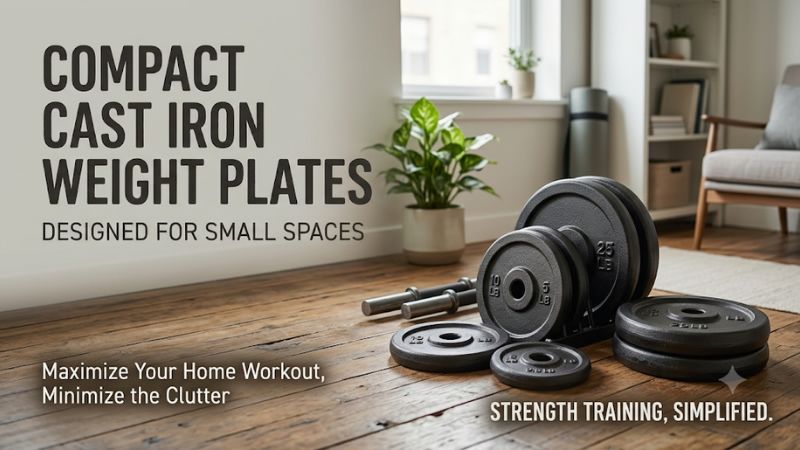
The space on the ends of a bar determines how much plate thickness fits. A compact bar can have the same span between sleeves as a longer bar and achieve its short overall length with shorter sleeves. Verify rack compatibility, loadable sleeve length, and the approval conditions for the bar you plan to buy.
Rogue’s C-70S is one example. The manufacturer lists 8.875 in of loadable sleeve length and 52 in between the sleeves on that bar. It lists 16.40 in of sleeve length on its Ohio Bar. Those dimensions show how a shorter bar can keep a familiar rack position while providing less space for the discs and collars.
Subtract the actual collar requirement from the usable sleeve before buying the heaviest stack. Verify how the inner shoulder and outer end are shaped. A length shown in a product drawing can differ from the usable room once particular hardware is installed. Measure the real configuration on both ends if you already own the bar.
Reserve space for the whole stack and collar
Add the thickness of every plate on one end at your regular top load, including small change plates. Reserve the room required for the collar and any additional clearance specified by the maker. Use a stack plan for each sleeve. Avoid buying an extra pair based on the remaining space before small plates are added.
Suppose you have an illustrative 8.875 in sleeve and a collar that needs 1.50 in of suitable engagement. That leaves 7.375 in for plates before accounting for any other requirements. Four 1.50 in discs use 6.00 in, leaving 1.375 in for other plates. Four 0.89 in discs use 3.56 in, leaving 3.815 in in the same example.
This is a dimensional calculation. Your bar, collars, plates, and floor still need to be appropriate for the selected weight and use. If a stack leaves insufficient space, choose compatible thinner plates or reduce the load to an approved configuration. A partially seated collar is not a way to reclaim sleeve room.
Build a compact set around regular training loads
A compact set works best when every pair has a job. Use the bar’s actual nominal mass, then list your regular loads from the lightest warm-up to the heaviest working set. Divide the difference between the bar and each target across both ends. Select the fewest pairs that cover the loads you train often.
Choose the main plates before filling every gap
A 45 lb pair adds 90 lb to a bar. A 25 lb pair adds 50 lb, and a 10 lb pair adds 20 lb. Start with the weights that get you near your regular targets. Add smaller plates after checking where the combinations leave gaps. This often saves more storage than buying every denomination in the catalog.
For example, a 45 lb bar with a 25 lb pair starts at 95 lb before collars. Adding a 10 lb pair gives 115 lb, and adding a 5 lb pair to that gives 125 lb. If those loads appear repeatedly, the three pairs have a clear purpose. A second large pair can wait until the relevant loads appear in your plan.
The same idea works for heavier training. A buyer who already owns several 45 lb discs may need one pair of 10s to close more gaps than another pair of 45s would. Write out two warm-up sequences and the usual working sets. The weights that show up repeatedly are the ones that deserve convenient storage and the first spending.
Compare storage mass with the maximum load you can make
The total weight of a set tells you what it weighs in storage. The weight on the bar includes its own mass and any collars you count. Some useful sets reach a high nominal maximum without covering every smaller step. Compare the actual inventory and combinations before choosing how much equipment to keep in the room.
| Plate inventory | Stored plate mass | Maximum on a 45 lb bar before collars | Most useful when |
|---|---|---|---|
| One pair each of 25, 10, and 5 lb | 80 lb | 125 lb | A compact station mainly uses light and moderate loads |
| One pair each of 45, 25, 10, 5, and 2.5 lb | 175 lb | 220 lb | Several lifts use both large and small changes |
| Two 45 lb pairs plus one pair each of 25, 10, 5, and 2.5 lb | 265 lb | 310 lb | Heavier training is regular and adequate storage is available |
The table describes arithmetic, independent of equipment ratings. Check whether the full stack fits both ends, whether the bar and other equipment are suitable, and whether each combination corresponds to a load you actually need. Keep enough place on a suitable rack or tree for the entire collection when the bar is empty.
Use small plates where they genuinely replace bulk
For a 5 lb total bar increase, you need two 2.5 lb plates. For 2.5 lb total, two 1.25 lb plates do the job if they fit your sleeves. If one smaller pair fills a progression gap, it can be a more useful compact purchase than another heavy pair that is difficult to store or will stay unused.
Small discs can also need a defined parking spot. A 1.25 lb pair may disappear behind a larger plate on a crowded peg. Set aside an accessible position, making sure the bore and support fit. Keep the labels visible, particularly if you use more than one unit or own separate sets for standard and Olympic equipment.
Track the space needed by mixed stacks. Smaller change plates can be thin, but stacking several to reach a target adds both thickness and handling. A single appropriate plate per side can become the cleaner option if that weight recurs often. Compare the finished stack and the storage cost of adding that pair.
Choose a storage layout that keeps the heaviest plate reachable
Compact storage needs more than a place where the discs fit at rest. You need room to lift the plate out, grasp it securely, carry it to the sleeve, and return it without blocking an aisle. Measure the longest move in that sequence before buying a tree, rack attachment, or storage tray.
Pick a rated plate tree when the footprint can stay clear
A plate tree organizes several pairs into vertical positions. Verify the diameter and usable length of each peg, the local and total ratings, and the approved load distribution. Check the separation between pegs with the largest plates in place. Discs that fit the bare tree can crowd a nearby handle or another plate.
Place the tree so you can remove its heaviest regularly used plate without reaching around furniture. Allow enough room to slide the plate all the way off the peg and turn toward the bar. The loaded footprint includes the plates. A tree with a small base can project substantially when 45 lb discs sit on both sides.
Follow the manufacturer’s guidance for placement of heavy weights. A tree that tips or moves during normal removal needs to be unloaded and evaluated before further use. Check the surface under the base and verify compatibility with the intended floor finish and any protection. Keep the storage out of doors and normal walking routes.
Compare rack-mounted pegs with freestanding storage
Rack-mounted storage can give the plates a home close to the bar. Check the rack’s instructions for approved attachment points, peg limits, and any required installation. Measure from the upright to the end of the loaded peg. Then leave room to remove a full-size disc without crossing a bench or an active lifting area.
A peg mounted on the outside of an upright may make loading faster in a garage but use the exact space you need in a narrow bedroom. A lower or rear placement can have different access. The addressable question is where the weights and your hands fit when the rack is already set up for the lift.
For a folding rack, follow the manufacturer’s restrictions for folding and storing with plates attached. Model-specific requirements can affect whether mounted storage is available at all. A freestanding tree may be simpler where the rack moves or its approved mounting positions are already occupied by other equipment.
Use a stable low tray for a small number of plates
A rated, suitable low storage position can work for a limited collection when plates are restrained from moving and easy to lift. Check whether the shape and weight of the discs work with the support and the floor. Leave a clear area for the removal of the largest plate without forcing a reach under furniture.
If you own just two large discs and a few change plates, a small dedicated floor-supported solution may preserve wall space. Keep smaller discs in a stable separate position so they do not get trapped underneath the largest pair. Use a design intended for the actual mass. Avoid leaving plates balanced upright against a wall where they can roll or tip.
Think about the room after the workout. Plates should return to a position that keeps hands and feet clear and prevents accidental movement. A garage door, a drawer, or a person entering the room can change the space around the storage. Check the normal room use as well as the exercise layout.
Match the plate dimensions to your room and routine
A broad 45 lb disc can need more room to turn through a narrow aisle than a compact 25 lb disc. A short sleeve can make thickness the greater concern. Check both dimensions at the exact weights you want and compare how each plate fits storage, bar loading, and lifts that start close to the floor.
Use thickness to estimate how much fits on a short bar
At the same nominal 45 lb, Rogue lists its USA Olympic plate at 0.89 in thick, while York lists its G-2 at 1.5 in thick. Four discs differ by 2.44 in of nominal stack thickness on each end. The example shows why an exact thickness is more useful than the general description of a plate as cast iron.
A compact setup may have enough room for either design on the bar, in which case grip or price can matter more. If the sleeve is already close to full, prioritize the actual stack and approved collar engagement. Take account of plate faces that seat together differently. Verify the finished stack rather than relying only on a drawing.
Use outside diameter for storage and floor height
If a 450 mm disc contacts the floor, its radius is approximately 225 mm before allowing for any flooring or surface effects. A smaller disc starts the bar lower if it is the largest one on that side. For an exercise that depends on a specific starting position, account for this before buying a set made entirely of smaller plates.
A large, thin plate can be roomy on the sleeve while difficult to carry through a narrow corner. A smaller diameter can reduce that handling envelope, even if it comes with more thickness. Measure the intended storage opening and the reach needed to lift the plate free with your hands clear of adjacent discs.
Keep projected load and floor protection separate
Add the mass of the plates, rack, storage, and other relevant equipment when planning a concentrated location. If the floor’s suitability is uncertain, follow the building or property guidance and obtain a qualified assessment where needed. A rack or mat specification applies to its own intended use and cannot establish building capacity.
A stable, compatible protector can help with ordinary surface contact. Plan controlled placement, particularly in a shared building where vibration can carry. Choose different equipment and an appropriate lifting surface if intentional drops are central to the routine. A compact plate collection can still weigh hundreds of pounds at its storage point.
Apply the measurements to common small gyms
The same principles produce different purchases for an apartment, a bedroom setup with 1-inch handles, and a shared garage. Start with what is hard to reach or hard to load. Then choose a set and storage arrangement that remain usable when the rest of the room is in its usual position.
Apartment setup built around a short Olympic bar
Confirm the short bar fits the rack and leaves room to load at both ends. Start with a limited group of plates that covers your working loads, and check the heaviest stack with the collars installed as directed. Choose thinner plates where the sleeve is the limiting feature and where the higher cost is worthwhile.
A small, protected landing area can handle controlled set-downs when the equipment and floor suit the activity. Keep the plates in a suitable low position or plate tree near the loading area. Avoid putting them where another occupant has to step around the bar just to enter or leave the room.
Bedroom setup with standard loadable handles
Start with the measured handle and its original or approved retaining hardware. Compare the inner diameter of compatible plates, the usable length of the threads, and the outside diameter nearest your arm. Count the plates for both ends of both handles if you use matched dumbbells. The number of pieces can exceed the number for one bar.
A few smaller plates can cover the frequent adjustments without a separate stand for a full fixed-dumbbell set. Store them in an appropriately rated place near a stable loading area. Keep the plates clear of the path between the bed and door and verify the setup still works with drawers and cabinets open.
Garage bay that also stores a vehicle or tools
Mark the layout with the car or other large equipment in its normal place. Check that you can reach both sleeves and remove the largest plates from storage without stepping into the vehicle path. If the bar only fits when another object moves, decide whether that change is realistic for every normal session.
A freestanding tree may work where it can sit level and stay out of the main route. Rack storage may save a separate base if the rack permits it and the loaded pegs leave access. In a damp garage, dry the discs and follow the finish care instructions. Inspect storage contact points periodically for movement or damage.
Frequently asked questions
A compact setup can benefit from thin plates, a shorter bar, or a smaller inventory. The right answer comes from the actual constraint in the room. These questions cover how to distinguish the dimensions, how much mass you need to buy, and when a compatible storage position matters more than the smallest footprint.
Are all iron plates thinner than rubber bumpers?
No. Compare actual thickness at the same nominal weight. Many traditional iron discs are thinner than full rubber training bumpers, but rim and construction vary. A cast plate with a deep profile can use more space than another iron design. Use the exact dimensions for the intended load and leave room for the collars.
How many pairs should I buy for a compact gym?
Start with the combinations needed for your regular lifts and warm-ups. Three carefully chosen pairs can cover many moderate loads. A larger set can be useful as your working loads and progression require it. Include the space for the largest future pair only if it is a realistic purchase.
Do small plates make deadlifts start lower?
They can when the smaller discs are the largest ones resting on the floor. The loaded bar’s starting height depends partly on that radius and the surface under it. Compare actual diameters and use a suitable setup for the movement. Avoid assuming that all iron or all 45 lb discs share the same outside size.
Can I store plates flat underneath a bench?
Use a stable and suitable storage position that keeps the plates restrained and accessible. Check what happens when the bench is folded, adjusted, or rolled. A plate tucked deep underneath can force a long reach and awkward lift. Choose a position you can access safely even after the bench has moved.
Conclusion
Measure the loaded sleeves, leave the collar space required by the manufacturer, and buy the pairs that cover your actual lifts. Choose thinner discs for a crowded bar, a suitable tree or low tray for storage, and a layout that lets you reach the heaviest plate with the room in normal use.
More from Amazon
Programs that pair well with the guide above. Offers and eligibility are set by Amazon and may change.
Free shipping on eligible items, Prime Video and more. Eligible new members can start with a free trial.
Start a Prime free trialA Prime membership for ages 18-24 with a trial period. Eligibility is set by Amazon.
See Prime for Young AdultsAudiobooks and podcasts to listen to on the go. Eligible new members can start with a free trial.
Try Audible freeAd-free music streaming. Eligible new subscribers can start with a free trial.
Try Music Unlimited freeAs an Amazon Associate we earn from qualifying purchases.


Write Your Review
No reviews yet. Be the first to share your experience!