
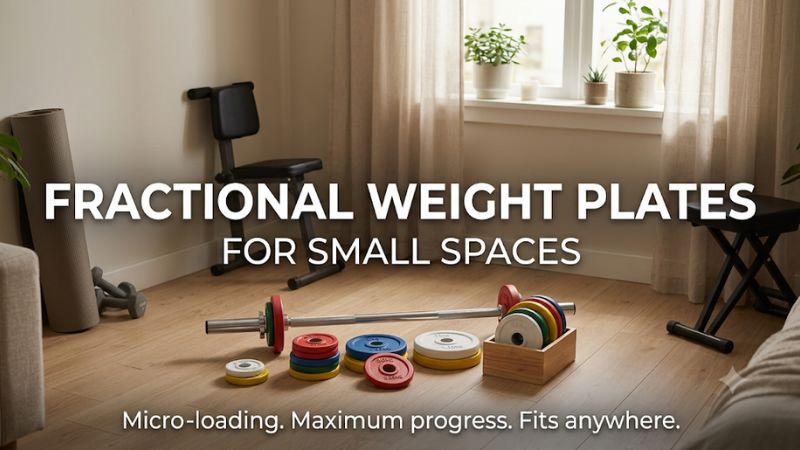
The right fractional weight plates for small spaces fit the bar before they fit the shelf. A single pair can cover one useful increase, while a mixed kit gives more options in a small pouch. Measure the sleeve after your working plates are mounted and keep enough room for the collars to seat properly.
Identify which part of the setup is short on space
A compact gym can be short on sleeve length, storage space, or room to change the load. Those constraints lead to different purchases. Check the bar at a normal working load and measure the area around its ends. Then decide whether you need thinner plates, fewer plates, or easier access to the weights you already own.
Measure the loadable sleeve at your normal working weight
Start with the working plates you use most often. Their combined thickness matters more than the sleeve length shown by itself. With the bar securely supported and the plates held in the intended position, measure the available sleeve beyond the stack and account for how the collar must sit and lock on that sleeve.
A practical planning example uses 0.90 in of remaining sleeve and a collar that needs 0.60 in fully seated. The measured allowance for extra discs is 0.30 in per end, subject to the equipment’s instructions. A 0.155 in disc would fit the calculated allowance. A 0.35 in disc would exceed it. Confirm the measurement on both sides and include any required clearance.
Avoid trying to reclaim space by letting the collar hang over the working end or by moving a plate outside the collar when the arrangement is not approved. If room is too limited, choose a thinner plate or change the approved setup. A narrower base stack may be an option if the main plates also meet the bar’s intended use.
Compare the bar ends with the surrounding room
A short bar can solve a room-width problem and still leave too little reach at either end. Measure where you stand to slide the plates and collar onto the sleeve. Check a nearby cabinet, wall, and the normal position of any rack upright. Allow clearance for the actual movement of your hands and the disc.
A bar may fit a corner while a plate has to travel past a door frame to reach the sleeve. Try a dry rehearsal before buying. Use a lightweight disc-sized object and simulate loading from the working position. Include room to set a pair down temporarily, and repeat the check with the bench or rack in its normal place.
For a folding rack or shared space, note whether the sleeve can be reached when the rack is deployed. A storage location that works only when the bench is moved may interrupt a session with several loading changes. Set aside one clear spot for changing weights and one for parking the kit after the workout.
Separate axial thickness from outside diameter
Thickness controls how much sleeve length a plate uses. Outside diameter controls how much space it occupies across a drawer, bag, or nearby piece of equipment. A plate can be thin and wide or compact across its face and thick enough to challenge a short sleeve. Check both dimensions on the exact weight.
Weight It Out lists a 0.25 lb disc at 0.155 in thick and 3.375 in across. Rogue lists its 0.25 lb coated disc at 0.35 in thick and 120 mm across, or about 4.72 in. These are examples of two plates with the same nominal mass and different dimensions. Choose the form that fits the tightest part of your setup.
There can also be a handling trade-off. A thin disc can sit nearly flush against a larger plate. A wider face or thicker edge may give your fingers another way to handle it, depending on the design. Check how you will remove the micro plate without disturbing the rest of the stack or catching fingers between discs.
Build the smallest kit that covers your next steps
A single pair is an efficient purchase when one barbell increase appears repeatedly in your workouts. A mixed set is useful when several lifts need different increments or a second person shares the equipment. Count recurring changes and decide whether each size you add has a purpose beyond filling out a set.
Start with one matched pair for a known gap
If the next step you want is 1 lb on the bar, two 0.50 lb discs give you that increase symmetrically. If you want 0.50 lb total, buy two 0.25 lb discs. This is particularly easy to store when the same pair stays with one bar and you already have conventional change plates for bigger jumps.
For example, a lifter pressing 65 lb may want to train at 66 lb before taking the next larger step. One 0.50 lb disc on the left and one on the right gets there from the same baseline. Use the same collars and starting load if you want to compare sessions. A compact pair can serve that goal without buying weights you never remove from the bag.
If you already train with a 1.25 lb plate at each end, you have a 2.50 lb step. Decide if one additional micro pair bridges the gap you are trying to fill. Buying the smallest available pair can add a loading option, but there is more value in a size you can apply regularly to a specific exercise.
Use a mixed set when several lifts need different jumps
A kit with two each of 0.25, 0.50, 0.75, and 1.00 lb weighs 5 lb in total. It provides four direct single-pair increments between 0.50 and 2.00 lb. Combinations can cover additional changes when both sleeves and collars accommodate the stack. Buy a kit when the range replaces several individual orders.
| Your desired increase across a bar | Add to each side | Practical storage choice |
|---|---|---|
| 0.50 lb | One 0.25 lb plate | One matched pair in a small pocket or tray |
| 1.00 lb | One 0.50 lb plate | One matched pair or a duplicate pair for a second bar |
| 1.50 lb | One 0.75 lb plate | Dedicated pair when sleeve length is limited |
| 2.00 lb | One 1.00 lb plate | Dedicated pair for a frequent 2 lb increase |
| 2.50 lb | One 1.25 lb plate, or 1.00 plus 0.25 lb | Check one-disc thickness against the two-disc stack |
A mixed kit also lets you choose a different step for each lift. A small increase may be useful on a press while a 2 lb jump is more practical on another movement. Keep a simple list of the increases you use and how to load them, especially if plate colors differ between your home set and the gym.
Count the ends on your loadable dumbbells
Two double-ended dumbbells have four sleeves. If the approved arrangement calls for equal mass at both ends of each handle, adding one 0.25 lb disc at every end requires four matching discs. Each dumbbell then gains 0.50 lb. A package that supplies just two of each size can cover one dumbbell at a time.
The size problem can also be different. Micro Gainz lists its standard 1-inch kit at 3 in diameter, with the 1 lb disc approximately 0.67 in thick. A disc of that size may be compact in a drawer, while the extra thickness can leave little room for a spinlock on a loaded handle. Check the model, threads, and retention requirements before selecting the kit.
Two people who use a pair of dumbbells simultaneously can benefit from duplicate discs of the same weight. If you own four 0.50 lb plates, you have the pieces for a 1 lb increase on each of two double-ended handles, subject to fit and loading directions. That can take less storage than several rarely used sizes and avoid splitting up matched pairs.
Choose storage that keeps the plates usable
Micro plates are small enough to get covered by a conventional plate, lost in a bag, or forgotten under a bench. Give each matching pair a defined position near the area where you load the bar. Use a case, a shelf, or a rated peg only if it works with that plate size and the room’s normal access path.
Keep a small kit together in a pouch or divider
A pouch is useful if you carry the plates between rooms or to a gym. Check that it supports the whole kit and can close with the largest disc inside. Separate or label the pairs if the plates look similar from above. This helps you start and finish a session with the same complete set of discs.
A small divided box can work when the plates live permanently at home. Put pairs in separate positions so you can find them without moving the other pieces. A box on a stable low shelf can keep the plates accessible, especially if there is nowhere to mount a peg. Check the shelf’s guidance for the expected weight and keep the container out of the lifting path.
If the room is damp or used as a garage, dry the discs before closing them into a case. Follow the maker’s care directions for the finish and check the bore for debris before use. Small discs benefit from an obvious home because there is less material to see when one is left behind another piece of gear.
Use a storage peg only when the plate and peg fit
A peg can keep fractional plates near the rack when the hole and retention match and the wall or rack attachment is suitable. Check the peg diameter, usable length, and the permitted load. A nominal 1-inch plate has a different opening from an Olympic micro plate, so one peg may fit only part of a mixed collection.
An Olympic peg built for full-size plates might accept the micro discs but leave them trapped behind the larger weights. Give small plates an accessible position or store them separately. Check that the bar ends, uprights, and bench do not cross the peg’s access path when loaded. Small plates close to a lifting lane can still become an obstacle.
A rack-compatible storage peg can be useful in a garage where small discs otherwise gather on a workbench. Follow the maker’s placement and attachment directions. Keep protrusions away from the access route or active lifting area. For a rental or room with uncertain attachment conditions, a contained freestanding option may be easier to verify.
Separate ounces, pounds, and kilograms visually
Different markings and similar colors can cause a loading mistake, especially if several lifters share the equipment. Keep the kilogram and pound pairs in distinct positions and turn the labels outward. Check the printed or engraved mass on both discs before loading them, even when they came from the same drawer.
A 0.25 kg disc weighs about 0.55 lb, so it is much closer to a 0.50 lb disc than a 0.25 lb disc. The corresponding balanced additions are about 1.10 lb and 1.00 lb, respectively. That difference may be modest, but matching equipment units keeps the way you record the lift consistent.
Where several pairs share the same general shape, label their storage position with the total bar increase as well as the weight per piece. Write “0.50 lb each, 1.00 lb per bar” if the system is shared. This keeps the math clear and helps users return matching pairs to the same spot.
Apply the plan to three small home gym layouts
A one-wall apartment gym, a bedroom with standard spinlocks, and a compact Olympic setup can all use fractional plates. The purchase changes with sleeve diameter, the regular loading stack, and how much lifting equipment the room already holds. Use these layouts to work out the smallest useful kit for your own situation.
Apartment setup with a short Olympic bar
Start with the bar’s exact sleeve dimensions, working plates, and collar instructions. Load the largest stack you regularly use and check how much room remains. If the room usually runs out of sleeve first, a thin single pair may be the most useful purchase. If it runs out of access, change the rack layout before adding more gear.
Keep the micro plates close to the bar’s loading zone. For example, place a resealable pouch on a suitable low shelf away from the bar ends. This gives you a clear approach and makes it easy to find both discs after changing loads. Do not leave them on the floor beside a doorway or under the bench.
If one end sits near a wall, check that you can remove the collar and slide the micro plate all the way off while maintaining control. It can take more room to move an object than to store it. Consider the largest collar and plate you use, not only the tiny disc you intend to buy.
Bedroom setup with standard spinlock dumbbells
Measure the usable threaded ends and check the original retaining nuts with your existing plate stack. Decide whether you want a new per-dumbbell increase on one handle or an even increase across both. Buy matching discs for every intended end, using only a loading arrangement allowed by the handle maker.
A compact two-pair purchase can make sense when you only need 0.50 lb per dumbbell. Four 0.25 lb discs can provide that figure across two matching handles when placed one at each end. If the collars cannot seat properly at your normal load, try a thinner compatible plate or choose another way to progress.
Store the kit where you can assemble the weights without putting loose discs on the surface where you move around the room. A small divided tray near the bench can work if it is stable. Store the handles and micro plates after training so the shared room still works without changing where people walk or sit.
Garage corner with thick bumpers and limited sleeve length
A set of full-sized bumper plates can use most of an Olympic sleeve even where wall and floor storage are available. Measure the largest working stack first. Keep a written note of the space left with the collars mounted properly, so you can screen a new micro plate or change plate before ordering it.
If the sleeve is full, buy a thinner compatible disc only when the manufacturer’s loading requirements can still be met. Another option may be a different approved combination of main plates that gives the same base load in less room. A larger pouch solves storage convenience while the loaded sleeve needs its own solution.
Check the room and the storage spot after changing the bar height or moving the rack. A small plate stored close by can still be hard to reach when the bench is in position. Leave a clear place to set aside collars and unused plates so none are underfoot when the next exercise starts.
Frequently asked questions
A compact setup depends on the fit of the exact bar, collar, and plate. Use both the sleeve measurement and the number of weight changes you make to decide what to buy. These questions cover where thinner discs help, when a pouch is enough, and how to avoid purchasing the wrong quantity for a pair of handles.
Is a thin plate always better for a small home gym?
A thin plate helps when the sleeve is close to full. A small outside diameter matters more in a narrow drawer or pouch. Consider how easy the edge is to grip and whether the plate and collar seat as required. Buy the profile that addresses the actual constraint on the equipment you use.
Can I store fractional weights on the bar between sessions?
Follow the bar and rack makers’ storage instructions. Keeping the discs loose on the sleeves can make them easy to overlook when changing the base load. A dedicated pouch or shelf makes it easier to account for both pieces, check the bar’s starting weight, and keep the collars with the correct equipment.
What is the best first pair if I only have a little space?
Choose the pair for the increment you expect to use. Two 0.50 lb discs add 1 lb to a compatible barbell. Two 0.25 lb discs add 0.50 lb. A kit is worthwhile when several sizes will get regular use or more than one person trains, so start from your actual working targets.
Can I use an Olympic sleeve adapter on a standard bar?
Only use a compatible setup approved for the bar and the adapter, including an appropriate means of retaining the weights. An adapter adds hardware and can change usable sleeve length. For a compact standard-bar setup, a verified 1-inch plate and compatible collar may be the simpler purchase.
Conclusion
Measure the loaded sleeve and leave the required collar room, then buy the fewest compatible plates needed for your regular increases. Choose thin discs for a crowded sleeve, a pouch for a small portable kit, or a suitable tray for home storage. Keep matched pairs accessible without crowding the area where you train.
More from Amazon
Programs that pair well with the guide above. Offers and eligibility are set by Amazon and may change.
Free shipping on eligible items, Prime Video and more. Eligible new members can start with a free trial.
Start a Prime free trialA Prime membership for ages 18-24 with a trial period. Eligibility is set by Amazon.
See Prime for Young AdultsAudiobooks and podcasts to listen to on the go. Eligible new members can start with a free trial.
Try Audible freeAd-free music streaming. Eligible new subscribers can start with a free trial.
Try Music Unlimited freeAs an Amazon Associate we earn from qualifying purchases.


Write Your Review
No reviews yet. Be the first to share your experience!