
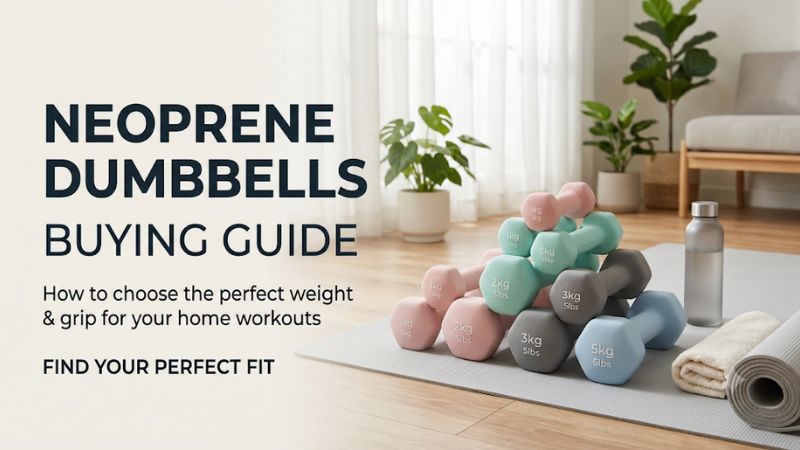
This neoprene dumbbells buying guide starts with your actual exercises. Write down the loads you use for a light raise, a press, and a row, then compare the next usable step for each. Handle size, head shape, and package quantity matter once you know which pairs will earn regular space in your home gym.
Start with the weight you use per hand
Make a list of the movements you want the dumbbells to support. Record the weight in one hand, whether the exercise needs a pair, and how you expect to progress. A single set can work across several movements, but the best starting load for each exercise may be different.
| Buyer question | What to check | Example |
|---|---|---|
| What is my lightest useful weight? | A load you can use with control for the intended exercise and repetitions | A 3 lb pair for a light raise variation |
| What do I use most often? | The common load across several exercises | A 5 or 8 lb pair for repeated accessory work |
| Where do I need more resistance? | The heaviest load your relevant exercises currently need | A 12 lb single for a unilateral row or a pair for bilateral work |
| What is my next useful step? | The smallest manageable increase at the current weight | 5 to 6 lb for a movement sensitive to small changes |
| Do I need both dumbbells? | Package quantity and the movements you perform | Two units for presses in both hands |
Choose the low end by your lightest regular exercise
A low starting weight is useful when several exercises require light resistance or when two people use the same equipment at different levels. Loads that are manageable in a row can be too much for a raise because the arm position changes leverage. Check the intended movement and repetitions rather than assuming one weight should work everywhere.
If you can try a few weights before buying, choose a controlled set within your planned repetition range. The first repetition tells you how the load feels initially, while the later repetitions show whether the weight fits the exercise as you perform it. A weight you can use consistently may be more valuable than a heavier option that only fits a lower-repetition version.
A bundle beginning at 5 lb can make sense for a buyer who prefers 5 lb or more for every intended movement. For someone who uses 2–3 lb frequently, an apparently versatile heavier kit leaves out part of the regular program. Determine the lightest useful setting before evaluating how far the bundle extends upward.
Buy the heavier pair for an exercise that needs it now or soon
The highest weight should correspond to a real movement. If you use 10 lb on two exercises today and have already been looking for a usable 12 lb option, a bundle topping out at 12 lb may fit. If you only intend to use the set for light accessories and do heavier work elsewhere, you may get more from smaller increments.
Consider how many movements are likely to outgrow the chosen range. One heavy unilateral row can sometimes be covered by one additional dumbbell. If your presses, rows, hinges, and split squats all need larger loads soon, buying several neoprene pairs up to 15 lb may be an inefficient way to cover your total strength program.
Use the product’s actual highest per-dumbbell weight. A 32 lb package that includes pairs of 3, 5, and 8 lb tops out at 8 lb in one hand. The storage location needs to accommodate 32 lb of weights, while the individual exercise only gets the pair or single you pick up.
Compare the next step as a percentage
A jump from 5 to 8 lb increases the load by 60% per hand. A jump from 8 to 10 lb increases it by 25%. That is why a bundle can contain three genuinely useful working weights and still have gaps that make progression difficult on one specific movement.
Calculate the change relative to your current load. If you use a pair, the total changes too. Two 5 lb weights total 10 lb, and two 8 lb weights total 16 lb. An available intermediate pair of 6 or 7 lb could help if your program calls for a smaller increase and you expect to use it regularly.
A small step is useful even at the lightest end. At 2 lb, an additional pound means a 50% increase. If you are buying specifically to fine-tune a light accessory exercise, check that the product line offers intermediate loads. Perform Better, for example, lists pairs at each whole pound from 1 through 10 lb, with 12 and 15 lb options above that.
Understand how the coating and shape affect handling
Neoprene is a form of synthetic rubber used as an outer coating on these weights. A typical dumbbell in this category has a solid core and a covered grip and heads. Grip comfort depends on the thickness, finish, and shape of the assembled product as well as the material named in the listing.
Check whether the handle fits your hand at the selected weight
Look for handle diameter and clear grip length. Diameter tells you how far your fingers need to wrap around the grip. Clear length tells you how much space your hand has before it meets the heads. A contoured center can also mean the grip feels different depending on where your hand settles.
Manufacturers sometimes change the handle with dumbbell size. Gaiam publishes a 1.42 in handle diameter on its 5 lb option and 1.62 in on its 10 lb option. That amounts to roughly 36 and 41 mm. If you have a handle that fits you well, measure it and use that as a reference before ordering a heavier pair in the same line.
Check the handle with the grip you normally use. A glove, a colder room, or sweat can change how you experience the finish. Where the listing provides little detail, in-person handling or a practical return route is more useful than a generic assurance about a comfortable grip.
Evaluate the head when you move both weights together
Flat or hexagonal sides help a dumbbell stay put on a level surface. Head size also changes how the equipment moves near your torso. In a close neutral-grip press, large heads can meet earlier than smaller ones. In a curl, the inside head needs room near your thigh and hip.
Check total length on the weight you intend to buy. A compact 3 lb version shown in a headline photo may look quite different from a 12 or 15 lb option. If you are planning a small home gym or using tight floor positions, find dimensions for the individual unit at the target load.
Treat floor-supported movements separately. A dumbbell with flat ends can stay put during ordinary placement on a level surface. Use it as a weight-bearing support only if the equipment manufacturer permits that use and your surface supports the setup. For some programs, a purpose-built support or hands on the floor is easier to implement.
Check coating coverage and practical care
Look at the actual contact points around the handle and head transitions. A continuous cover changes how the dumbbell contacts your palms and the floor. A visible seam, rough patch, or coating defect can be more noticeable on an exercise involving time under tension or repeated readjustment of the grip.
Follow the maker’s cleaning instructions and inspect the coating periodically. If part of it separates near the handle, stop and check whether the surface remains stable enough to grip. Exposed metal or a torn patch can also change the way the weight contacts furniture or floors when stored.
Look up floor and surface guidance before setting up permanent storage. Gaiam specifies spot cleaning and advises against storage on painted or varnished surfaces. Other brands may give their own instructions. A protective layer should also fit the selected floor and keep the equipment stable.
Choose the purchase format and storage together
Singles, matched pairs, and complete bundles all make sense under different buying conditions. Compare the price for the active exercise, the storage required for all pieces, and the value of the extra weights included in the package. Purchase format can change the real price more than the finish or color.
Buy a single when only one hand needs the load
A single dumbbell can cover unilateral rows, carries, or one-arm presses where your equipment and space suit the exercise. This is often the economical way to add one heavier weight to a set of lighter pairs. Use the same dumbbell for both sides of an exercise that calls for equal individual loads.
If you expect to add a second later, verify that the product is offered consistently in that weight. Different versions can have the same nominal load but different handle length or head shape. Two matching units generally make synchronized pressing or curling easier to compare from one side to the other.
Also check the price structure. A pair can be more affordable than buying two singles once delivery is included. If you can buy the second unit at the same time and already plan to use both weights, comparing bundles and singles now saves a second order later.
Buy individual pairs when the useful weights are specific
A matched pair is the easiest format when the target weight is clear and most of the weights in a bundle would duplicate what you own. A 10 lb pair can bridge a gap between 8 and 12 lb. A 4 lb pair can be the entire purchase if it solves a recurring light-weight progression problem.
In this situation, a full selection of colors and sizes adds little unless you plan to expand. Check the numbers printed on both weights and use the coating and shape to choose between comparable products. If you expect to add only two pairs, measure whether your current storage can accommodate them without a new rack.
Buy a rack set when several pairs need to stay ready
A rack bundle earns its cost when you regularly use multiple pairs, when someone else uses different loads, or when switching to another weight mid-session is part of your workout. A store-and-use station can keep the weights in arm’s reach while the rest of the floor remains clear.
Read the list of included weights exactly. A 20 lb set might contain 2, 3, and 5 lb pairs, while a 50 lb set with three pairs might contain 5, 8, and 12 lb. These bundles have the same number of dumbbells and markedly different applications. Compare an open rack with a case if you use the same room for other activities.
A case helps keep a few light pairs together between sessions. A stand makes repeated retrieval easier where you have a permanent location. For either format, count the weight of all the dumbbells plus the case or stand, and place the setup on a stable surface suitable for the full load.
Verify what the listing actually promises
Product deals can mix several packages on one page, and listings vary in how they describe materials and dimensions. Verify the selected weight, the number of pieces, the coating, and the measurements before you order. These facts determine whether the equipment fits and what the order will cost.
Read the selected variant and package count together
Look for the exact weight and a phrase such as “one dumbbell,” “pair,” or “two each” on the selected line. In a bundle, add up the listed weights to confirm the number. If the listed total and item count disagree, get the seller’s clarification before comparing it with another set.
Check that any dimensions describe the assembled product. A shipping box can include gaps, packaging, or a disassembled stand. A series page can also give dimensions for one popular load even after you select another. Confirm the size that matters most, whether it is the handle of one dumbbell or the base of the loaded stand.
Verify the coating instead of inferring it from the photo
Neoprene, vinyl, and conventional rubber-coated products can all appear in the same search results. Matte color, bright labels, or a similar hex head cannot identify the material. Read the specifications for the exact variant and resolve any conflict between the title and product description before ordering.
A fully covered neoprene model changes the contact surface of the handle. A rubber hex dumbbell with an exposed metal grip offers a different feel even though it also has covered heads. Decide which contact points matter to you. If you need more load, grip information and construction may be more important than keeping all equipment in the same finish.
Check the delivered cost and what you would return
The delivered price includes both units if needed, shipping, tax, and any storage you have to buy. When comparing sellers, confirm the seller and return terms on the exact product. Returning two dense weights can be more effort than returning a light accessory, especially if you need a separate handling trip.
On receipt, verify the labeled weights and quantity. Make sure that both grip surfaces are intact and the dumbbells rest as expected on a level surface. If one looks or feels different, compare the model labels and address the mismatch before using the pair at full workout speed.
Frequently asked questions
Small buying details affect both comfort and cost. Decide which parts of the purchase are essential before spending on more weights or storage. These questions address common uncertainty about coating, increments, and the fit of pairs across different product lines.
Is neoprene the same as a soft foam grip?
Neoprene refers to a synthetic rubber, and the finish on a dumbbell is a coating applied to the load-bearing core. Its feel can range across products. If you want a certain amount of softness or traction, look at the exact handle construction and try the model when possible.
Do I need a full range from 1 to 15 lb?
Most buyers can start with the loads used often, then add an intermediate or heavier pair when there is a specific reason. A full range can make sense when several people use it regularly. Otherwise, each extra pair adds cost and storage, even if it rarely gets picked up.
How many pounds should I add when a pair feels too light?
The useful next change depends on the current weight, exercise, repetition target, and available settings. Compare the next step as a percentage. For a light exercise, an extra pound can be a meaningful increase. A movement using heavier weights may tolerate a larger absolute step.
Are neoprene pairs sold as exact calibrated weights?
Treat the markings as nominal unless the manufacturer publishes a tolerance or calibration specification. If a noticeable difference between two weights affects your routine, confirm the package and model and contact the seller. Colored labels indicate the selected size rather than verified precision.
Can I use neoprene and rubber hex weights together?
Yes, when you select weights appropriate to each exercise. Many buyers use neoprene pairs for light accessories and heavier rubber hex pairs for presses or rows. When you need matching resistance and handling in both hands, use two dumbbells with the same labeled load and geometry.
Conclusion
Choose neoprene dumbbells by identifying your working loads and the next useful step before comparing bundles. Verify handle fit at the selected weight, check the number of pieces, and price the complete setup. Buy one pair for a recurring load, a compact set when several sizes fit, or an individual intermediate pair when the equipment you already have is close to right.
More from Amazon
Programs that pair well with the guide above. Offers and eligibility are set by Amazon and may change.
Free shipping on eligible items, Prime Video and more. Eligible new members can start with a free trial.
Start a Prime free trialA Prime membership for ages 18-24 with a trial period. Eligibility is set by Amazon.
See Prime for Young AdultsAudiobooks and podcasts to listen to on the go. Eligible new members can start with a free trial.
Try Audible freeAd-free music streaming. Eligible new subscribers can start with a free trial.
Try Music Unlimited freeAs an Amazon Associate we earn from qualifying purchases.
Write Your Review
No reviews yet. Be the first to share your experience!