
Key takeaways
- A PowerBlock Sport 24 dumbbell offers settings from 3 to 24 lb in 3 lb increments and measures 10 × 5.5 × 5.5 in.
- Rogue offers fixed rubber hex dumbbells as pairs across weights from 2.5 to 125 lb. Every pair you buy is ready at its own load.
- Rogue’s stainless DB-15 Olympic loadable dumbbell is 20.5 in long, with 6.75 in of loadable sleeve per end and a listed empty assembly weight of 15 lb with OSO collars.
- The BowFlex SelectTech 840 adjustable kettlebell has six listed settings of 8, 12, 20, 25, 35, and 40 lb.
The choice between adjustable dumbbells vs alternatives comes down to the resistance your exercises need and how often you change it. A selector pair covers many two-handed lifts in a small footprint. A few fixed pairs, a kettlebell, bands, or a barbell can make more sense when your routine has a narrower focus.
Quick comparison table
Compare the alternatives first by the movements you need to keep in your routine. Fixed dumbbells give the closest exercise match. Kettlebells change grip and load position, bands change how resistance behaves across the movement, and barbells change how the hands share a heavier load.
| Equipment | Resistance and adjustment | Storage and working setup | Where it fits best | Main compromise |
|---|---|---|---|---|
| Selector adjustable dumbbells | Select from preset weight steps with a dial, handle, or pin | One pair and any required trays or stand | A broad set of dumbbell exercises with frequent changes | Mechanism-specific handling and possible gaps between settings |
| Fixed dumbbells | Each handle has one weight | One or more pairs, with access to each load | A few frequently used loads, immediate changes, or shared sessions | A broad range takes more space and more pairs |
| Manual loadable dumbbells | Add plates and secure them with compatible collars or screws | Handles, collars, and plate storage | Higher capacity on a budget or reuse of compatible plates | Slower changes and possible sleeve or plate interference |
| Kettlebells | One fixed mass or settings on an adjustable bell | Bell or base and room for its movement path | Swings, carries, cleans, and rack-position work when equipment permits | Different grip and balance from paired dumbbells |
| Resistance bands | Tension varies with stretch and setup geometry | Small storage bag and a reliable anchor where needed | Portable workouts or lines of pull free weights cannot provide | Resistance depends on setup and differs across the movement |
| Barbell and plates | Plates set a shared load across both hands | Bar, plates, collars, loading access, and any rack or safeties the lift needs | Heavy bilateral squats, presses, pulls, and hinges | More setup and working space |
Compare real specs before comparing outcomes
Manufacturer examples help show the physical differences among equipment types. The relevant figures include total handle length, starting load, available settings, and how weight is secured. Compare each on the same exercise and include all hardware that the movement or storage setup requires.
- A PowerBlock Sport 24 dumbbell offers settings from 3 to 24 lb in 3 lb increments and measures 10 × 5.5 × 5.5 in.
- Rogue offers fixed rubber hex dumbbells as pairs across weights from 2.5 to 125 lb. Every pair you buy is ready at its own load.
- Rogue’s stainless DB-15 Olympic loadable dumbbell is 20.5 in long, with 6.75 in of loadable sleeve per end and a listed empty assembly weight of 15 lb with OSO collars.
- The BowFlex SelectTech 840 adjustable kettlebell has six listed settings of 8, 12, 20, 25, 35, and 40 lb.
These are examples of product designs. A 15 lb unplated loadable handle can leave out lighter accessories, while a 24 lb selector can cover those accessories and still hit a ceiling on rows. A 40 lb adjustable bell can provide a useful top weight for kettlebell work, but the advertised range alone says little about the comfort of its handle or suitability for a particular movement.
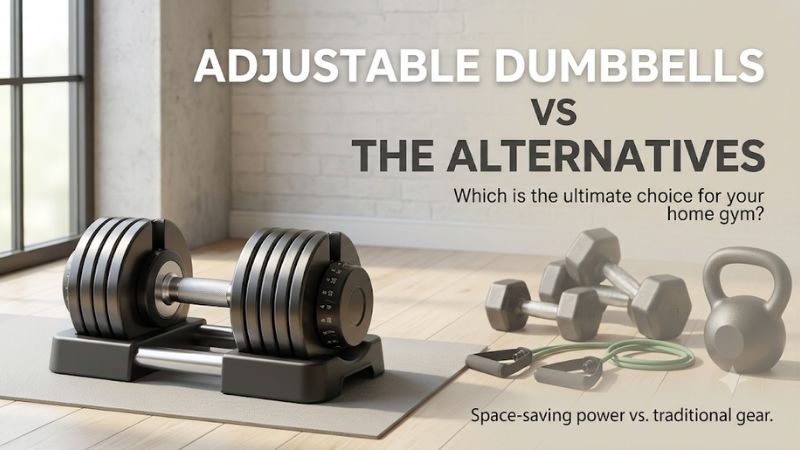
Adjustable dumbbells vs fixed and manual dumbbells
The closest alternatives share the same general free-weight movement patterns. The differences show up in the setup, the space used for each additional load, and the dimensions of what you hold. A choice that works well on a bench can feel quite different during a curl, floor press, or busy circuit.
Fixed dumbbells make sense when you use a few weights often
A fixed pair is ready whenever you pick it up. If your routine stays at a few repeating loads, buying those specific pairs can be economical and simple. For example, 10 lb for raises, 25 lb for pressing, and 40 lb for rows might cover much of a home accessory plan without any selection between sets.
Fixed hex ends can reduce rolling when resting on a level surface. If you want to use any dumbbell as a support point in an exercise, verify that the specific product and surface suit that use. A stable-looking shape and a documented use rating are separate considerations. Traditional round fixed dumbbells need their own storage arrangement.
The cost changes as you add loads. A complete 5–50 lb progression in 5 lb increments takes ten fixed pairs, including multiple sets of handles and heads to store. A selector pair with those settings takes one set of handles and its storage equipment. On the other hand, two people can use different fixed pairs simultaneously. One selector pair usually has to alternate between them.
Choose fixed dumbbells when the load list is short, you value immediate availability, or people frequently train together. Choose selector adjustables when your workouts use many settings and storage space is limited.
Manual loadable handles make sense when plates carry over
Manual handles combine familiar dumbbell exercises with plates you change by hand. Standard spin-lock and Olympic loadable systems use different hardware and generally different plate-hole conventions. Check the actual fit, collar requirements, and allowable loading before assuming your existing plates will transfer.
If you own compatible Olympic plates, two handles and four compatible collars can make additional dumbbell loading affordable. The trade-off is geometry. Large-diameter plates can contact your thighs or floor sooner. Long sleeves may touch the opposite dumbbell in a close press. A bar that works well with compact 5 lb plates may feel crowded with large iron or bumper plates.
Measure usable sleeve length after reserving room for the collars, and check the assembled starting weight. A 15 lb handle can suit rows and presses while skipping several loads used for shoulder accessories. Plate thickness also matters, since a stack of lighter plates can consume sleeve length well before you reach the desired weight.
If you want higher weights on a tight budget and train straight sets, manual loading is a strong option. If you routinely superset two exercises at different loads, the repeated plate changes can make a selector pair worth the additional expense.
A mixed setup can solve one recurring weight gap
Some routines fit adjustable dumbbells well except for one repeated transition. A dedicated light fixed pair can stay ready for raises or warm-ups while the adjustable pair remains at its pressing weight. This can cost and occupy less than a second adjustable set, particularly if you use the additional fixed pair several times each week.
The same approach can work at the top end. If only one movement needs more weight, a single heavy fixed dumbbell may suit the routine. That applies to a single-arm row more readily than a two-hand dumbbell bench press, where you would need a matching pair. Compare the one recurring problem with the cost of a full platform upgrade.
Adjustable dumbbells vs kettlebells and resistance bands
Kettlebells and bands offer different training options with small storage requirements. Their value depends on whether those movements and lines of pull are part of your program. Identical numbers on a label can produce different handling because of the grip, weight distribution, or stretch behavior.
Kettlebells offer a better fit for bell-specific movements
A kettlebell’s mass sits below the handle and can rest on a different part of the forearm in the rack position. This affects how you hold it during a clean, carry, or overhead movement. A handle with a suitable window also gives two hands room for a swing when the model and manufacturer’s instructions support that use.
A dumbbell carries plates on both ends. It sits differently in the hand and naturally suits exercises such as bilateral bench presses, curls, flyes, and independent dumbbell rows. Some movements are possible with either tool, such as a goblet squat or suitcase carry. Compare how each fits your grip and how the weight clears your legs or torso.
An adjustable bell saves storage relative to multiple bells. It can have uneven jumps, such as the 8-to-12-to-20 lb progression on the SelectTech 840 example. If you need a particular weight for repeated cleans or swings, check every available setting and verify that the model supports your intended use. A fixed bell can be practical if one or two loads handle most of your work.
Choose kettlebells when swings, cleans, carries, or rack positions shape the program. Choose dumbbells when you need a broad menu of independent pressing and curling loads with more familiar handling.
Resistance bands change the resistance across the movement
A band provides resistance as it stretches, and the force generally rises with extension. An adjustable dumbbell applies gravity to a set mass. The torque on a particular joint still changes with body position and leverage, but you can carry and repeat the same nominal load without reproducing a band length or anchor angle.
A band rated for a stated resistance range represents conditions defined by the maker. In a row, your distance from the anchor and your starting hand position affect how much tension you begin with. In a squat with a band underfoot, the tension near the top depends on your height and the band’s starting setup. Numbers on band packaging cannot be substituted directly for pounds on a dumbbell.
Bands can provide horizontal resistance from a secure anchor, which is useful when a dumbbell’s downward pull does not match the exercise you want. They also fit easily in luggage. Check the anchor and band condition before each use, inspect for damage, and follow the maker’s stretch limits and setup instructions.
Choose bands when portability, cost, or anchor-based movements matter most. Choose dumbbells when readily repeatable loads, independent hand control, and measurable weight progressions matter more to your program. Many small gyms can use a band for the few movements the dumbbells cover poorly.
Match each tool to the progression you can repeat
With adjustable dumbbells, write down the selected weight, repetitions, and exercise setup. With bands, record the band, anchor height, starting length or floor position, and grip. Marking a repeatable position on the floor can help you compare band sessions more consistently over time.
For kettlebells, record both the load and the movement variation. A two-handed swing, single-arm swing, and clean place different demands on the hands and body even with the same bell. Pick the equipment that lets you repeat the movement and progress in the way your program calls for.
Adjustable dumbbells vs barbells for heavier strength work
Barbells become relevant when your limiting factor is the ability to load a bilateral lift or set up for it consistently. The bar couples both hands to the same load. Dumbbells let the hands move independently, which changes coordination, handling, and how each exercise starts and finishes.
Barbells simplify adding load to heavy bilateral lifts
A bar centered with equal plates on both ends can be loaded with substantial resistance while keeping the hands connected to the same implement. Adding a 2.5 lb plate to each side increases total load by 5 lb, subject to compatible plates and collars. That is a useful progression for a heavy move when the rest of the setup supports it.
With two dumbbells, the limiting factor may become getting into position. You have to bring each weight to the start and control it through the final repetition and set-down. A pair can be excellent for presses, rows, and unilateral lower-body work while requiring more handling effort at weights near the user’s capacity.
For barbell bench presses and squats, include the relevant rack, safeties, setup, and clearance in the comparison. For deadlifts, plan for the bar length, plate loading at both ends, and the floor or platform. These requirements are part of the purchase decision because the advertised bar price does not represent a full working setup.
Dumbbells offer independent paths and a smaller setup
Dumbbells allow neutral grips, independent arm paths, and unilateral exercises with one handle. That makes them flexible when you work across exercises or share a small area. You can perform floor presses without a bench and use one dumbbell for rows or carries, provided the equipment and space suit the exercise.
The compact setup is especially useful when your training mixes several movements without a central focus on heavy bilateral lifts. You can add a bench later if it opens up exercises you actually want. If you’ve already outgrown a moderate dumbbell ceiling on several large movements, a rack or platform may add more than paying for larger dumbbells.
Choose a barbell system when heavy bilateral squats, presses, or pulls define the program and the room accommodates the required setup. Choose dumbbells when independent loading, unilateral movement, and adaptable use of a smaller space do more for your routine.
Choose the equipment your routine can justify
Four factors usually settle the shortlist. Begin with the movement you need most, then identify the load or tension range, how frequently it changes, and the equipment you can use safely in the available space. Apply those factors to a real week of training before comparing purchase prices.
For a small room with one general strength session
A selector pair can cover several resistance levels without dedicating a wall to storage. Include both cradles and their working clearance. If your routine uses only a few loads, price those exact fixed pairs as well. Their lower setup effort can make sense if the available floor or shelf space already accommodates them.
A portable band kit can supplement either option, particularly if you need a horizontal pull. If a band is your only resistance, build the session around exercises and anchor positions you can reproduce. If the adjustable pair is your only resistance, choose the maximum based on the main lift and the minimum based on accessories.
For shared sessions or frequent paired exercises
Two lifters using different weights at the same time can share a small fixed collection more easily than one adjustable pair. A quick selector helps if the users alternate. Confirm whether each user needs small intermediate settings and whether those changes require a separate micro-weight operation.
If one user mostly does lighter accessory exercises and the other trains heavy, a compact fixed or adjustable light pair beside a manual heavy pair can make sense. That arrangement keeps the heavy units ready while avoiding repeated rebuilding for light sets.
For a heavy program on a limited budget
Start by checking whether you own plates and collars that can carry over to compatible manual handles. If you do, total up both handles and any small plates or collars required. Then check whether the starting weight and dimensions work for your exercises. You may still want a few lighter fixed pairs.
If heavy bilateral work drives the program, price a barbell setup with its supporting equipment. If your space will never accommodate the necessary hardware, select an adjustable or manual dumbbell platform with a realistic ceiling and plan movements that suit it. The right comparison is between complete setups you can actually use.
Frequently asked questions
These questions address the points where equipment types overlap. In each case, compare how the load is supported and how you will repeat the movement. A similar label weight can describe a useful alternative while changing how the exercise is performed.
Can adjustable dumbbells replace an entire fixed rack?
One pair can cover many nominal weights if the range and steps match the rack you use. A rack also lets multiple people access different weights at once and provides immediate changes between exercises. Decide how much you need those capabilities at home.
Can bands and dumbbells produce the same workout?
They can train overlapping movement patterns, but load curves and anchor requirements differ. A band can pull horizontally from a suitable anchor. A dumbbell is pulled downward by gravity. Choose substitutions based on which muscles and movements your program targets and how consistently you can reproduce the setup.
Are adjustable kettlebells easier to store than adjustable dumbbells?
One bell and its base generally require less storage than a pair of dumbbells and two cradles. If you buy two bells, measure both bases and the room needed for handling. Also compare whether the exercises you intend to do call for one load, independent weights in both hands, or a specific overhead or rack position.
Can Olympic plates make loadable dumbbells inconvenient?
Yes. Large plates can alter the position at which the dumbbell contacts your body or the floor. Thick plates take up sleeve length, and long handles can get in the way during narrow positions. A compatible compact plate can solve some geometry problems if it stays within the handle’s operating requirements.
Do I need to choose one type for my entire home gym?
A primary tool can handle most of the work, with a small addition for a specific gap. One light fixed pair can keep a superset moving. A band can add a practical line of pull. A single kettlebell can cover a dedicated swing or carry without changing the rest of your dumbbell setup.
Conclusion
Choose adjustable dumbbells when you need many independent hand loads in one compact setup. Buy fixed pairs when your load list is short or multiple people train at once. Manual handles offer a route to heavier dumbbell work when compatible plates and slower changes fit your routine. Kettlebells, bands, and barbells earn their place when bell-specific movements, portable tension, or heavy bilateral loading are central to what you do.
More from Amazon
Programs that pair well with the guide above. Offers and eligibility are set by Amazon and may change.
Free shipping on eligible items, Prime Video and more. Eligible new members can start with a free trial.
Start a Prime free trialA Prime membership for ages 18-24 with a trial period. Eligibility is set by Amazon.
See Prime for Young AdultsAudiobooks and podcasts to listen to on the go. Eligible new members can start with a free trial.
Try Audible freeAd-free music streaming. Eligible new subscribers can start with a free trial.
Try Music Unlimited freeAs an Amazon Associate we earn from qualifying purchases.
Write Your Review
No reviews yet. Be the first to share your experience!