
Our Top Picks
 SAGAWHALE 2026 Window 11 Pro Traditional Laptop Computer16GB RAM 丨256GB SSD17 x 13 x 3.5 inches3.5 PoundsCheck on Amazon
 HP 14" Laptop Computer for 2026 Student Business4GB RAM + 628GB Storage12.76 x 8.86 x 0.71 inches3.24 PoundsCheck on Amazon
The best student laptop deal for most people in 2026 is the drkako 15.6″ FHD IPS Student Laptop with AI assistant and Office 365 included. It sits in the mid-range price tier, gives you a full-size 1080p IPS panel instead of a cramped 1366×768 display, and bundles the productivity software most students would otherwise pay for separately inside their first week of term. It suits the typical undergraduate or graduate student who writes papers, sits through video lectures, keeps a dozen browser tabs open and wants a machine that still feels usable in year three. If your budget is genuinely tight, the jumper 15.6″ FHD Laptop is the sharper buy — same screen size class, 12GB of RAM, and storage that expands to 512GB. If you run virtual machines, oversized spreadsheets or design software, the AKCHART 15.6″ AI Laptop is the premium pick. For commuters, the 14-inch HP models trade screen area for a lighter bag. The rest of this guide matches each machine to coursework, portability, battery life, screen size, memory, storage, repairability and a realistic school budget.
Top 3 Picks
Best overall: drkako 15.6″ FHD IPS Student Laptop
The strongest balance of screen, bundled software and price tier for a general student workload. A 15.6-inch FHD IPS panel delivers roughly 141 pixels per inch and enough horizontal room to keep a document and a browser window side by side, and Office 365 is part of the package rather than an extra purchase. Pick it if you want one order that covers writing, research, lectures and light spreadsheet work for several years without babysitting a tiny display.
Best budget: jumper 15.6″ FHD Laptop
Twelve gigabytes of RAM and 256GB of storage that expands to 512GB at the lowest price tier in this roundup is difficult to argue with. It suits students who want the most memory and storage per dollar and are willing to accept a plainer chassis and a shorter feature list. This is the pick for a first laptop, a backup machine, or a first-year budget that has to stretch across textbooks and fees as well.
Best premium: AKCHART 15.6″ AI Laptop
The premium option here is defined less by raw power than by headroom: 12GB of RAM, a 256GB SSD and Windows 11 with Office 365 included, wrapped in a 15.6-inch AI-branded chassis. It is the right call for students who keep heavy browser sessions, run statistics packages or want the assistant features built into the operating system rather than bolted on. If your coursework is writing and reading, you can save the premium tier and put the difference toward a monitor.
Quick Comparison
Every laptop below is a real current listing. Price tiers are relative bands rather than fixed figures, because street prices for student laptops move week to week and vary by configuration.
| Product | Best for | Key specs from the listing | Price tier |
|---|---|---|---|
| drkako 15.6″ FHD IPS Student Laptop | Best overall for everyday coursework | 15.6″ FHD (1920×1080) IPS, AI assistant included, Office 365 included | Mid-range |
| AKCHART 15.6″ AI Laptop | Best premium for heavy multitasking | 15.6″, 12GB RAM, 256GB SSD, Windows 11, Office 365 included | Premium |
| jumper 15.6″ FHD Laptop | Best budget all-rounder | 15.6″ FHD, 12GB RAM, 256GB storage, expandable to 512GB | Budget |
| HP Stream 14″ Student & Business Laptop | Best for cloud-first light workloads | 14″ HD, Intel Processor N150, 4GB RAM, 128GB UFS, 1TB cloud storage, Copilot AI | Budget |
| SAGAWHALE 2026 Windows 11 Pro Laptop | Best for business and office-style coursework | 16GB RAM, 256GB SSD, Windows 11 Pro (screen size not stated in the title — verify) | Mid-range |
| HP 14″ Student & Business Productivity Laptop | Best portable budget option | 14″, Intel 4-core processor, MS Office, Windows 11 Pro, Copilot AI | Budget |
How We Chose
This roundup is assembled from published product listings, manufacturer specification pages and the hardware norms that apply to student workloads in 2026 — not from laboratory measurement. Each machine was judged on four things. First, specification class: the display resolution and panel type, the memory and storage figures the listing actually states, and the operating system edition, since those determine what a laptop can do on day one and how long it stays comfortable. Second, category fit: whether the machine belongs in the budget, mid-range or premium band, and whether its specification list justifies that position relative to its neighbours here. Third, use case: a student writing essays, a student compiling code, and a student editing video need different floors for RAM, storage and screen area, and a laptop that is excellent for one can be frustrating for another. Fourth, upgrade path and ownership: whether storage or memory can be expanded later, whether the software bundle removes a recurring subscription cost, and whether the machine is likely to remain serviceable for a three-to-four-year degree. Where a listing does not state a figure — processor generation, battery capacity, screen size — we say so and describe the component by class instead of guessing.
1. drkako 15.6″ FHD IPS Student Laptop – Best for Everyday Coursework

drkako 15.6" FHD IPS Student Laptop, AI Assistant Included, Office 365
Chosen because it specifies AI Assistant Included and Office 365.
View on AmazonThis is the machine to buy when you want one purchase to cover the whole of a normal degree. The drkako sits in the mid-range tier, but its defining feature is the display: a 15.6-inch FHD IPS panel at 1920×1080. That combination matters more than most students expect. A 15.6-inch FHD screen works out to roughly 141 pixels per inch, which is dense enough that text stays crisp when you scale a PDF to fit the width of the page, and IPS technology keeps colours stable when you tilt the lid — useful when two people are watching a recorded lecture on the same laptop.
It suits the humanities, social science, business and general education student who spends the day in a browser, a word processor and a video call, plus anyone taking a course that involves reading long documents on screen. The bundled Office 365 licence is the quiet value here: word processing, spreadsheets and presentation software are included rather than a subscription you renew every year, which is a real cost a listing price alone never shows.
Key specs at a glance
- Display: 15.6-inch FHD (1920×1080) IPS — approximately 141 PPI, wide viewing angles
- Software bundle: Office 365 included with the machine
- AI assistant: an assistant tool is included for drafting, summarising and search-style tasks
- Operating system: Windows-class environment — confirm the edition on the listing page before ordering
- Memory and storage: the listing headline does not lead with these figures, so check the configuration line carefully; treat this as a mid-range 15.6-inch class machine and buy the largest configuration you can justify
- Form factor: full-size 15.6-inch chassis, which in this class usually means a fuller keyboard layout and a wider port selection than a 14-inch equivalent
The strengths are screen real estate and software value. Fifteen inches is the sweet spot for split-screen work: a document on the left half and a source on the right, each about 950 pixels wide, which is enough for readable 11-point text. Nothing about the chassis is exotic, and that is part of the appeal — a plain, mid-range 15.6-inch laptop is the least fussy thing you can hand a student.
Pros
- Full 1920×1080 IPS panel, which is the single biggest quality-of-life upgrade at this price tier
- Office 365 included, removing a recurring software cost from the student budget
- Large screen area makes split-screen research genuinely practical
- Mid-range tier keeps the outlay well below premium flagship pricing
- AI assistant tooling is included for students who want help drafting and summarising
Cons
- 15.6-inch chassis is heavier and bulkier to carry than a 14-inch machine
- Battery endurance is not the headline claim, so plan on carrying the charger for full days
- Memory and storage configuration is not spelled out in the product title — verify before you buy
- Integrated graphics class hardware is not intended for gaming or serious video editing
Compared with the jumper 15.6″ FHD Laptop, the drkako trades the jumper’s explicit 12GB/256GB-expandable storage headline and lower price for an IPS panel and a clearer software bundle. If screen quality and included Office 365 matter most, take the drkako. If you want the largest memory and storage numbers for the least money and are willing to accept a plainer panel specification, the jumper is the more economical call.
2. AKCHART 15.6″ AI Laptop – Best for Heavy Multitasking
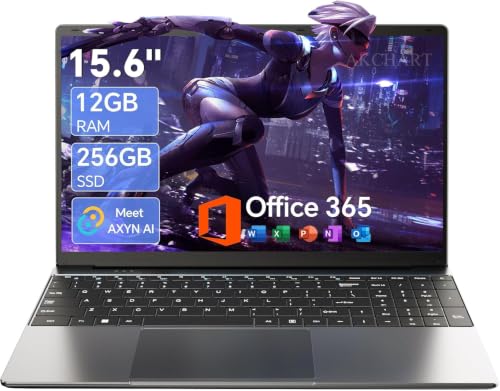
AKCHART 15.6'' AI Laptop with Office 365 12GB RAM 256GB SSD Win 11 Laptops
Picked as a relevant option in this category.
View on AmazonThe AKCHART is the premium pick in this group, and the specification list explains why: a 15.6-inch chassis, 12GB of RAM, a 256GB solid-state drive, Windows 11 and Office 365 bundled together. Where the budget machines ask you to ration browser tabs, 12GB of memory lets you keep a research session, a spreadsheet, a chat client and a video call open at once without the machine paging to disk and stuttering.
It suits the student whose day is genuinely multi-window: a finance or economics student building models, a marketing student running analytics dashboards, a law student with a dozen statutes open, or anyone whose course has moved to browser-based tools that each want their own tab and their own slice of memory. It also suits the student who wants the AI assistant features built into the operating system rather than living in a separate app.
Key specs at a glance
- Display: 15.6-inch class panel — check the listing for the exact resolution and panel type
- Memory: 12GB RAM, comfortably above the 8GB that is the practical floor for modern multitasking
- Storage: 256GB SSD, the sensible minimum for a four-year machine
- Operating system: Windows 11
- Software bundle: Office 365 included
- AI features: assistant tooling positioned as a core feature of the machine
What you are paying the premium for is headroom. A 256GB SSD, once Windows and the bundled Office suite are installed, typically leaves somewhere in the region of 200GB usable — enough for a few years of documents, slides, a photo library and a modest local media collection, though not enough for a large video project archive. The 12GB of RAM is the more consequential number: memory is what determines whether a laptop feels quick in year three, and it is usually the component you cannot add later on thin consumer chassis.
Pros
- 12GB RAM is generous at this size and keeps heavy browser sessions smooth
- 256GB SSD storage is the correct floor for a machine you intend to keep for a degree
- Office 365 included removes an annual subscription from the budget
- Windows 11 with integrated assistant features suits students who want AI help inside the OS
- 15.6-inch footprint keeps the screen large while the internals stay current
Cons
- Premium price tier — you pay noticeably more than the jumper or the HP Stream
- 256GB fills faster than students expect once media projects begin
- AI branding does not translate into extra physical performance; it is a software story
- 15.6-inch machines are not the easiest to use on a lecture-hall lap desk
Against the drkako, the AKCHART’s advantage is memory and a stated SSD capacity: it removes the guesswork about configuration and gives you more headroom for parallel apps. The drkako’s counter-argument is its explicitly FHD IPS panel, which is a visible, everyday benefit. If you cannot confirm the AKCHART’s panel resolution, weigh whether the extra memory is worth an unverified display; for most heavy multitaskers, it is.
3. jumper 15.6″ FHD Laptop – Best Budget All-Rounder

jumper 15.6" FHD Laptop, 12GB RAM 256GB Storage Expandable to 512GB
Chosen because it specifies 12GB RAM 256GB Storage Expandable to 512GB.
View on AmazonOn paper, the jumper is the value play of this entire roundup. The listing states a 15.6-inch FHD display, 12GB of RAM and 256GB of storage that can be expanded to 512GB — a specification set that would have sat in the mid-range tier two years ago, offered here in the budget band. For a student who needs the biggest possible numbers for the smallest possible outlay, this is where the maths works hardest.
It suits first-year students buying their first laptop, students adding a second machine for a shared flat, and anyone whose budget is fixed and unforgiving. It also suits the student who understands that storage is the thing most likely to run out first and wants a machine with a documented expansion path rather than a sealed unit.
Key specs at a glance
- Display: 15.6-inch FHD (1920×1080) — full high definition on a large panel
- Memory: 12GB RAM
- Storage: 256GB as configured, expandable to 512GB
- Form factor: 15.6-inch clamshell
- Expansion: the listing explicitly advertises expansion to 512GB, which is unusual at this tier and worth confirming in the specification section
The strengths are straightforward: a large FHD screen, a memory figure that clears the 8GB comfort threshold with room to spare, and expandable storage. That combination means the machine does not need to be replaced the moment a video project or a game installation eats the drive — you add storage rather than replacing the whole laptop.
Pros
- 12GB RAM and a 15.6-inch FHD panel at the budget price tier
- Storage explicitly expandable to 512GB, which extends the machine’s useful life
- Large screen makes it a comfortable primary machine for writing and research
- Lowest-cost route to a genuinely usable specification in this list
- Straightforward, unfussy design that is easy to live with
Cons
- Budget-tier chassis materials and finish will not match the premium pick
- No bundled Office 365 mentioned in the listing title — budget for software separately
- Panel quality beyond resolution is not specified, so colour accuracy is unknown
- Battery life and weight are not headline claims; expect typical budget-class endurance
Compared with the drkako, the jumper wins on price and on the clarity of its memory and storage figures, and loses on the explicitly IPS panel and included Office 365. If you already have access to a university Office licence, the jumper’s savings are even more compelling. If you do not, add the cost of a productivity suite to the jumper’s price before comparing — the gap narrows considerably.
4. HP Stream 14″ Student & Business Laptop – Best for Cloud-First Light Workloads
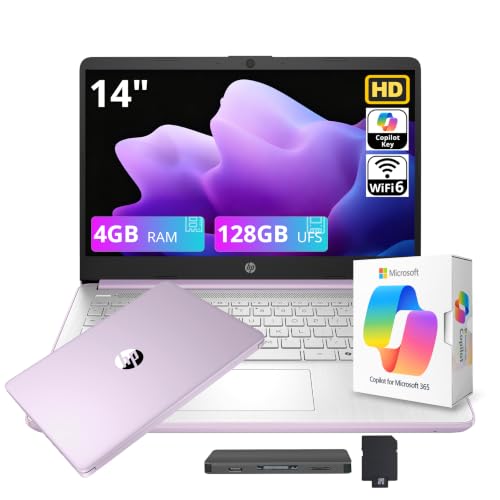
HP Stream 14" HD Student&Business Laptop with AI Copilot, Intel Processor N150, 4GB RAM, 128GB UFS&1TB Cloud Storage, 1 Year Office 365, Intel Graphics, Wi-Fi 6, Win 11, Lavender Purple
Chosen because it specifies Intel Processor N150 and 4GB RAM.
View on AmazonThe HP Stream is the specialist in this group, and the specification list tells you exactly who it is for: a 14-inch HD display, an Intel Processor N150, 4GB of RAM, 128GB of UFS storage and 1TB of cloud storage, with Copilot AI built in. That is a cloud-first machine by design. The modest local storage is offset by a terabyte of online space, which changes how you are expected to work.
It suits the student who genuinely lives in a browser: lecture slides in the cloud, essays saved to OneDrive or Google Drive, note-taking apps that sync rather than store locally. It also suits the commuter who wants a 14-inch, genuinely light machine and is willing to accept less local muscle in exchange. It does not suit a student who edits video, compiles large codebases, plays games or runs desktop statistical packages — 4GB of RAM is the hard constraint here, and no amount of cloud storage fixes it.
Key specs at a glance
- Display: 14-inch HD — a compact panel, roughly 112 pixels per inch at HD resolution, so text is less crisp than on a 15.6-inch FHD screen
- Processor: Intel Processor N150, an entry-tier chip built for efficiency rather than heavy computation
- Memory: 4GB RAM — the practical floor for Windows 11, adequate for a handful of light apps and browser tabs
- Storage: 128GB UFS, plus 1TB of cloud storage included
- AI features: Copilot AI integrated
- Form factor: 14-inch chassis, the most portable size class in this roundup
The real strength is the combination of price, size and cloud capacity. A 14-inch laptop disappears into a bag in a way a 15.6-inch machine does not, and 1TB of online storage is far more space than most students will ever fill with documents. The N150 processor is efficient, which helps endurance on a small chassis, and Copilot integration puts AI assistance one keystroke away.
Pros
- 14-inch form factor is the most portable option here
- 1TB of cloud storage included effectively removes the local-storage squeeze for document-based work
- Efficient Intel N150 processor suits all-day light use
- Copilot AI is integrated into the operating environment
- Budget price tier — the cheapest way into a brand-name 14-inch machine in this list
Cons
- 4GB RAM is limiting; several heavy browser tabs plus a video call will slow it down
- 128GB of local storage is small, and UFS is slower than a conventional SSD
- 14-inch HD resolution means less screen area and lower pixel density than the 15.6-inch FHD options
- Not suitable for video editing, gaming, large code builds or desktop statistical software
- Cloud storage is only as good as your campus Wi-Fi
Against the other 14-inch machine in this list, the HP 14″ Student & Business Productivity Laptop, the Stream’s distinguishing feature is that 1TB cloud allocation and the Copilot integration, while the other HP leans on MS Office and Windows 11 Pro. If you work almost entirely online and want the smallest bag footprint, the Stream is the better fit. If you want local productivity software and a Pro edition of Windows, the other HP 14-inch is the stronger choice.
5. SAGAWHALE 2026 Windows 11 Pro Laptop – Best for Business and Office-Style Coursework
SAGAWHALE 2026 Window 11 Pro Traditional Laptop Computer, 16GB RAM 256GB SSD for Business Student School College, 15.6" FHD IPS Display, Lightweight Portable, 4H Battery, 3.5 lbs
Chosen because it specifies 16GB RAM 256GB SSD for Business Student School College and 15.6" FHD IPS Display.
View on AmazonThe SAGAWHALE is the memory leader of this group: 16GB of RAM and a 256GB SSD running Windows 11 Pro. Sixteen gigabytes is a serious figure for a student machine. It is the amount of memory that lets you keep a virtual machine, a development environment, a large spreadsheet model and a video call running simultaneously without the machine gasping. Windows 11 Pro also brings features that matter in a business or placement context — BitLocker device encryption, Remote Desktop, and domain-join capability that some university and internship IT departments expect.
It suits the student on a business, accounting, computer science or engineering-adjacent course where placement years, remote access and heavier desktop software are part of the plan. It also suits the student who wants to buy once and not think about memory again for four years. The listing title does not state the screen size, so confirm that on the product page before ordering — the RAM, storage and operating system edition are the headline claims, not the panel.
Key specs at a glance
- Memory: 16GB RAM — the highest in this roundup, and the most future-proof figure on the list
- Storage: 256GB SSD
- Operating system: Windows 11 Pro, including encryption and remote-access tooling
- Display: not stated in the listing title — verify size and resolution on the product page
- Positioning: described as a traditional laptop computer for business, student and school use
Sixteen gigabytes of memory is the single most useful specification here for anyone running virtual machines, containers, large datasets or professional-grade spreadsheet models. It is also the component that most often forces an early laptop replacement: a machine that felt fine with 8GB in year one can feel sluggish in year three as software requirements creep upward. Buying 16GB now is the cheapest way to avoid that upgrade.
Pros
- 16GB RAM is the most headroom in this comparison and comfortably supports virtual machines and heavy models
- Windows 11 Pro adds encryption and remote-desktop features useful for placements and internships
- 256GB SSD is a sensible baseline for a machine intended to last a full degree
- Mid-range price tier rather than premium, despite the memory advantage
- Traditional laptop design is straightforward to live with and repair-friendly in principle
Cons
- Screen size and resolution are not stated in the listing title, which is a real gap for a laptop purchase
- 256GB storage can fill quickly if you keep large local datasets or media projects
- No bundled Office 365 mentioned, so budget for productivity software separately
- Battery capacity and weight are not specified; assume typical mid-range figures
Compared with the AKCHART, the SAGAWHALE offers 16GB of memory instead of 12GB and a Pro edition of Windows, but drops the bundled Office 365 and the AI-branded feature set. If your course involves virtual machines or you want the longest possible service life from the memory you buy, the SAGAWHALE’s 16GB is worth more than the AKCHART’s software bundle. If you would rather have Office included and a more clearly specified display, the AKCHART is the safer pick.
6. HP 14″ Student & Business Productivity Laptop – Best Portable Budget Option
HP 14" Laptop Computer for 2026 Student Business Productivity, MS Office & Win 11 Pro, Copilot AI, Intel 4-Core CPU, 4GB DDR5 RAM, 628GB Storage (128GB UFS+500GB Ext), Wi-Fi 6, HubxcelAddon, Lavender
Chosen because it specifies MS Office & Win 11 Pro and Copilot AI.
View on AmazonThis second HP entry is the productivity-focused 14-inch option: an Intel 4-core processor, MS Office included, Windows 11 Pro and Copilot AI, in a 14-inch chassis at the budget tier. Where the HP Stream leans on cloud storage, this machine leans on local software and a Pro operating system, which changes who it is for.
It suits the student who wants a light 14-inch laptop but does not want to depend on campus Wi-Fi for basic productivity. With MS Office installed locally and Windows 11 Pro on board, it works on a train, in a library with flaky signal, or on a plane without a subscription or a connection. It is the pick for the commuter student, the mature student balancing study with a job, and anyone whose course expects documents delivered in native Office formats.
Key specs at a glance
- Display: 14-inch panel — compact and portable, though check the resolution on the listing
- Processor: Intel 4-core processor — confirm the exact model and generation on the product page
- Software: MS Office included, plus Windows 11 Pro
- AI features: Copilot AI integrated
- Form factor: 14-inch chassis, the lightest class in this comparison
- Memory and storage: not stated in the listing headline — verify before purchase, since this determines the machine’s ceiling
The value story is the software stack. A locally installed Office suite plus a Pro edition of Windows at the budget tier removes two recurring costs, and Windows 11 Pro’s encryption and remote-desktop features are genuinely useful if your university or employer expects them. A 4-core Intel processor in a 14-inch chassis is also a reasonable efficiency proposition: fewer cores at lower power generally means quieter fans and steadier battery drain for word processing, browsing and video calls.
Pros
- MS Office included locally, so productivity does not depend on an internet connection
- Windows 11 Pro adds encryption and remote-desktop capability at a budget price
- 14-inch chassis is easy to carry between classes, library and home
- Intel 4-core processor is well matched to document and browser workloads
- Copilot AI integration is included
Cons
- Memory and storage are not stated in the listing title — a genuine unknown until you check
- 14-inch screens usually mean a smaller working area than 15.6-inch machines
- No dedicated graphics, so gaming and video editing are out of scope
- Budget-tier build quality typically means more flex in the lid and deck over time
Against the HP Stream, this machine wins on local software and operating system edition and loses on the 1TB cloud allocation. The decision is simple: if you work offline and want Office installed, choose this one; if you work in a browser and want maximum cloud capacity plus the lighter specification, choose the Stream. Against the 15.6-inch jumper, the trade is screen area for portability — and if you carry a laptop every day, that trade is often worth making.
How to Choose
Student laptop buying goes wrong in predictable ways. People over-index on the processor, under-index on memory and screen, and forget that the machine has to survive four years of being carried around in a bag. Here is the order in which to make the decision, with the numbers that actually matter.
Start with screen size, because you cannot change it later
Screen size is the one specification with no upgrade path. A 14-inch panel is the portable sweet spot: light enough to carry every day, large enough for one document at a time. A 15.6-inch FHD panel is the productivity sweet spot, giving you roughly 141 pixels per inch and enough width to place two windows side by side at readable sizes. Anything above 16 inches is a desktop replacement that most students will resent carrying by week six.
Resolution matters as much as size. A 14-inch HD panel works out to around 112 pixels per inch, while a 15.6-inch FHD panel delivers around 141. That difference is visible in small text, and it is the difference between reading a PDF comfortably and zooming in constantly. If you have a choice between a larger HD screen and a slightly smaller FHD screen, take the FHD panel.
Treat 8GB of RAM as the floor and 16GB as the ceiling worth paying for
Windows 11 will run in 4GB, but it will not run well with a browser open. For a machine you intend to keep for three or four years, the practical tiers are:
- 4GB: light, single-purpose use — one or two apps at a time, cloud-first workflows
- 8GB: the realistic minimum for a general student — browser, word processor, video call simultaneously
- 12GB: comfortable multitasking, several heavy browser tabs plus a spreadsheet and a call
- 16GB: virtual machines, development environments, large data models, professional software
Memory is usually soldered on thin consumer laptops, which means the figure you buy is the figure you keep. This is why 12GB and 16GB machines are worth their premium: they are buying you years, not benchmarks.
Size storage against your coursework, not your habits
Windows itself occupies somewhere around 25–30GB once updates are applied. A full Office suite adds several gigabytes. After that, the numbers are yours to control: a 4K video project can run to tens of gigabytes, a photo library to hundreds. The practical tiers are 128GB (tight — work in the cloud or add external storage), 256GB (the sensible baseline for a degree), and 512GB or more (comfortable, especially with media work). Check whether storage is expandable: the jumper’s advertised path to 512GB is a meaningful long-term advantage, because adding a drive later costs far less than replacing the machine.
Calculate battery endurance rather than trusting a marketing claim
Battery life is capacity divided by average power draw. A 38Wh battery drawing an average of 8W gives you roughly 4.75 hours; the same battery drawing 6W gives you a little over 6 hours; a 50Wh battery at 7W gives you about 7 hours. Screen brightness is the biggest lever you control — running at 60% brightness instead of 100% can extend runtime by a third or more. If your timetable includes back-to-back lectures in rooms with few power sockets, a 14-inch efficient machine will usually outlast a larger, brighter 15.6-inch one.
Budget in bands, and think in cost per academic year
Student laptops generally fall into three bands: budget (broadly under a few hundred), mid-range (roughly the middle hundreds), and premium (upper hundreds and beyond). A useful habit is to divide the purchase price by the number of years you expect to use the machine. A mid-range laptop that lasts four years costs a quarter of its price per year; a budget machine that needs replacing after two costs half its price per year. Add the value of bundled software: an included Office 365 licence removes a recurring annual cost, which can shift the comparison between two machines by more than the price gap between them.
Check the upgrade and repair path before you buy
Ask three questions. Can I add storage? Is the memory soldered? Is the battery replaceable? A machine with a user-accessible M.2 slot and a removable battery is a machine you can keep for five years rather than three. On a laptop that gets carried daily, the parts that wear first are the hinge, the charging port and the battery itself — a battery typically manages several hundred charge cycles before capacity drops noticeably, which is roughly two to four years of daily use. Treat the battery and the charger as consumables you will replace once during a degree.
Match the machine to the situation
| Your situation | Screen | RAM | Storage | Notes |
|---|---|---|---|---|
| Essays, reading, video lectures only | 14″ or 15.6″ FHD | 8GB | 256GB | Spend the saved money on a second monitor |
| Heavy browser multitasking, research papers | 15.6″ FHD | 12GB | 256GB | Memory matters more than processor here |
| Coding, virtual machines, data science | 15.6″ FHD | 16GB | 256GB+ | Storage expansion or external drive recommended |
| Design, photo editing | 15.6″ FHD IPS | 12–16GB | 512GB or expandable | Panel quality and colour coverage are the priority |
| Daily commute with a full bag | 14″ | 8GB | 128–256GB | Weight and charger size are the deciding factors |
| Cloud-first, minimal local files | 14″ HD or FHD | 4–8GB | 128GB + cloud | Confirm campus Wi-Fi coverage before committing |
| Four-year programme, buy once | 15.6″ FHD | 12–16GB | 256GB+ expandable | Prioritise memory and repairability over thinness |
Do not ignore the software and operating system edition
Windows 11 Pro versus Home matters less than people assume for everyday study, but it matters for encryption, remote desktop and any institution that expects domain joining. A bundled Office suite matters a great deal: over four years, the subscription cost of a productivity suite can approach the price gap between a budget and a mid-range laptop. When two machines are close on hardware, the one with software included is usually the better financial decision.
Common mistakes worth avoiding
- Buying 4GB of RAM for a four-year course because the price looked good
- Choosing 128GB of local storage without confirming there is an expansion slot
- Prioritising processor model numbers over memory and screen, which are the parts you actually feel
- Ignoring weight until the first week of carrying it across campus
- Assuming a bundled cloud allocation replaces local storage when you have unreliable Wi-Fi
- Skipping the warranty and repair question until the hinge fails in month eighteen
Frequently Asked Questions
Is 4GB of RAM enough for a student laptop in 2026?
It is enough for cloud-first work where the heavy lifting happens in a browser and files live online, which is exactly what the HP Stream is designed for. It is not enough for comfortable local multitasking: a video call plus a spreadsheet plus several browser tabs will expose the limit quickly. If your course runs four years and involves any local software, aim for 8GB at minimum and 12GB or 16GB if the budget allows.
Should I choose a 14-inch or a 15.6-inch screen?
Choose 14 inches if you carry the laptop every day and mostly work on one document at a time; the smaller chassis is meaningfully easier on your shoulders and your bag. Choose 15.6 inches if you regularly work with two windows side by side, read dense PDFs, or use the laptop as your primary screen at a desk. Resolution matters as much as size — a 15.6-inch FHD panel is noticeably crisper than a 14-inch HD panel.
Is 256GB of storage enough, or should I look for expandable storage?
256GB is the sensible baseline for a degree: after the operating system and Office, you typically have around 200GB for your own files, which covers documents, slides and a reasonable photo collection. If your course involves video, audio or large datasets, prioritise a machine with an expansion slot — the jumper’s advertised path to 512GB is the kind of flexibility that extends a laptop’s useful life by a year or more.
How much does a bundled Office 365 licence actually change the value?
It removes a recurring annual cost that most students would otherwise pay for word processing, spreadsheets and presentations. Over four years that adds up to a meaningful sum — often enough to close the price gap between a budget machine and a mid-range one. When two laptops are otherwise close on specifications, the one with productivity software included is usually the better long-term purchase.
Do I need Windows 11 Pro, or is Home fine?
For most students, Home is fine: browsing, writing, streaming and video calls all work identically. Pro becomes relevant if you need device encryption, remote desktop access, or your university or placement employer expects domain joining. If a Pro machine is only slightly more expensive and the hardware is otherwise comparable, it is a reasonable upgrade rather than a necessity.
How long should a student laptop last?
With 12GB or 16GB of RAM and a 256GB SSD, three to five years is a realistic expectation. The components that limit lifespan are memory and storage, because neither can usually be added to a sealed chassis; the components that wear out are the battery, the hinge and the charging port. Buying more memory than you need today is the cheapest way to extend the machine’s useful life.
Can I upgrade the RAM or storage on these laptops later?
Storage is sometimes upgradeable and memory usually is not on thin consumer machines. The jumper explicitly advertises storage expansion to 512GB, which is a genuine advantage; most 14-inch budget machines solder memory in place. Before buying, check the specification section for an M.2 slot and for whether the memory is described as soldered or replaceable.
Is a 128GB UFS drive a problem compared with a 256GB SSD?
Yes, in two ways. It holds less, and UFS storage is generally slower than a conventional solid-state drive, which shows up in boot times and large file transfers. The HP Stream offsets this with 1TB of cloud storage, which works well if your campus connectivity is reliable and your files are documents rather than media. If you work offline or handle large files, a 256GB SSD is the better foundation.
The Short Version, by Situation
If you want one machine that handles a normal degree without compromises, take the drkako 15.6″ FHD IPS Student Laptop: the 1080p IPS panel and included Office 365 are the two things you will notice every single day. If money is the binding constraint and you want the biggest numbers for the least outlay, the jumper 15.6″ FHD Laptop gives you 12GB of RAM, a 15.6-inch FHD screen and storage that expands to 512GB. If your coursework involves virtual machines, development environments or large data models, the SAGAWHALE’s 16GB of RAM is the specification that will still feel adequate in year four, and the AKCHART’s 12GB with a 256GB SSD and Office 365 is the balanced premium alternative. If you carry your laptop everywhere and work mostly in a browser, the HP Stream 14″ is the lightest way to do it, with 1TB of cloud storage covering the small local drive. And if you want portability plus locally installed Office and Windows 11 Pro, the HP 14″ Student & Business Productivity Laptop is the sensible middle path. Whichever you choose, spend your attention on memory, storage and screen before you spend it on processor model numbers — those three decide how the laptop feels in year three.










Write Your Review
No reviews yet. Be the first to share your experience!