
Our Top Picks
The best roman shades are chosen by matching fabric opacity, mounting style, and measured window depth to the room’s light, privacy, and clearance needs—not by appearance alone.
Best Roman Shades by Room and Situation
| Room or priority | Best shade type | Recommended opacity | Mounting choice | Why it fits |
|---|---|---|---|---|
| Bedroom | Blackout or room-darkening roman shade | 90–100% light reduction | Outside mount when possible | Reduces early-morning light and covers edge gaps better |
| Living room | Light-filtering woven or lined shade | 50–75% light reduction | Inside mount for a built-in look | Softens glare without making the room feel closed in |
| Bathroom | Moisture-resistant synthetic fabric | 70–90% privacy | Inside or shallow outside mount | Handles humidity better than many natural-fiber fabrics |
| Kitchen | Washable polyester or performance fabric | 40–70% light reduction | Inside mount away from the sink and cooktop | Less vulnerable to splashes, grease, and frequent cleaning |
| Shallow window recess | Flat or relaxed roman shade with a compact headrail | Light-filtering to blackout | Outside mount | Avoids interference with the glass, locks, or window operation |
| Large or frequently used window | Relaxed or cascading roman shade with reinforced construction | 50–100% light reduction | Outside mount or divided into two shades | Controls weight and makes operation easier |
Fabric Opacity: Sheer, Light-Filtering, or Blackout?
Opacity describes how much light passes through the shade, while privacy depends on the fabric’s weave, lining, and the difference between indoor and outdoor light. A shade can look opaque during the day yet reveal silhouettes at night when lights are on indoors.
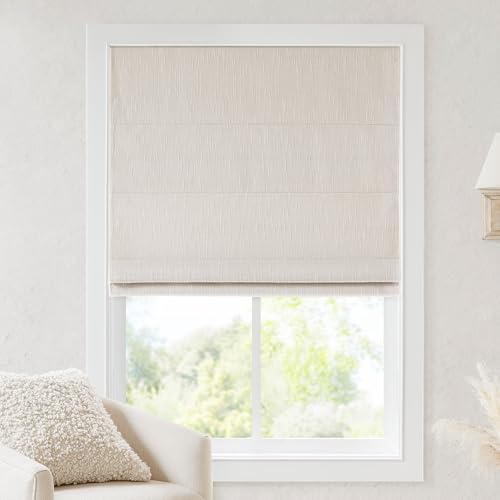
Madison Park Roman Shade, Blackout Blinds Thermal Insulated, 34x64 Linen
Chosen because it specifies Blackout Blinds Thermal Insulated and 34x64 Linen.
View on Amazon
LazBlinds Cordless Bamboo Roman Shades, 34x64, Highfield Teak
Chosen because it specifies 34x64 and Highfield Teak.
View on Amazon
Chicology Cordless Roman Window Shade, Belgian Flax, 34"W x 64"H
Chosen because it specifies Belgian Flax and 34"W x 64"H.
View on Amazon
LazBlinds No Drill Roman Shades, Blackout, 30" W x 64" H, Beige
Chosen because it specifies Blackout and 30" W x 64" H.
View on AmazonSheer and semi-sheer fabrics
Sheer roman shades provide a softer view and diffuse direct sunlight, but they offer limited nighttime privacy. They work well in formal living rooms, dining rooms, and windows that face a private garden. Choose them when preserving daylight matters more than blocking glare or views.
Light-filtering fabrics
Light-filtering shades typically reduce glare while retaining a visible glow from the window. They are a practical middle choice for living rooms, home offices, and nurseries where complete darkness is not required. A white or pale lining can reflect more heat and maintain a brighter appearance; a darker fabric usually gives stronger visual contrast and can reduce perceived glare.
Room-darkening and blackout fabrics
Room-darkening fabrics substantially reduce incoming light but may still allow a bright outline around the shade. Blackout fabric or blackout lining blocks the fabric area more completely. For the best result, pair it with an outside mount that extends beyond the window on all sides. Even then, small gaps at the edges can admit light unless the shade uses side channels or overlapping coverage.
For a bedroom window 36 inches wide, an outside-mounted shade that extends 2 inches beyond each side covers 40 inches of width. If the shade is mounted 3 inches above the frame and extends 3 inches below it, it covers 6 additional inches of vertical perimeter. These modest extensions often improve darkness more than upgrading from one opaque fabric to another.
Inside Mount vs. Outside Mount
Choose an inside mount for a tailored appearance
An inside mount sits within the window recess and leaves the trim visible. It is usually the cleaner choice when the recess is deep, square, and unobstructed. Measure the narrowest width at the top, middle, and bottom; use the smallest measurement so the shade does not bind. Do not subtract an extra amount from a made-to-measure order unless the manufacturer specifically instructs you to.
Check the minimum recess depth before ordering. Many roman shade headrails need approximately 2 to 3 inches of depth, while some fabric folds require additional clearance when raised. A shallow recess, inward-opening window, handle, or crank can make an inside mount impractical.
Choose an outside mount for coverage and flexibility
An outside mount attaches to the wall or window trim above the opening. It is usually better for blackout performance, shallow recesses, uneven frames, and windows with hardware that would obstruct the shade. It also makes a small window look larger when the shade extends beyond the frame.
A useful starting point is to add 2 to 3 inches to each side and 3 to 6 inches above the frame. Increase the side overlap when privacy and darkness are priorities, but first confirm that nearby doors, cabinet fronts, and adjacent windows still open freely.
How to Measure Roman Shades Correctly
- Inspect the window. Identify the trim, recess, handles, locks, radiator, nearby wall, and any inward-opening sash.
- Measure width in three places. Record the top, middle, and bottom dimensions. For an inside mount, use the narrowest width.
- Measure height in three places. Use the shortest height for an inside mount so the bottom does not drag on the sill.
- Measure the recess depth. Include only clear, usable depth—not the part occupied by handles or molding.
- Choose the finished dimensions. For an outside mount, calculate the desired coverage rather than copying the glass size.
- Check the raised stack. The folded shade may cover 8 to 14 inches of glass on a typical window, and larger shades can stack higher. Confirm that the raised shade will not block a view or collide with a transom.
Example: a recess measures 35 1/2, 35 5/8, and 35 3/4 inches wide. For an inside mount, the order width should normally be based on 35 1/2 inches, subject to the maker’s deduction policy. If you want an outside mount with 2 1/2 inches of overlap on each side, the target finished width is 40 1/2 inches.
Roman Shade Styles Compared Head-to-Head
| Style | Appearance when lowered | Raised stack | Best use | Main drawback |
|---|---|---|---|---|
| Flat fold | Clean, broad fabric panels | About 8–12 inches | Modern rooms and patterned fabrics | Creases and imperfections are more visible |
| Classic fold | Regular horizontal folds | About 10–14 inches | Traditional rooms and frequent raising | Uses more fabric and can cost more |
| Relaxed fold | Soft curved bottom edge | About 9–13 inches | Bedrooms and casual living spaces | May look uneven on very wide windows |
| Hobbled or cascading fold | Layered folds with more depth | About 12–18 inches | Decorative rooms and tall windows | Heavier, bulkier, and harder to clean |
Flat folds generally suit a minimalist interior, while classic and cascading folds disguise minor fabric variation more effectively. On a wide window, two narrower shades can hang more evenly than one oversized shade, although a split creates a center gap and may increase the total cost.
Decision Matrix: Which Shade Should You Buy?
| Your priority | Recommended specification | Trade-off |
|---|---|---|
| Lowest cost | Standard-size polyester, light-filtering, inside mount | Fewer size and lining choices |
| Maximum darkness | Blackout lining, outside mount, generous side overlap | More visible hardware and a larger raised stack |
| Beginner installation | Lightweight shade with included brackets and simple cordless lift | May have fewer fabric and width options |
| High-use window | Reinforced headrail, durable lift mechanism, washable synthetic fabric | Usually costs more than a decorative, low-use shade |
| Small room | Light-colored flat fold with inside mount | Less dramatic texture and limited blackout coverage |
| Large room or wide window | Room-darkening shade divided into balanced sections | Center seams or separate controls |
Durability, Cleaning, and Ownership Costs
The lift mechanism and mounting brackets usually determine service life before the fabric does. Repeatedly pulling at an angle, raising a shade while an object obstructs it, or allowing a heavy shade to slam down can strain cords, loops, and clutch components. Cordless shades reduce dangling-cord hazards and are especially suitable for homes with children or pets; follow the manufacturer’s installation and operating instructions.
Dust fabric with a soft brush or low-suction upholstery attachment. Do not soak a lined roman shade unless its care label permits washing, because moisture can distort folds, loosen adhesive, or cause the lining to separate. In kitchens and bathrooms, clean small marks promptly with a barely damp cloth and mild detergent, then allow the shade to dry fully while lowered.
Budget for brackets, extension hardware, professional installation, and premium lining when comparing prices. General market pricing can range from roughly $50–$150 for basic ready-made shades to $200–$800 or more for larger custom shades with specialized fabric, blackout lining, or motorization. A very wide window may require two shades, which can cost more but reduce weight and improve alignment.
Final Buying Checklist
- Decide whether the room needs privacy, glare control, darkness, or all three.
- Confirm the fabric’s actual opacity and lining rather than relying on the color alone.
- Measure width, height, and recess depth at multiple points.
- Choose inside mount for a neat recess fit and outside mount for better coverage or limited depth.
- Check the raised stack, nearby handles, doors, cabinets, and adjacent windows.
- Use moisture-resistant, washable fabric in humid or messy rooms.
- Select reinforced hardware for wide or frequently operated shades.
- Verify the return and made-to-measure policies before submitting dimensions.
For most homes, the best roman shades are light-filtering polyester or woven fabric in living areas, blackout-lined shades mounted outside the frame in bedrooms, and washable moisture-resistant fabric in kitchens and bathrooms. Accurate measurements and sufficient overlap matter as much as the fabric choice, because a well-fitted mid-range shade usually performs better than a premium shade that is too narrow, too shallow, or blocked by the window hardware.




Write Your Review
No reviews yet. Be the first to share your experience!