
Our Top Picks
Best Balanced-Output Portable DAC Amplifiers in 2026
For the best balance of pocket size, useful power, and broad device support, choose the Qudelix-5K; choose the FiiO BTR15 for more output and a screen, or the iFi hip-dac 3 if you want a larger battery-powered unit for demanding wired headphones. A balanced socket alone does not guarantee better sound: match the amplifier’s power and noise floor to your headphones, and check that your source can deliver the formats and connection you need.
What matters when you buy
Balanced outputs—usually 2.5 mm or 4.4 mm—use separate amplifier paths for each channel. Compared with the same device’s single-ended output, they can provide more voltage or power. That can help with inefficient headphones, but it is not an automatic sound-quality upgrade. You need headphones with a compatible balanced cable; adapters do not convert a single-ended headphone cable into a balanced one.
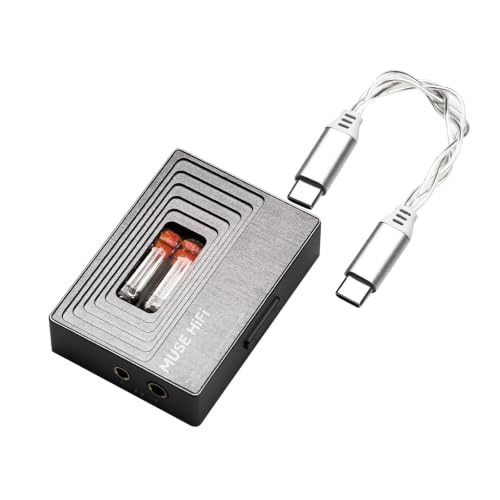
HiFiGo MUSEHiFi M3 Ultra Portable Tube DAC Amp with JAN6418 Vacuum Tube, 460mW/480mW Balanced Output, USB C Dongle DAC for IEMs & Headphones, Amplifier for Phone/PC/Mac
Chosen because it specifies 460mW/480mW Balanced Output and USB C Dongle DAC for IEMs & Headphones.
View on Amazon
MOONDROP Dawn PRO 2 Decoder Headphone Amplifier 3.5/4.4 Phone Out Dual CS43198 32Bit/384KHz DSD256 Portable USB DAC/AMP
Picked as a relevant option in this category.
View on Amazon
TRN Black Pearl USB-C DAC Amp, Dual CS43131 Portable Headphone Amplifier
Chosen because it specifies Dual CS43131 Portable Headphone Amplifier.
View on Amazon
TempoTec Sonata BHD Portable USB DAC& dongle,3 Adjustable gain Level, 4.4mm&3.5mm, Volume Button,for Android,iOS,MAC,Windows Portable DAC Amp
Chosen because it specifies 3 Adjustable gain Level and 4.4mm&3.5mm.
View on Amazon- Power: Published output figures depend on load and connection. Compare figures at a similar impedance, and leave headroom rather than buying on the biggest number alone.
- Formats: Check the maximum PCM and DSD rates if you use high-resolution files. For everyday streaming, reliable app and operating-system compatibility often matters more than extreme format support.
- Battery: Bluetooth and high output can shorten runtime. USB-powered models avoid charging a separate battery but draw power from the connected device.
- Noise: Sensitive in-ear monitors can reveal hiss that is inaudible with larger headphones. A low gain setting and a clean, low-noise output matter more than headline power.
- Size and controls: A tiny Bluetooth receiver is convenient on a walk; a larger USB DAC may be easier to operate and better suited to a desk or bag.
Shortlist by listening situation
| Model | Balanced output | Size and weight | Battery or power | Best fit |
|---|---|---|---|---|
| Qudelix-5K | 2.5 mm; up to about 240 mW + 240 mW at 32 ohms | About 52 × 26 × 16 mm; about 25 g | Built-in battery; roughly 6–20 hours depending on use | Small Bluetooth receiver, app-based EQ, commuting |
| FiiO BTR15 | 4.4 mm; up to about 340 mW + 340 mW at 32 ohms | About 72 × 32 × 13 mm; about 37 g | Built-in battery; roughly 8–9 hours over Bluetooth | More output, screen and physical controls |
| iFi hip-dac 3 | 4.4 mm; up to about 400 mW at 32 ohms | About 102 × 70 × 14 mm; about 135 g | Built-in battery; up to about 12 hours, depending on load | Wired listening and harder-to-drive headphones |
| FiiO KA17 | 4.4 mm; up to about 650 mW + 650 mW at 32 ohms in desktop mode | About 64 × 27 × 13 mm; about 33 g | No internal battery; powered by the source or external USB supply | High output in a compact wired DAC, with suitable power |
Figures are manufacturer-published specifications and may vary by operating mode, firmware, load, and region. Battery estimates are not directly comparable: volume, codec, screen use, and headphone demand all affect runtime. Check current manuals before purchase, especially if a specific output level or file format is essential.
Qudelix-5K: best for a clipped-on everyday setup
The 5K is the sensible pick when you want a compact Bluetooth DAC, app control, and a balanced jack without carrying a phone-sized battery pack. It supports USB DAC use as well as Bluetooth, and its companion app gives detailed equalizer and device controls. Its 2.5 mm connector is less common than 4.4 mm, so check your cable before ordering. Choose it for efficient headphones and portable convenience, not as a guarantee that every full-size headphone will reach a satisfying level.
FiiO BTR15: best for controls and a 4.4 mm connection
The BTR15 offers a screen, buttons, USB DAC operation, and Bluetooth in a still-pocketable body. Its 4.4 mm balanced socket is a practical advantage if your headphones already use that connector. Compared with the 5K, it is a better fit for someone who values onboard status and direct controls over the smallest possible clip-on receiver. Expect battery life to depend heavily on whether you use Bluetooth or USB and how loudly you listen.
iFi hip-dac 3: best for a bag-based wired rig
The hip-dac 3 is larger and heavier than the Bluetooth receivers, but its internal battery means it does not need to draw operating power from a phone or laptop in the same way a USB-only dongle does. It is aimed at wired listening, with a 4.4 mm balanced output and physical volume control. Pick it for a backpack or desk setup with more demanding headphones; skip it if your priority is a light, unobtrusive device for a pocket.
FiiO KA17: best when you need wired power, not a built-in battery
The KA17 is a compact USB DAC and amplifier rather than a Bluetooth receiver. Its desktop mode can raise output substantially, but that mode requires an adequate external power supply. This is a useful solution for a laptop or a powered portable setup, not a free increase in phone-friendly performance. Confirm that your phone, cable, and any required adapter support USB audio, and account for the extra power draw.
Choose by your actual use
| Your situation | Good starting point | Why |
|---|---|---|
| Frequent walks, light headphones, minimal pocket bulk | Qudelix-5K | Small Bluetooth receiver with a built-in battery |
| You want physical controls and already own a 4.4 mm cable | FiiO BTR15 | Screen and buttons make quick adjustments easier |
| Mostly wired listening from a bag or desk | iFi hip-dac 3 | Internal battery and a larger control surface |
| High output is essential and an external USB supply is acceptable | FiiO KA17 | Desktop mode offers additional power without a built-in battery |
Compatibility and setup checks that prevent disappointment
Before choosing a model, verify four things: the headphone’s connector, the source device’s USB audio support, the Bluetooth codecs you can actually use, and whether your preferred app can control the DAC. A codec listed on the receiver only helps if the phone supports that same codec. On iPhones and many Android devices, a wired USB connection may require a suitable adapter; some phones may also need settings changed to allow USB audio.
For a balanced setup, use a properly wired balanced headphone cable that matches the DAC’s socket. Do not plug a balanced output into an incompatible single-ended adapter: the wiring can short amplifier outputs and potentially damage equipment. Start at low volume, particularly after switching outputs or gain modes, and raise it gradually.
Noise, battery, and ownership realities
If you use sensitive in-ear monitors, listen between tracks at your normal gain setting before deciding that an amplifier is quiet enough. A little background hiss can be more noticeable than any difference in maximum power. Low gain, a lower volume setting on the DAC, or a different model with a quieter output may solve the issue. Avoid compensating for hiss by turning the source volume to an extreme.
Portable units mostly wear through connectors, cables, and batteries rather than through routine audio use. Reduce strain on the USB port by unplugging at the connector rather than pulling the cable, and store the device where its volume controls cannot be pressed accidentally. Keep charging and headphone sockets free of lint and moisture; use a dry, soft brush rather than liquid cleaners. For a Bluetooth receiver, remember that wireless convenience trades some runtime for fewer cables, while wired USB use may consume the phone’s battery.
Prices vary by region and retailer, so treat these models as feature tiers rather than fixed-value rankings: compact Bluetooth units generally sit in the lower-to-mid portable DAC range, while higher-output or more feature-rich models cost more. The best buy is the least bulky option that provides enough clean output for your headphones, works reliably with your devices, and lasts through your typical listening day.










Write Your Review
No reviews yet. Be the first to share your experience!