
Key takeaways
- Alternating waves: Move arms independently for steady, sustainable conditioning.
- Double waves: Slam both arms together for explosive power and higher intensity.
- Rope slams: Raise both ends overhead and slam down hard to engage the whole body.
- Side-to-side waves: Sweep the ropes laterally to challenge your obliques and grip.
What's inside
Battle ropes look simple, but they deliver one of the most demanding full-body conditioning workouts you can do. Every wave, slam, and spiral fires your shoulders, core, and legs while spiking your heart rate within seconds. Used correctly, a battle rope builds grip strength, muscular endurance, and cardiovascular fitness all at once, with almost no impact on your joints.
This guide covers anchoring, proper form, the most effective wave patterns, and how to program battle rope work into your week. Whether you own a 30-foot rope or a compact ropeless trainer, you will learn how to get the most out of every explosive interval.
As an Amazon Associate we earn from qualifying purchases at no extra cost to you. Product prices and availability are accurate as of the date shown and are subject to change.




⚡ Save on Your Next PC — Amazon Prime
Prime members get fast free shipping on the systems above, plus early access to Prime Day & Black Friday PC deals. New members get a 30-day free trial.
Watch: How to Use a Battle Rope Effectively for Full-Body Conditioning — Video Review
Anchor and Set Up Correctly
A battle rope needs a solid anchor point. Loop the rope’s midpoint around a heavy kettlebell, a squat rack post, or a dedicated wall anchor, and step back until only a slight slack remains. Most ropes run 30 to 50 feet; a 30-foot rope like the 1.5-inch weighted training ropes gives you plenty of wave amplitude for a home setup, while a 50-foot rope adds more challenge for larger spaces.
Master the Basic Wave
Stand in an athletic stance, knees soft, hips hinged slightly, and grip one end in each hand. Drive the ropes up and down rapidly, keeping the waves even and continuous. The power comes from your legs and hips, not just your arms. Keep your core braced and your spine neutral throughout.
Progress Through Wave Variations
- Alternating waves: Move arms independently for steady, sustainable conditioning.
- Double waves: Slam both arms together for explosive power and higher intensity.
- Rope slams: Raise both ends overhead and slam down hard to engage the whole body.
- Side-to-side waves: Sweep the ropes laterally to challenge your obliques and grip.
Program Effective Intervals
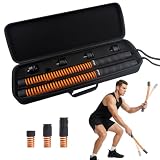
Battle ropes shine in short, intense bursts. Try 10 rounds of 20 seconds of work with 40 seconds of rest, or work them into a circuit between strength movements. Keep sessions to 10 to 20 minutes; the intensity makes longer durations counterproductive. A ropeless option like the ATIVAFIT Ropeless Battle Rope with adjustable weight blocks lets you train the same patterns in tight spaces without a long rope.
Tips
- Drive power from your hips and legs, not just your arms, to sustain waves longer.
- Keep a slight bend in your knees to protect your back and stay athletic.
- Use a rope sleeve to reduce fraying if you anchor around abrasive surfaces.
- Film yourself once to check that your waves stay even and your posture stays tall.
Frequently Asked Questions
What length battle rope should I buy?
A 30-foot rope suits most home gyms, while 50-foot ropes add intensity and need more space. Thickness of 1.5 inches is the standard, versatile choice.
How heavy is a battle rope workout?
Very. Even fit athletes are breathing hard after a few 20-second rounds, because the ropes recruit large muscle groups continuously.
Can I use a battle rope indoors?
Yes, if you have an anchor and clearance. For tight spaces, a ropeless battle rope trainer replicates the movement without the long rope.
How often should I train with battle ropes?
Two to four short sessions a week is plenty. Because the intensity is high, quality intervals beat long, drawn-out workouts.
Conclusion
Battle ropes turn a few square feet and 20-second bursts into a complete conditioning tool. Anchor securely, drive power from your hips, rotate through wave variations, and keep intervals short and intense. Do that consistently and you will build grip, endurance, and cardio fitness with minimal joint stress.



Write Your Review
No reviews yet. Be the first to share your experience!