
Our Top Picks
 MobiCyc 32Miles All-Terrain Heavy-Duty Mobility Scooter for Seniors32Miles53.35 x 26.73 x 48.12 inches265 poundsCheck on Amazon
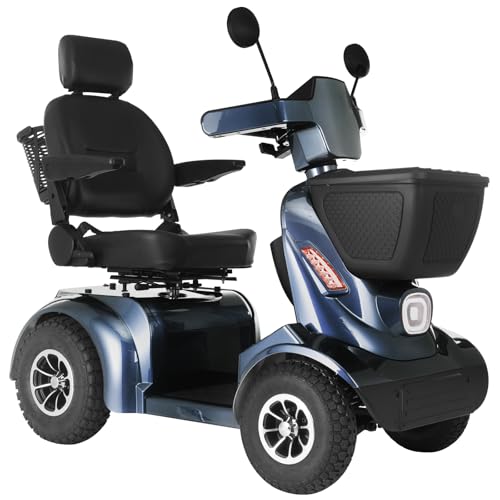 Ecomobi 32 Miles Heavy-Duty 1000W Mobility Scooter for54.3 x 26.7 x 48 inches265 PoundsCheck on Amazon
The best heavy duty mobility scooters are the Pride Mobility Jazzy 1450 for maximum capacity, the Afikim Afiscooter S4 for long-distance outdoor travel, and the Drive Medical Cobra GT4 for a more balanced combination of range, suspension, and maneuverability.
“Heavy-duty” should mean more than a high weight limit. A useful scooter must also fit through the spaces you use, provide enough seat width, remain stable on your usual surfaces, and offer a realistic range after accounting for hills, cold weather, rider weight, and stop-and-go driving. The comparison below focuses on those practical differences.
MobiCyc 32Miles All-Terrain Heavy-Duty Mobility Scooter for Seniors &Adults
Picked as a relevant option in this category.
View on Amazon
Unificare 4-Wheel Folding Mobility Scooter 22Mi Range 418LBS Large Size
Picked as a relevant option in this category.
View on Amazon
Mobility Scooter for Seniors & Adults, 19.7" Wide Seat, 400 lbs Capacity
Chosen because it specifies 19.7" Wide Seat and 400 lbs Capacity.
View on AmazonEcomobi 32 Miles Heavy-Duty 1000W Mobility Scooter for Seniors & Adults
Picked as a relevant option in this category.
View on AmazonBest heavy-duty mobility scooters compared
Specifications can vary by battery, seat, and regional configuration. Treat these figures as manufacturer-listed approximate values and confirm the exact configuration with a dealer before ordering.
| Model | Weight capacity | Seat width | Advertised range | Ground clearance | Turning radius | Suspension and terrain | Approximate scooter weight |
|---|---|---|---|---|---|---|---|
| Pride Jazzy 1450 | 600 lb | 22 in | Up to 18.6 miles | About 5 in | About 31 in | Full suspension; pavement, ramps, firm paths | About 400 lb with batteries |
| Afikim Afiscooter S4 | Up to 660 lb | About 23 in | Up to 37 miles | About 6.3 in | About 59 in | Full suspension; extended outdoor use and uneven ground | About 400–440 lb, configuration dependent |
| Drive Medical Cobra GT4 | 450 lb | About 20 in | Up to 35 miles | About 5.5 in | About 54 in | Four-wheel suspension; pavement, gravel, packed paths | About 350 lb with batteries |
| Pride Victory LX Sport | 400 lb | About 20 in | Up to 19.7 miles | About 4 in | About 50 in | Limited suspension; neighborhood and smooth outdoor surfaces | About 250–300 lb with batteries |
Our picks by situation
Best for the highest weight capacity: Pride Jazzy 1450
The Jazzy 1450 is the clearest choice when capacity is the first requirement. Its 600-pound rating, wide seat, substantial frame, and full suspension give it a more confidence-inspiring platform than a typical 300- or 400-pound scooter. Its relatively tight turning radius is also useful for a heavy model.
The trade-off is portability. This is not a scooter to lift into a car, and many ordinary vehicle ramps or compact lifts are unsuitable. It is better viewed as a powered outdoor chair for a home, accessible van, or permanent transport solution. Check doorway widths, ramp ratings, and storage-floor strength before buying.
Best for long outdoor trips: Afikim Afiscooter S4
The Afiscooter S4 stands out when range and stability matter more than tight maneuvering. Its high capacity, generous seat, substantial ground clearance, and long-range battery options make it appropriate for extended trips on paved paths, parking areas, and reasonably firm uneven surfaces. The full suspension helps reduce jolts over cracked pavement and shallow transitions.
Its almost 59-inch turning radius is a major limitation indoors. A scooter that feels stable on a broad path can be awkward in a narrow hallway or crowded shop. Measure turning spaces, not just door openings. The advertised 37-mile range is also a best-case figure rather than a promise for every rider and route.
Best balanced heavy-duty option: Drive Medical Cobra GT4
The Cobra GT4 offers a useful middle ground: a 450-pound capacity, long advertised range, four-wheel stability, suspension, and a lower overall commitment than the largest 600- and 660-pound models. It suits frequent outdoor use on pavement, compact gravel, and firm paths when the rider does not need the maximum capacity available.
Its size still makes it a poor choice for tight interiors, and its range depends on the battery configuration. The Cobra is most convincing for someone who wants an outdoor scooter that can cover several miles between charges without stepping up to the largest commercial-style chassis.
Best for lighter heavy-duty needs and easier ownership: Pride Victory LX Sport
Some buyers use “heavy-duty” to mean more robust than a travel scooter, not necessarily a 600-pound platform. The Victory LX Sport is more manageable than the largest models while supporting up to 400 pounds. It is a sensible option for neighborhood trips, paved paths, and everyday errands where storage and transport matter.
With less ground clearance and less suspension than the larger outdoor scooters, it should not be treated as an off-road machine. Avoid deep grass, soft sand, steep broken ground, and abrupt curbs.
How to choose the right specifications
Capacity and seat width
Do not select a scooter at the exact edge of its stated capacity. Include clothing, bags, oxygen equipment, and anything carried on the tiller or rear basket. A practical target is at least 50 pounds of unused capacity, and more if the route includes hills or rough surfaces.
Seat width should allow the rider to sit centered with a little clearance at both hips, but excessive width can reduce steering control and make transfers harder. Measure the usable seat area rather than relying only on the nominal width. A 20-inch seat and a 23-inch seat can feel very different depending on armrests, bolsters, and cushion shape.
Range and charging time
Advertised range is usually measured under favorable conditions. Hills, heavy loads, low temperatures, tire pressure, frequent starts, and soft ground all reduce it. A conservative planning method is to use 60–70% of the advertised range.
For example, a scooter rated for 35 miles should be planned as roughly 21–24.5 usable miles. If your round trip is 12 miles, that leaves about 9–12 miles of estimated reserve. That reserve matters because battery gauges can fall quickly under load and recover slightly when the scooter stops.
Charging commonly takes about 8–12 hours with a standard charger, though the exact time depends on battery condition and charger output. Charge after regular use in a dry, ventilated area, and do not use an extension cord unless the manufacturer specifically permits it.
Ground clearance, suspension, and terrain
Ground clearance helps with thresholds, shallow ruts, and uneven pavement; it does not turn a scooter into an all-terrain vehicle. Suspension improves comfort and control over irregular surfaces, but tires, wheelbase, speed, and weight distribution matter just as much.
- Smooth pavement: a lower-clearance scooter may be sufficient.
- Cracked sidewalks and firm gravel: choose four wheels, pneumatic or solid outdoor tires, and suspension.
- Grass and compact trails: prioritize clearance, torque, and a wide, stable chassis.
- Sand, mud, steep slopes, and loose rock: most mobility scooters are unsuitable; check the manual rather than relying on motor power.
Turning radius and portability
Turning radius is one of the most overlooked specifications. Measure the narrowest point in your home, garage, elevator, and regular destinations. A scooter with a 31-inch turning radius can be dramatically easier indoors than one near 59 inches.
Portability has two meanings: whether the scooter disassembles and whether the resulting pieces are realistically liftable. A heavy-duty scooter may separate into components but still leave a 100-pound base. For car transport, verify the vehicle’s payload, ramp capacity, hitch rating, and lift compatibility. A lighter scooter with a 400-pound capacity may be more useful than a larger one that cannot be transported.
Decision matrix for common buyers
| Your situation | Prioritize | Most suitable direction | Main compromise |
|---|---|---|---|
| Maximum rider capacity and home-based storage | Capacity, seat width, stability | Pride Jazzy 1450 | Very heavy and difficult to transport |
| Frequent long outdoor trips | Range, clearance, suspension | Afikim Afiscooter S4 | Large turning radius and footprint |
| Regular outdoor errands with a 450-pound limit | Range, suspension, value | Drive Medical Cobra GT4 | Still too large for many interiors |
| Occasional outings and limited storage | Lower weight, manageable dimensions | Pride Victory LX Sport | Less clearance and rough-terrain ability |
Ownership costs and maintenance realities
Expect a broad market range of roughly $2,500 to $7,000 or more for a new heavy-duty scooter, depending on battery size, seating, suspension, warranty, and delivery. Battery replacement is often the largest recurring expense. Lead-acid batteries commonly last around 12–24 months with regular use, while lithium configurations can last longer but usually cost more initially. Actual life depends on charging habits, storage temperature, and usage.
Wear usually appears first in tires, inner tubes on pneumatic models, brake components, armrest hardware, and batteries. Inspect tire pressure monthly, keep electrical connectors dry, clean mud from the wheels and underside, and check that the tiller, seat, and armrests remain firmly secured. Have a qualified mobility-equipment technician inspect unusual noises, reduced braking, steering looseness, or repeated battery cutouts.
Common mistakes include charging only when the battery is completely empty, carrying more than the rated load, driving across slopes too quickly, attempting curbs beyond the manual’s limit, and storing the scooter outdoors uncovered. Follow the manufacturer’s slope, water, temperature, and charging instructions.
Bottom line
Choose the Pride Jazzy 1450 when maximum capacity and a relatively manageable turning radius outweigh transport concerns. Choose the Afikim Afiscooter S4 for maximum outdoor range and a spacious, stable platform. Choose the Drive Medical Cobra GT4 for a strong all-round outdoor specification, or the Pride Victory LX Sport when 400 pounds is sufficient and easier storage matters. Before purchase, compare the actual seat fit, doorway measurements, route surfaces, vehicle-lift requirements, and charging location—not just the headline weight capacity.
These scooters are general mobility equipment, not a substitute for individualized clinical advice. A qualified occupational or physical therapist can help assess seating, transfers, posture, and the safest model for a particular user and environment.









Write Your Review
No reviews yet. Be the first to share your experience!