
This cast iron weight plates buying guide starts with your bar and the loads you want to reach. Verify the bore, calculate the plates for each side, and leave room for the collars. Then compare grip, tolerance, and delivered price so you buy a set you can load, store, and expand as your training progresses.
Start with the bar and the loads you intend to use
Identify the exact bar, sleeve diameter, loadable length, and collar requirements. Then write down the working loads for the lifts you train regularly. Subtract the nominal bar mass and any collar mass you include in your log. The remaining weight is the amount the plates need to supply evenly.
Confirm the sleeve standard before comparing prices
Olympic plates are intended for sleeves commonly described as 2 inches, and standard plates are made for smaller equipment commonly described as 1 inch. The measurement that matters is the part of the bar that accepts the plates. Check the model documentation alongside the physical sleeve where possible.
A product description may use the word “standard” to mean a basic Olympic model, as well as to describe nominal 1-inch equipment. Read the actual opening. Common Olympic models can publish slightly different bore dimensions. For example, REP states 52 mm on its Old School Iron plates, while the checked Titan 25 lb pair lists 50.5 mm ±0.2 mm.
Check the collar or retaining nut as a separate part of the system. A compatible 1-inch plate can fit over a handle without leaving room for sufficient thread engagement. An Olympic sleeve adapter only makes sense if the equipment makers approve the entire arrangement and it leaves the correct means of retaining the weights.
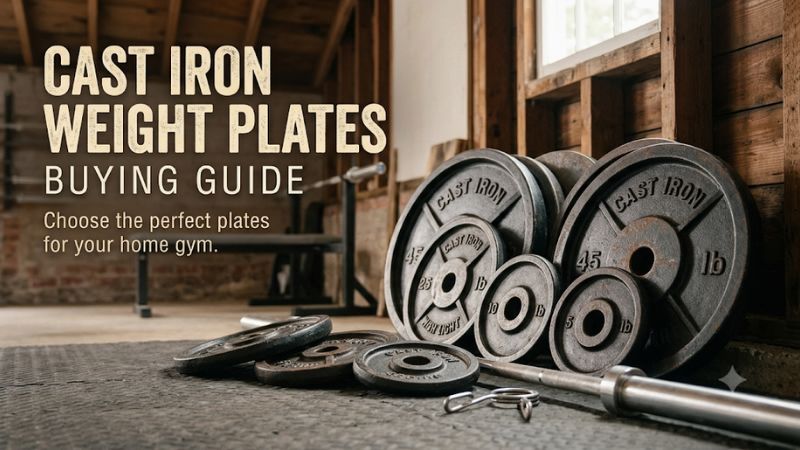
Translate working targets into plates per end
A 185 lb target on a nominal 45 lb bar needs 140 lb of plates before collars. That is 70 lb on each side. One 45 lb disc and one 25 lb disc at each end produce that total. Use this method for the loads you expect to repeat, including warm-ups and smaller progression steps, before deciding on a set.
| Target with a nominal 45 lb bar | Plate mass per end | Example arrangement per end |
|---|---|---|
| 95 lb | 25 lb | One 25 lb plate |
| 135 lb | 45 lb | One 45 lb plate |
| 185 lb | 70 lb | One 45 lb and one 25 lb plate |
| 225 lb | 90 lb | Two 45 lb plates |
| 235 lb | 95 lb | Two 45 lb plates and one 5 lb plate |
These examples exclude collars and use nominal labels. Compare your actual bar and equipment when exact tracking matters. A 20 kg bar is about 44.09 lb, and 45 lb is a separate nominal weight. If your equipment uses kilograms, start from its listed mass and keep the final load calculation in the same unit.
Select change plates for the gaps you will use
A pair of 2.5 lb plates gives a 5 lb barbell increase. Two 1.25 lb plates give a 2.5 lb increase. Start with the increments your program needs and the plates you already own. One small pair can add a useful new load without requiring another large set, a new storage position, or a longer sleeve.
For a gym with few small plates, buying one pair each of 2.5 and 5 lb can add more flexibility than another heavy pair. If you already own those sizes and consistently run out of weight on heavier lifts, the next useful purchase may be 25s or 45s. Review several training sessions to see which inventory change will get used.
If you plan to load two double-ended dumbbells, count all four ends and follow the handle maker’s approved layout. One pair of change plates can cover a barbell, while four identical discs may be needed to increase both dumbbells equally at every end. Account for the mass of collars or retaining nuts when tracking total dumbbell weight.
Compare plate construction and dimensions at the chosen weight
Cast plates can use a plain or machined bore, a deep rim or grip holes, and a coating or surface finish. The terms describe parts of the product. Read the observed consequence for your setup, such as clearance to put on collars, a place to hold a heavy disc, or the floor height of the loaded bar.
Measure thickness across the whole proposed stack
Take the usable sleeve length and subtract the space required for properly seated collars. Add the thickness of each plate on one end, including change plates. Check both sleeves and follow the equipment instructions for any required spacing. Thickness matters most when your regular high load approaches the usable length.
For example, three 45 lb plates at 1.50 in each take 4.50 in on one end. Three at 0.89 in take 2.67 in, a nominal difference of 1.83 in before collars. If your current stack already has sufficient room, prioritize grip, delivered price, or tolerance instead of buying a thinner model automatically.
Individual plates can be thicker or thinner than you expect from their weight labels. Some 25 lb plates are thicker than larger plates in the same line because of their diameter and shape. A stack’s settled dimensions can also differ when pieces have designed nesting or when unlike plate faces meet. Measure the intended combination rather than extrapolating from one sample.
Check outside diameter for your floor lifts and storage
The largest plate touching a level floor helps determine the bar’s initial height. Compare diameters at the exact weights you use for floor work. A 450 mm plate and one listed at 17.5 in are close but can sit at slightly different heights. A smaller 25 lb disc can make a much larger change in starting position.
If your program needs a consistent setup across light and heavy loads, account for which plates make contact at the start. Use an approved platform or support where needed. Check manufacturer rules before loading different diameters together for movements that involve floor contact. Unequal diameters can concentrate contact on the largest plates.
Diameter also affects handling. A broad disc may reach the floor at a familiar height and require more space to turn onto a storage peg. A small disc can be easier to store low and may sit thicker on the sleeve. Check your real loading and carrying path before deciding which dimension matters most.
Choose a rim or grip openings for the way you move plates
A deep rim gives your fingers a ledge, and cutout handles give you defined places to grip. Either can work if there is room to reach it on the bar and in storage. Check how the plate faces sit against neighboring pieces. A convenient handhold on an empty peg may become awkward when the peg fills up.
When plates are moved often, handling can matter more than a small difference in tolerance. Someone training alone may value a 25 or 45 lb plate that they can guide onto a sleeve easily. Someone who leaves a regular stack in a stable training station may prioritize thinner plates or easier weight identification instead.
Look at both sides of the disc when comparing a one-sided rim with a plate that has a more symmetric profile. Consider where your fingers go when the plate sits flush against another. If you can try the shape with a manageable weight, simulate removal and return rather than judging how it feels when it is already in your hand.
Read bore and finish as separate specifications
The bore determines the physical fit over the sleeve. The finish affects exposed surfaces, upkeep, and contact with other pieces. A black or hammertone finish does not establish how closely the plate fits. Look for actual opening dimensions and check the manufacturer’s intended sleeve type before choosing a finish.
A machined center opening can provide a more clearly specified fit, but a close fit depends on the bar and plate as a pair. Paint, debris, a sleeve finish, or deformation can affect how the plate slides. Do not force a poorly fitting disc onto a sleeve. Check whether the parts are correct and contact the seller if fit seems wrong.
Ordinary coatings can wear at contact points. Follow the maker’s care instructions, especially in a damp garage. Choose stable storage that keeps the plates accessible and dry. Check the bore and edges when you unpack a new purchase or inspect a used one, since damage there affects handling more than a superficial mark on the face.
Understand what tolerances mean when you load a pair
A published tolerance gives the allowable deviation from the nominal label under the maker’s specification. Convert it to actual pounds at the size you want. Compare the full possible range, including whether the tolerance is symmetric, and decide how much actual matching matters for the way you record and repeat training.
Convert percentage specifications into pounds
At 45 lb, a symmetric ±3% allowance is ±1.35 lb. A ±1% allowance is ±0.45 lb. A +2% / −0% specification gives a lower edge at 45 lb and an upper edge of 45.90 lb. Calculate the figure at the nominal weight, since the same percentage represents less mass on a smaller disc.
| Published specification on a nominal 45 lb disc | Possible mass under the stated specification |
|---|---|
| ±3% | 43.65 to 46.35 lb |
| ±1% | 44.55 to 45.45 lb |
| +2% / −0% | 45.00 to 45.90 lb |
| ±10 g | Approximately 44.978 to 45.022 lb |
These ranges illustrate the specifications. They are not measurements. Producing the endpoints is allowed under the applicable specification, while actual units may cluster closer to nominal. Do not compare a tolerance at 45 lb directly with a tolerance at 5 lb without converting both at the intended sizes.
Treat pair matching as an additional check
Two plates can both meet a tolerance and still differ. For example, 44.6 and 45.4 lb would both be within a ±1% range for 45s while differing by 0.8 lb. If that difference matters, use a suitable scale, repeat the measurement, and keep the pair together. Consider the scale’s resolution and repeatability.
For many home programs, consistent use of the same labeled pairs makes the progression easy to reproduce. For detailed testing or preparation that depends on particular equipment, a tighter tolerance or measured set can be useful. When ordering more later, compare the actual sizes, manufacturer policies, and compatibility instead of assuming all cast plates behave the same.
Buy a set you can store, receive, and expand
A 175 lb plate set and a 245 lb plate set may have different contents rather than the same mix scaled up. Compare the exact list, the amount you can load on your bar, and the positions needed when everything is in storage. Then compare shipping, handling, and the likely next purchase before choosing a retailer.
Compare complete inventory rather than the set headline
A 175 lb set made from pairs of 45, 25, 10, 5, and 2.5 lb supplies 87.5 lb per side if you put the entire set on a conventional bar. A 245 lb version can add a pair of 35s. Another set at a similar total can distribute the weight differently. List each pair against your normal working targets.
The package may include a bar or collars, or the seller may call a weighted bar package a particular total. Check whether the headline figure includes just the discs. If you already own the bar and several smaller plates, a complete kit can increase storage and delivery costs with little effect on the loads you can use.
For later expansion, verify whether the seller offers the heavy sizes as singles or pairs. A replacement for one damaged plate is easier to plan if singles are available. Matching the new piece with the same shape and actual mass still matters. Record the model, nominal size, and relevant dimensions so you can compare later.
Check how the weights will arrive and where they will go
Confirm the delivery method for each order, including whether heavy plates arrive separately or whether freight stops outside. Work out the path to storage before accepting a large purchase. Verify the capacity and fit of the intended rack or tree, and follow property guidance where floor suitability for a concentrated load is uncertain.
A heavy plate takes room to carry and return. Check the height of the storage location and avoid placing the most frequently used 45s where they are hard to handle. Use the storage maker’s limits for each post or shelf, including any placement instructions. A fitting bore does not establish that the full loaded storage arrangement is approved.
Inspect the plates, then test the fit in a controlled setup
Confirm the delivered quantity and read the weight label on each plate. Look at the bore, rim, and grip openings for damage. Follow the manufacturer’s directions and verify the disc seats on the intended sleeve before adding it to a full working stack. Check the collars with the exact combination you will use.
If a plate is damaged, visibly distorted, or does not fit as documented, keep the packaging and contact the seller with the model and measurements. On a tight fit, inspect both the sleeve and the bore for interference without modifying the parts. Keep the instructions and order details where you can refer to them when expanding.
Frequently asked questions
A good buying check resolves the bore, package count, actual loading increment, and available sleeve room. The remaining decisions often depend on floor use, handling, or how closely the actual discs need to match. Use the exact product’s instructions before treating another manufacturer’s specs as interchangeable.
What Olympic plates should I buy first?
Choose the pairs needed for your current working loads. A mix of 25s, 10s, and small change plates may be useful at lower loads. As training progresses, one or more 45 lb pairs can cover larger changes with fewer pieces. Check your actual bar, program, and storage before buying a complete set.
Are machined iron plates different from cast iron plates?
A plate can be cast from iron and machined afterward. Machining can refine the bore, surfaces, or mass depending on the product. Compare the maker’s finished specifications at your intended weight. A machined description alone does not give you the actual tolerance or the measured size of that variant.
Are Olympic cast iron plates safe to use with a standard bar?
Use only equipment that the manufacturers approve as a complete arrangement. The typical Olympic disc opening is much larger than a standard sleeve. If you already own standard equipment, an appropriate standard-bore plate with the correct retaining hardware is generally the simpler way to extend it.
Can I load a 45 lb pair with smaller iron plates?
Usually, compatible smaller iron plates can be used to create intermediate loads if the equipment permits the arrangement and retains the whole stack correctly. For floor lifts, verify which plates touch down and follow any restrictions on mixed diameters or contact. Keep the loading matched on both sleeves.
Conclusion
Identify the sleeve and your working loads first. Select the pairs that reach those loads evenly, measure the stack with space reserved for collars, and compare handling and tolerance at the exact weights. Confirm the delivered quantity and choose storage before a large purchase arrives.
More from Amazon
Programs that pair well with the guide above. Offers and eligibility are set by Amazon and may change.
Free shipping on eligible items, Prime Video and more. Eligible new members can start with a free trial.
Start a Prime free trialA Prime membership for ages 18-24 with a trial period. Eligibility is set by Amazon.
See Prime for Young AdultsAudiobooks and podcasts to listen to on the go. Eligible new members can start with a free trial.
Try Audible freeAd-free music streaming. Eligible new subscribers can start with a free trial.
Try Music Unlimited freeAs an Amazon Associate we earn from qualifying purchases.


Write Your Review
No reviews yet. Be the first to share your experience!