
Compare a vertical dumbbell stand vs alternatives using the weights you own and how you reach for them. A tower suits several fixed pairs on limited floor space. Horizontal racks, approved adjustable stands, and rated shelves can give you better access when your collection or room calls for a different layout.
Quick comparison table
The useful comparison is how each storage system supports the whole collection in your actual room. Consider what contacts each dumbbell, where you stand to pick it up, and whether all positions can be accessed without moving other weights. Similar base dimensions can offer different working space.
| Storage option | What it supports best | Space and access | Main compromise |
|---|---|---|---|
| Vertical A-frame or tower | Several compatible fixed dumbbell pairs | Compact base, with front or side clearance depending on design | Cradle fit and capacity limit the range of acceptable weights |
| Horizontal tiered rack | Numerous or bulky compatible fixed pairs | More wall length, with most pickup access from the front | Larger footprint and more furniture to accommodate |
| Dedicated adjustable stand | One approved adjustable pair, with any required trays | Elevated docking or selection station | Limited to the manufacturer’s compatible systems |
| Rated low shelf or tray | A few weights with compatible resting surfaces | Flexible placement and simple access | Support, load, and retention need verification |
| Floor parking area | One or two frequently used weights | Minimal extra equipment, with a dedicated clear area | Requires floor-level pickup and can occupy useful workout space |
| Multi-use fitness rack | Mixed equipment with appropriate shelves or pegs | Combines several storage jobs into one station | Each shelf and attachment has separate fit requirements |
Compare complete storage setups before comparing footprints
Bare dimensions describe only the frame. A vertical rack with dumbbell heads sticking out can use a wider envelope than the opening it stands in. A horizontal rack can sit along a wall and still leave a clear front approach. Measure both with the entire intended inventory and normal furniture positions.
Manufacturer examples show how these options differ. FitRx lists its four-pair A-frame at 14.6 × 12.6 × 20.9 in and 100 lb total. REP lists its three-tier horizontal rack at 48 in long, 23.4 in deep, and 34.6 in high, with a 1,000 lb rating. These products serve distinctly different collections. The bigger figure makes sense when the rack’s usable area and compatible shapes support the weights you actually own.
PowerBlock lists its Small Compact Stand at 16 × 14 × 25 in unfolded, for a verified compatible pair up to 50 lb per hand. It can look similar in footprint to a small A-frame while supporting a single adjustable pair differently. The top tray and model compatibility matter more than how many square inches the stands occupy.
For any setup, add the equipment stored on it. A 5–50 lb fixed sequence in 5 lb increments totals 550 lb of dumbbells. A pair of adjustable dumbbells maxing out at 50 lb each totals 100 lb of dumbbells at maximum load, plus any stand or tray. The two choices also differ in whether multiple loads can be in use at once.
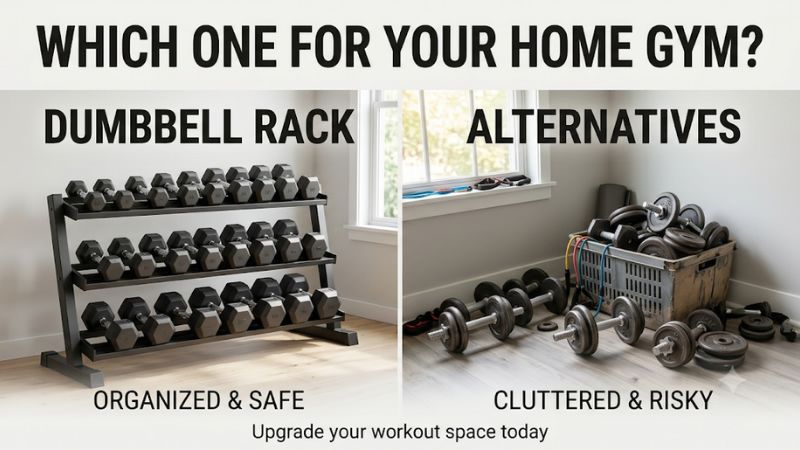
Vertical dumbbell stand vs horizontal tiered rack
A vertical rack concentrates dumbbells in a narrow area, commonly using shaped cradles. A horizontal rack spreads them along a shelf or rails. The layout determines how you approach the weights, how readily the rack can hold pieces of different shapes, and what happens when you add another pair.
Choose vertical storage for a short matched run
A 4- or 5-pair vertical stand can be an efficient choice for a short set of compatible fixed hex dumbbells. All pairs have a defined position, and the rack takes little wall length. This is useful if you use a bench or cardio machine in the same room and have only one open corner.
That advantage depends on the weights sitting correctly. A short handle, large rounded head, or wide coating can interfere with the support around it. Compare published fit for your dumbbells and examine the two closest pairs with both positions occupied. A buyer with mixed brands may need a physically roomier storage type.
A vertical rack also works best when each intended face is reachable. If most of the space is in front of a wall and the sides are blocked, choose a front-access vertical design or a horizontal shelf that works from the exposed side. The shortest frame is only useful if it can be used day to day.
Choose horizontal shelves for numerous compatible or bulky pairs
Horizontal racks can give heavier pairs more room along a row and make the whole collection easy to scan from the front. That is useful when several people share the gym or when bigger heads need more lateral space than a compact A-frame offers. Check the shelf or rails for the exact shapes.
For example, REP says its rack accommodates its own round urethane dumbbells and recommends one rack for its 5–50 lb set. It also states that fit for other brands is not guaranteed. Check usable shelf length if your collection is larger than the maker’s example or includes heavily flared head shapes.
Measure the approach height. The lowest row can still require a deep reach or bend, especially if another row projects above it. A horizontal shelf helps when the open approach and shelf geometry match how you prefer to lift the heaviest pairs off the rack.
Compare how each handles the next pair
Adding one more pair to an A-frame requires two appropriate free slots. A horizontal shelf can sometimes accept another size if usable length remains and the load limit permits it. Wider heads can take up the space intended for another pair even if the total weight remains comfortably below the rating.
Before replacing a current rack, plan the next likely expansion. A five-pair stand that fits the complete set today can justify its small size. A long shelf can become more economical if the collection is already expanding beyond six pairs and you can commit wall space to it.
Vertical fixed rack vs adjustable dumbbell stand
A fixed rack supports many individual weights. An adjustable stand supports one pair that changes load. That distinction affects the contact surface, lifting height, and work needed for each transition. Buy a dedicated adjustable stand based on model compatibility and the complete docking or selector procedure.
Use a compatible elevated platform for an adjustable pair
Some adjustable dumbbells need a cradle to change weight. The cradle must remain aligned and stable when the loaded handle goes in and out. An approved stand puts the system at a workable height and provides a surface suitable for its feet, tray, and any parts left behind.
Use the exact model and capacity stage. PowerBlock’s Small Compact Stand can support specified products up to 50 lb per dumbbell, but its compatibility list excludes some models that may be sold at a comparable starting capacity. Verify the actual series even when the maximum working weight seems to fit.
Also include any room needed to operate pins, knobs, switches, or adder weights. A product fits on the top tray only if you can use those controls and lift the handles clear. A shelf directly above the rack can cause problems similar to those on a vertical stand’s top tier.
Keep fixed racks when several people use different loads
A single adjustable pair can offer many settings sequentially. A fixed rack provides multiple independent pairs at the same time. A household that trains together may prefer fixed weights even if the rack takes more space. Check whether two pairs are commonly used at once before considering a replacement.
A hybrid can make sense. A dedicated adjustable stand can handle the main strength work, while two light fixed pairs live on a small suitable rack or shelf. The arrangement works well when the adjustable pair’s lower settings are inconvenient to repeat or another person uses the light weights simultaneously.
Compare the equipment’s readiness after a set. A fixed dumbbell goes back to its support. An adjustable handle may need to be returned squarely to its cradle before the next weight can be selected. For short rests and frequent changes, the difference depends on which fixed pairs you already have staged.
Vertical stand vs shelves and floor storage
A dedicated rack gives fixed pairs defined supports. A low shelf or suitable floor area can be enough for a small inventory, especially when there is no advantage to packing several pairs together. The practical decision is whether the storage surface can support each weight and keep it accessible outside the walkway.
Use a rated low shelf for one or two light pairs
A low shelf can hold a couple of pairs if its rating, stability, and contact surfaces suit the equipment. Confirm how the load should be distributed and that the dumbbells cannot roll or fall out. A miniature rack that consumes floor space may add little if there is already a stable place for both pairs.
Measure the shelf depth and width with the heads and hands in place. If the shelf has a front lip, imagine lifting the dumbbell higher to clear it. If the unit is a piece of furniture, check the maker’s loading and anchoring instructions and take into account whether a drawer or door changes stability.
A standard shelf can be a poor fit when you have heavier pairs or choose several levels. A rack with clear rating and geometry becomes more useful as the inventory grows. Use furniture only for loads and handling conditions it can support.
Use floor storage when you need one pair close to the workout
A dedicated clear floor area can work for a small number of fixed dumbbells. It avoids adding a stand and puts the equipment next to a mat or bench. Choose a compatible surface and a location outside walking routes. Keep the weights on their stable side and use controlled set-downs.
The main trade-off is pickup height. Taking one light pair from the floor occasionally may be easy. Returning several heavy pairs after repeated sets can demand more handling and leave them spread around a floor that is already small. A suitable elevated rack becomes more valuable when you want every pair in the same place.
If an area has several different uses, floor parking can become temporary. When the workout ends, the weights need a permanent suitable location. Compare how often you move them and whether a small fixed stand could reduce that work.
Check the support around rounded or irregular heads
Floor and shelf choices should account for head shape. Hex sides can help the dumbbell remain at rest on a firm level surface. Round heads can need approved stops or cradles. A shelf with a lip does not necessarily hold a shape securely, especially if the weight can move sideways.
Consider where the head contacts the surface and whether the finish is compatible. Follow the dumbbell and surface care instructions. A practical setup keeps the weight supported and stable without requiring another weight to hold it in place.
Vertical stand vs multi-use fitness storage
A multi-use rack can organize dumbbells, kettlebells, and plates in one place. It suits a mixed collection where a dedicated hex stand would leave other equipment scattered. The useful comparison is whether each part of the rack is designed and rated for the equipment assigned to it.
Use a mixed rack when several equipment types need storage
A flat shelf may suit kettlebells, while separate rails hold compatible dumbbells and rated pegs hold plates. Check each compartment separately. The whole-rack rating does not mean a single shelf or peg can support the same load, and a surface intended for one equipment type is only suitable for others when the maker supports that use.
A wall of mixed equipment can be easier to manage if the items used together are near each other. It can be less practical if the kettlebell tray blocks the lower dumbbell shelf or if loose plates must be removed to get to the stand. Use your normal workout sequence to plan each location.
The real advantage is consolidation. If the collection is almost entirely fixed hex dumbbells, a dedicated rack may be simpler and take less room. If the inventory includes several compact implements, a mixed rack can earn the added width and depth by replacing two or three separate storage pieces.
Keep plate storage compatible with the plate standard
For loadable handles, a rated plate tree and stable storage for the unloaded handles may make more sense than a fixed-dumbbell rack. A plate tree has pegs suited to a particular opening and load. Marcy’s PT-5740, for example, is an Olympic plate tree with a listed maximum capacity of 300 lb.
A plate tree stores discs separately, so it changes the setup time and loading area. If your routine uses two common built dumbbell weights repeatedly, a suitable shelf for those assembled weights may be more convenient if the rack manufacturer supports the specific geometry and load.
If both fixed and loadable equipment will be used, compare a small dumbbell stand and a plate tree with a single multi-use rack. The better choice can depend on how often you move plates to a barbell and whether the two setups need to remain accessible simultaneously.
Choose a layout based on the weights you actually use
A short light set, a full fixed range, and one adjustable pair each need a different kind of support. Identify the most frequent pickup and the heaviest stored object. Then compare access, compatibility, and floor space for the specific configuration you will keep in your home gym.
| Your situation | Start with | Main check before buying |
|---|---|---|
| One or two light pairs | Suitable low shelf, tray, or designated floor area | Rated support, stable placement, and a clear walkway |
| Four or five matching fixed hex pairs | Vertical A-frame | Total load and fit of the largest pair |
| Many bulky or mixed-shape fixed pairs | Compatible horizontal rack | Usable shelf length, retention, and total load |
| One selector pair with cradles | Manufacturer-approved stand | Model and stage compatibility, tray fit, and docking clearance |
| Dumbbells and kettlebells in one area | Multi-use rack or separate approved storage | Access to each shelf and individual load limits |
| Existing Olympic plates with loadable handles | Olympic plate storage plus approved handle or loaded-weight support | Peg compatibility and room to assemble each weight |
Frequently asked questions
The decision often comes down to how many matching loads you want available, how close the rack must sit to a wall, and whether your equipment uses shaped supports. These answers cover the differences that show up after the weights are on the rack and ready to use.
Is vertical storage always smaller in practice?
A vertical frame often uses less floor area, but its loaded heads and access faces can expand the working area. A front-access horizontal rack may work better against a long wall if side approaches are restricted. Measure both with your intended collection.
Is a vertical rack cheaper than a horizontal rack?
Small vertical stands can cost less for several light pairs. Heavy towers and specialized cradles can cost more. Compare two products that support the same weights and count, then add delivery and any other storage you need to buy with them.
Can a shelf replace a purpose-built rack?
A suitable shelf can support a few weights if it meets load, stability, fit, and retention requirements. Check the exact surface and structure. A purpose-built rack becomes more useful when the collection needs separate positions, documented weight distribution, or specialized support.
What is the most compact choice for adjustable dumbbells?
Use the matching cradles or a manufacturer-approved stand if the system requires one. You may be able to keep approved cradles on a suitable level floor. If you need an elevated pickup height, choose a stand that explicitly supports the model and fully loaded configuration.
Which option makes sense for many round dumbbells?
Look for documented compatibility and appropriate supports, such as shaped saddles or rails the manufacturer approves for the specific type. Some towers work with named round models, and some horizontal racks support particular round ranges. Verify fit and retention for your actual dumbbells.
Conclusion
Choose a vertical dumbbell stand when several compatible fixed pairs need an organized home with limited floor space. Choose horizontal storage for more or larger pairs when you have usable wall length. Use a dedicated stand for adjustable dumbbells, a suitable shelf for a few light weights, or a mixed rack when several equipment types need support. Compare the loaded layout and pickup path before deciding which option takes the least useful space.
More from Amazon
Programs that pair well with the guide above. Offers and eligibility are set by Amazon and may change.
Free shipping on eligible items, Prime Video and more. Eligible new members can start with a free trial.
Start a Prime free trialA Prime membership for ages 18-24 with a trial period. Eligibility is set by Amazon.
See Prime for Young AdultsAudiobooks and podcasts to listen to on the go. Eligible new members can start with a free trial.
Try Audible freeAd-free music streaming. Eligible new subscribers can start with a free trial.
Try Music Unlimited freeAs an Amazon Associate we earn from qualifying purchases.

Write Your Review
No reviews yet. Be the first to share your experience!