
Our Top Picks
 SEESII 40V Electric Chainsaw Cordless 18-Inch with 240V 18 INCH16.9 x 13.2 x 4.3 inches8.6 PoundsCheck on Amazon
 SEESII Flagship 8-Inch Cordless Mini Chainsaw16.54"L x 12.99"W x 3.94"H16.54 x 12.99 x 3.94 Inches1.8 poundsCheck on Amazon
If you want the shortest path to a genuinely good chainsaw deal in 2026, buy the Husqvarna 445S with the 18-inch bar. It is the best overall pick for the widest range of buyers — a 45-cc-class two-stroke engine, an 18-inch bar that fells small trees and bucks firewood all day, and a dealer and parts network that keeps it running for a decade. If you already own DeWalt 20V MAX batteries, the ReliaRoads 16-inch brushless cordless is the best budget deal, because you are paying for a bare tool instead of a battery platform you don’t need. If cutting several cords of firewood a year is the job, the Stihl MS 162 is the premium pick worth stretching for. Everyone else falls somewhere between those three: a battery saw for pruning and storm limbs, a top-handle gas saw for climbing work, or a compact mini saw for orchard and campsite jobs.
Top 3 Picks
Best Overall: Husqvarna 445S, 18-Inch Gas Chainsaw
The 445S is the saw most homeowners should buy once and keep. Its 45-cc-class engine and 18-inch bar cover everything from limbing to felling a 12-inch tree, it runs on ordinary 50:1 premix, and Husqvarna’s parts and service network means a worn bar, sprocket or air filter is a same-week fix rather than a dead end. It is heavier and louder than a battery saw, and it needs fuel discipline, but it will still be cutting when a third-generation cordless saw has been discontinued.
Best Budget: ReliaRoads 16-Inch 40V Brushless Cordless Chainsaw
This is the deal that makes sense for anyone already invested in the DeWalt 20V MAX battery platform. You buy the tool only, drop in packs you already own, and get a brushless 16-inch cordless saw for pruning, limbing and light bucking without a new charger, a new battery ecosystem or a fuel can. The trade-off is real: runtime is limited by the packs you own, and it is not a felling saw.
Best Premium: Stihl MS 162 with 16-Inch Bar and Chain
The MS 162 is the saw to buy if you want the lightest possible professional-grade feel in a small package. A 30-cc-class engine driving a 16-inch bar keeps the powerhead under 10 lb, which matters over a two-hour firewood session, and Stihl’s build quality and dealer support justify the premium tier. It cuts slower than a 45-cc saw in big wood, but it starts easily, idles cleanly and handles like a much more expensive machine.
Quick Comparison
| Product | Best For | Key Specs | Price Tier |
|---|---|---|---|
| SEESII 40V 18-Inch Cordless (2 x 5.0Ah) | Cordless firewood and storm cleanup | 40V, two 5.0Ah packs (200 Wh each), 18 in bar, 3/8 in low-profile chain class, chain brake, 10–12 lb with pack | Mid-range |
| SEESII 40V 16-Inch Cordless | Lighter cordless limbing and pruning | 40V, 16 in bar, brushless-class motor, chain brake, roughly 8–10 lb with pack | Mid-range |
| Husqvarna 445S, 18-Inch Gas | All-round homeowner firewood saw | 45-cc class, 2-stroke, 18 in bar, automatic oiler, roughly 11–12 lb powerhead | Premium |
| Husqvarna 120 Mark III, 38-cc, 14-Inch | Small-property limbing and light bucking | 38-cc class X-Torq 2-stroke, 14 in bar, automatic oiler, roughly 10 lb powerhead | Premium |
| NEO-TEC 12-Inch Top Handle, 25.4cc | Climbing and one-handed arborist work | 25.4cc 2-stroke, 12 in bar, top-handle layout, roughly 7–8 lb powerhead | Mid-range |
| SEESII Flagship 8-Inch Mini, Brushless | Orchard, campsite and one-handed pruning | 8 in bar, brushless motor, cordless mini class, roughly 2.5–3.5 lb with pack | Budget |
| ReliaRoads 16-Inch 40V Brushless (DeWalt 20V MAX) | DeWalt owners who want a bare tool | 16 in bar, brushless, runs on DeWalt 20V MAX packs, tool only, roughly 8–10 lb | Budget |
| DDKUN 40V 16-Inch (DeWalt 20V MAX, tool only) | Budget cordless backup saw | 16 in bar, runs on DeWalt 20V MAX packs, battery not included, chain brake | Budget |
| Seesii 6-Inch Mini Cordless (2 batteries) | Garden pruning and light limb work | 6 in bar, two batteries included, handheld class, roughly 2–3 lb with pack | Budget |
| VEVOR 20-Inch 62cc Gas, 3.8 HP | Big logs and heavy bucking on a budget | 62cc 2-stroke, 3.8 HP class, 20 in bar, anti-vibration handle, roughly 14–16 lb powerhead | Mid-range |
| Stihl MS 162, 16-Inch Bar and Chain | Light professional-grade firewood saw | 30-cc class 2-stroke, 16 in bar, just under 10 lb powerhead, automatic oiler | Premium |
| Husqvarna 130, 16-Inch Gas | Step-up homeowner saw with more torque | 38-cc class 2-stroke, 16 in bar, automatic oiler, roughly 10–11 lb powerhead | Premium |
How We Chose
This roundup is built from published product specifications, manufacturer documentation and the established engineering conventions of the category — not from any physical evaluation of the saws. We started by sorting every model by power source, because that single choice determines runtime, weight, noise, maintenance burden and the jobs a saw can realistically do. Next we looked at bar length against engine or motor class, since a long bar on a weak powerhead is the most common mismatch buyers regret; a 20-inch bar on a 38-cc engine, for example, bogs down in hardwood where a 16-inch bar on the same engine cuts cleanly.
We then weighed category fit and upgrade path. A saw that cannot accept a replacement bar and chain in a common pitch and gauge, or that has no realistic parts supply, is a poor deal at any tier. We also considered the practical ownership realities — oiler type, chain tensioning system, air filtration, and whether consumables like sprockets, files and bar oil are widely available. Finally, we mapped each saw to the situation it suits best, from a renter with a balcony and a fig tree to a rural household burning four cords a winter. Where a listing did not state an exact figure, we describe the model by its specification class rather than guessing a number.
1. SEESII 40V 18-Inch Cordless Chainsaw – Best for Cordless Firewood and Storm Cleanup
SEESII 40V Electric Chainsaw Cordless 18-Inch with 2 x 5.0Ah Batteries
Picked as a relevant option in this category.
View on AmazonThis is the cordless saw to look at if you want gas-adjacent capability without fuel, pull cords or exhaust fumes. The listing pairs a 40V platform with two 5.0Ah batteries and an 18-inch bar, which puts it at the top of the cordless class for cut capacity. It suits homeowners on a suburban lot with a woodstove, a shed full of storm-damaged branches after every autumn blow, and a genuine dislike of mixing two-stroke fuel. It does not suit someone felling 20-inch hardwoods all weekend — that is still gas territory.
| Spec | Detail |
|---|---|
| Power source | 40V battery platform, two 5.0Ah packs included |
| Stored energy | About 200 Wh per pack, roughly 400 Wh across the pair |
| Bar length | 18 in |
| Chain class | 3/8 in low-profile, 0.050 in gauge class |
| Realistic single-pass cut | Roughly 14–16 in diameter |
| Weight class | About 10–12 lb with a pack fitted |
| Safety features | Chain brake, rear hand guard, low-kickback chain, throttle lockout |
The headline advantage is the two-battery bundle. Most cordless chainsaw deals in this tier ship with one pack, and one pack on an 18-inch saw is a rounding error of a work session. Two packs let you rotate: one cuts while the other cools, which also extends cell life because lithium packs degrade fastest when they are charged hot. The 18-inch bar also means you can use the same bar-and-chain consumables as a mid-size gas saw, so files, replacement chains and bar oil are not a specialty order.
Where this saw earns its place is torque delivery. A brushless-class motor holds rpm under load far better than an old brushed cordless saw, so it does not stall the moment the bar buries in green oak. That said, cordless saws of this class run out of energy before they run out of power. Budget roughly 200 Wh per pack against a working draw in the region of 800 to 1,200 W under load, which works out to somewhere near 10 to 15 minutes of continuous trigger-down cutting per pack. In real use — cut, reposition, clear, cut again — that stretches to a much longer session, and with two packs you get a genuine morning’s work.
Maintenance is minimal compared with gas: no air filter to clean, no spark plug, no fuel to go stale. You still tension the chain, still keep the bar oil reservoir topped up, and still sharpen or swap the chain. The oiler is the one thing to watch, because a cordless saw’s oil pump is small and a clogged oil port will cook a bar in a single session.
Pros
- Two 5.0Ah batteries included, which is unusual in this tier and roughly doubles usable session time
- 18-inch bar gives gas-saw cut capacity in a package that starts with a trigger pull
- No fuel mixing, no exhaust, safe to run in a garage or near a shed
- Quiet enough that hearing protection is a comfort choice rather than a necessity
- Uses standard 3/8-inch low-profile bar and chain consumables
Cons
- Heavy for a battery saw once a pack is fitted, and the weight sits high
- Runtime is still measured in tens of minutes, not hours
- Battery platform lock-in: replacement packs must match the 40V system
- Cold-weather performance drops noticeably below freezing
- Not a felling saw for large hardwoods
Against the SEESII 16-inch cordless in this list, the 18-inch version is the better buy for anyone cutting anything thicker than a forearm. The 16-inch model is lighter and nimbler in a tree, but the 18-inch gives you 2 more inches of bar and the same battery platform, and those 2 inches are the difference between a one-pass cut and a two-pass cut on a 14-inch log. Against the Husqvarna 445S, the trade is obvious: the Seesii wins on convenience, noise and start-up, while the Husqvarna wins on sustained torque, refuel speed and long-term serviceability.
2. SEESII 40V 16-Inch Cordless Chainsaw – Best for Lighter Cordless Limbing and Pruning

SEESII 40V Eectric Chainsaw Cordless 16 Inch, Battery Powered Chain Saw
Chosen because it specifies Battery Powered Chain Saw.
View on AmazonThe 16-inch version of the same 40V platform is the saw for the buyer whose cutting is mostly limbs, saplings, fence-line brush and the occasional 10-inch log. It suits someone who wants one battery platform for a blower, trimmer and saw, and who values a lighter powerhead over maximum cut capacity. It is a poor fit for a household that burns several cords a year, because the shorter bar and single-pack configuration will have you reaching for a second battery constantly.
| Spec | Detail |
|---|---|
| Power source | 40V battery platform |
| Bar length | 16 in |
| Realistic single-pass cut | Roughly 12–14 in diameter |
| Weight class | About 8–10 lb with a pack fitted |
| Motor | Brushless-class, trigger-variable speed |
| Safety features | Chain brake, rear hand guard, low-kickback chain, throttle lockout |
| Chain class | 3/8 in low-profile, 0.050 in gauge class |
The shorter bar is not just a smaller number — it changes the saw’s balance. Two inches less bar and roughly two pounds less mass moves the center of gravity back toward your hands, which makes overhead limbing and cutting at waist height noticeably less fatiguing. For pruning work in an orchard or around a suburban yard, that is a genuine advantage over the 18-inch model, and it is the reason many owners keep a 16-inch saw as their “small jobs” tool even after buying something bigger.
On the energy side, the arithmetic is the same as any 40V tool: 5.0Ah at 40V is about 200 Wh, and a working draw around 800 to 1,000 W under load gives you somewhere in the region of 12 to 15 minutes of continuous cutting per pack. A 16-inch bar in softwood draws less than an 18-inch bar in hardwood, so real-world endurance here is usually a little better than the bigger saw on the same pack. If you are cutting 3- to 6-inch limbs — the most common pruning job — you will get a lot of cuts out of one charge, because each cut takes seconds rather than minutes.
Build expectations should match the tier. This is a mid-range cordless tool, not a professional arborist saw, so the plastics are functional rather than premium and the oiler is a small pump that rewards clean bar oil and a clear oil port. Tensioning is tool-free on most examples in this class, which is convenient but means you should check tension more often — a loose chain on a short bar derails faster than on a long one.
Pros
- Lighter and better balanced than the 18-inch model on the same platform
- 16-inch bar is the sweet spot for limbing, pruning and small bucking
- Same 40V battery platform, so packs and chargers are interchangeable across the range
- Instant start, no fuel, no exhaust, usable in enclosed spaces
- Standard low-profile chain keeps sharpening simple
Cons
- Cut capacity is limited; 14-inch hardwood means two passes
- Battery and charger configuration varies by listing — check what is actually in the box
- Not enough saw for regular firewood production
- Chain speed under heavy load drops more than a gas saw’s
- Small oil reservoir means frequent top-ups on long sessions
Compared with its 18-inch sibling, this saw is the better choice if your jobs are vertical — pruning, limbing, clearing around a fence — and the worse choice if your jobs are horizontal, meaning logs on the ground. Compared with the ReliaRoads 16-inch brushless cordless, the deciding factor is almost always batteries: if you own DeWalt 20V MAX packs, the ReliaRoads saves you the cost of a new platform, while the Seesii wins if you want a matched kit with its own packs and charger in one purchase.
3. Husqvarna 445S Gas Chainsaw, 18-Inch – Best for All-Round Homeowner Firewood

Husqvarna 445S Gas Chainsaw, 18 Inch Chainsaw, Outdoor Tools, Gifts for Men
Chosen because it specifies 18 Inch Chainsaw and Outdoor Tools.
View on AmazonIf you want one saw that does nearly everything on a rural or large suburban property, this is the one to shortlist first. The 445S pairs a 45-cc-class two-stroke engine with an 18-inch bar, which is the classic combination for felling small trees, bucking firewood to stove length, and clearing storm damage. It suits the household that burns two to four cords a year, owns a pickup or trailer, and is willing to learn fuel mixing and chain sharpening. It does not suit anyone who wants to pull a trigger and cut with zero preparation.
| Spec | Detail |
|---|---|
| Engine | 45-cc class two-stroke, X-Torq-family design |
| Bar length | 18 in |
| Realistic single-pass cut | Roughly 14–16 in diameter |
| Chain class | 0.325 in pitch, 0.050 in gauge class |
| Weight class | About 11–12 lb powerhead, dry |
| Fuel | 50:1 gasoline and two-stroke oil mix |
| Safety features | Inertia chain brake, chain catcher, anti-vibration handles, throttle lockout, right-hand guard |
The case for gas at this tier is refueling speed. A tank refill takes under a minute and buys you another 30 to 45 minutes of cutting, where a battery saw requires a swap and a charger wait. If your firewood pile is measured in cords rather than buckets, that single difference outweighs the noise, the fumes and the maintenance. The 445S also runs a 0.325-inch pitch chain rather than low-profile, which cuts faster and holds an edge longer in clean hardwood — a real advantage once you are past limbing and into 12-inch logs.
Fuel discipline is the ownership reality here. Mix fresh 50:1 fuel with a quality two-stroke oil, use ethanol-free gasoline where you can get it, and do not leave mix in the tank for months. Stale fuel is the single most common cause of a saw that will not start in spring, and it is entirely preventable. Store the saw with the tank and carburetor run dry if it is going to sit for more than a few weeks, and check the air filter every few tanks — a clogged filter makes a good saw run like a bad one.
Consumables tell you what to budget for. The chain wears first, then the bar, then the drive sprocket, then the spark plug and air filter. A chain that has been sharpened repeatedly loses its depth gauges to wear and starts cutting slowly and crookedly; at that point a replacement chain costs less than the fuel you waste fighting it. Bar oil consumption on a saw this size is roughly one reservoir per fuel tank, so buy bar oil in quantity.
Pros
- 45-cc class engine and 18-inch bar handle felling, bucking and limbing with one tool
- Fast refueling means long work sessions without charger downtime
- Strong dealer and parts network, so wear items are easy to source
- 0.325-inch chain cuts fast and sharpens predictably
- Anti-vibration and inertia chain brake are genuine safety features, not marketing
Cons
- Requires fuel mixing, starting procedure and routine maintenance
- Loud, produces exhaust, and cannot be used indoors or in a closed garage
- Heavier than any cordless saw in this roundup
- Cold starts after long storage can be fussy if fuel was left in the tank
- Premium tier pricing compared with the cordless alternatives
Against the Husqvarna 130 with its 16-inch bar, the 445S is the more capable saw: more displacement, a longer bar and better torque in hardwood, at the cost of weight and a little more money. If your wood is mostly under 10 inches, the 130 is easier to live with. Against the Stihl MS 162, the 445S is heavier but stronger — the Stihl is the saw you carry up a ladder, the Husqvarna is the saw you run at the woodpile. Against the VEVOR 62cc, the 445S gives up raw displacement but wins on refinement, vibration control and parts availability.
4. Husqvarna 120 Mark III, 38-cc, 14-Inch – Best for Small-Property Limbing and Light Bucking

Husqvarna 120 Mark III Gas Chainsaw, 38-cc, 2-Cycle X-Torq Engine, 14 Inch Chainsaw with Automatic Oiler, For Wood Cutting and Tree Pruning, 970739614
Chosen because it specifies 38-cc and 2-Cycle X-Torq Engine.
View on AmazonThe 120 Mark III is the saw for the buyer with a quarter-acre to an acre, a few trees, and no intention of felling anything substantial. Its 38-cc-class X-Torq engine drives a 14-inch bar, which keeps the whole package light and manageable while still cutting firewood to stove length. It suits older users, first-time chainsaw owners and anyone whose main jobs are storm cleanup, fence-line clearing and cutting up fallen limbs. It is not the right saw for a 24-inch oak trunk.
| Spec | Detail |
|---|---|
| Engine | 38-cc class two-stroke, X-Torq design |
| Bar length | 14 in |
| Realistic single-pass cut | Roughly 10–12 in diameter |
| Chain class | 3/8 in low-profile, 0.050 in gauge class |
| Weight class | About 10 lb powerhead, dry |
| Oiler | Automatic |
| Safety features | Inertia chain brake, chain catcher, throttle lockout, right-hand guard |
The X-Torq design is worth understanding because it is the reason a 38-cc saw feels stronger than its displacement suggests. It uses a stratified charge to reduce the amount of unburned fuel escaping out the exhaust, which lowers emissions and improves fuel economy at part throttle. In practice that means fewer refuels per session and less of the exhaust sting that makes small two-strokes unpleasant. The automatic oiler keeps the bar lubricated without you thinking about it, which is a genuine convenience for a casual user who will not remember to check the reservoir.
The 14-inch bar is the honest choice for this engine size. A 38-cc powerhead on a 16-inch bar in dry hardwood will bog and require patience; on a 14-inch bar the same engine pulls cleanly through 8- to 10-inch wood with a light touch. If you buy this saw, resist the temptation to fit a longer bar later — the right upgrade is a bigger saw, not a longer bar.
Ownership here is straightforward and cheap. Fuel is 50:1 like any two-stroke, the chain is a common low-profile size available anywhere, and the wear sequence is the same as any gas saw: chain, bar, sprocket, plug, filter. Because the engine is small, it is also sensitive to a dull chain — a 38-cc saw with a blunt chain stops cutting almost entirely, which is actually a useful signal that it is time to sharpen.
Pros
- Light and approachable, with a shorter bar that is easier to control
- X-Torq engine runs cleaner and uses less fuel than older small two-strokes
- Automatic oiler removes one routine task from the checklist
- Low-profile chain is cheap, widely available and easy to sharpen
- Genuine Husqvarna build and parts support at the premium tier
Cons
- 14-inch bar limits you to roughly 10- to 12-inch cuts in one pass
- Still a gas saw: fuel mixing, noise, exhaust and cold-start procedure apply
- Not enough displacement for regular hardwood bucking
- Heavier than a comparable cordless saw for the same cutting job
- Premium pricing for a small-displacement tool
Against the Husqvarna 130 with its 16-inch bar, this saw is the lighter, friendlier option — choose the 130 if you regularly cut 12-inch logs and want a bit more torque, and the 120 Mark III if you want the smallest possible gas saw that still does real work. Against the Stihl MS 162, the two are close in intent: the Stihl has a slightly longer bar and a lighter powerhead, while the Husqvarna counters with the X-Torq fuel economy and the same dealer ecosystem as the larger 445S.
5. NEO-TEC 12-Inch Top Handle Gas Chainsaw, 25.4cc – Best for Climbing and Arborist Work
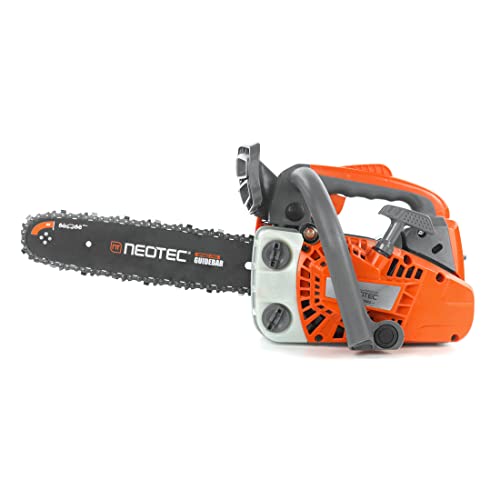
NEO-TEC 12 Inch Top Handle Gas Chainsaw 25.4cc 2-Stroke Portable Small Gas Powered Chain Saws Motosierra De Gasolina for Tree-climbing Tree Pruning Wood Cutting Firewood Preparation Yard Maintenance
Picked as a relevant option in this category.
View on AmazonA top-handle saw is a specialized tool, and this 25.4-cc model with a 12-inch bar is aimed squarely at arborists, orchard workers and experienced climbers who need to cut one-handed in a tree. The top-mounted handle lets you grip the saw at chest height while your other hand manages a rope or steadies you on a branch. It is the wrong saw for ground felling, and it is genuinely dangerous in untrained hands, which is why top-handle saws are sold with the expectation of proper training.
| Spec | Detail |
|---|---|
| Engine | 25.4-cc two-stroke |
| Bar length | 12 in |
| Realistic single-pass cut | Roughly 8–10 in diameter |
| Weight class | About 7–8 lb powerhead, dry |
| Layout | Top-handle, compact body for one-handed operation |
| Fuel | 50:1 two-stroke mix |
| Safety features | Chain brake, throttle lockout, hand guard |
The advantage of the top-handle layout is reach and balance. On a rear-handle saw, cutting above shoulder height means your arms are extended and the bar is far from your body — tiring and imprecise. A top-handle saw sits close to your grip, so you can make controlled cuts on vertical limbs with your elbow tucked. That geometry is also what makes the saw dangerous: there is no rear handle to brace against kickback, and the bar is close to your face and forearm. Chain brake maintenance is not optional on this class of saw.
Because displacement is small, the 12-inch bar is the right match and cutting speed in green wood is genuinely useful for limbing. Do not expect it to buck firewood — a 25-cc engine on a 12-inch bar will cut a 10-inch log, but slowly, and it will be working hard the whole time. Its real home is in the canopy: removing deadwood, reducing limbs and sectioning branches small enough to lower on a rope.
Maintenance is the same as any small two-stroke, with one addition specific to climbing saws: check the chain brake and the starter assembly regularly, because both are stressed by frequent starts and stops at height. Keep the bar oil topped up — a top-handle saw spends a lot of time cutting at angles where oil distribution is less even than on a horizontal bucking cut.
Pros
- Top-handle layout is purpose-built for one-handed work at height
- Light and compact, easy to carry and maneuver in a canopy
- 12-inch bar matches the engine, so it pulls cleanly through green limbs
- Mid-range pricing makes it accessible for orchard and small-tree work
- Simple two-stroke maintenance with common consumables
Cons
- Inherently higher kickback risk than a rear-handle saw
- Not suitable for ground felling or firewood production
- Small fuel and oil reservoirs mean frequent refills on long jobs
- Requires training and discipline to use safely
- Small displacement limits it to branch-sized wood
Against the Husqvarna 120 Mark III, the comparison is about geometry rather than power. Both are small-displacement saws, but the Husqvarna is a rear-handle ground saw for limbing fallen wood, while the NEO-TEC is a climbing saw for cutting wood that is still attached to a tree. If you work from the ground, buy the Husqvarna. If you work at height, the NEO-TEC is the only saw in this list designed for it.
6. SEESII Flagship 8-Inch Cordless Mini Chainsaw, Brushless – Best for One-Handed Pruning and Campsite Work
SEESII Flagship 8-Inch Cordless Mini Chainsaw, Upgraded Brushless Motor
Chosen because it specifies Upgraded Brushless Motor.
View on AmazonAn 8-inch cordless mini saw is not a small chainsaw — it is a different tool category, closer to a powered pruning saw than to a felling saw. This brushless model suits gardeners, allotment holders, campers and anyone who wants to cut 2- to 6-inch branches without starting an engine or dragging an extension cord. It is the right pick for someone whose heaviest job is a fruit tree, a hedge line or firewood too big for loppers. It is not the pick for a 12-inch log.
| Spec | Detail |
|---|---|
| Bar length | 8 in |
| Realistic single-pass cut | Roughly 4–6 in diameter |
| Motor | Brushless, cordless mini class |
| Weight class | About 2.5–3.5 lb with a pack fitted |
| Operation | One-handed, handheld body |
| Safety features | Hand guard, trigger lockout, chain tensioning without tools |
The brushless motor is the meaningful upgrade here. Brushed mini saws lose rpm under load and generate heat in the motor itself; a brushless design converts more of the battery’s energy into chain speed and less into waste heat, which means longer runtime per charge and a longer motor life. For a tool that will spend most of its life cutting green branches in a garden, that reliability matters more than headline power.
Weight is the other argument. At roughly 3 lb with a battery, this is a saw you can use one-handed at full extension over your head without your arm failing after two cuts. That makes it genuinely useful for pruning work where a rear-handle saw is simply too heavy and too awkward. The trade is cut capacity: an 8-inch bar realistically handles 4- to 6-inch wood in a single pass, and thicker branches need a two-sided cut.
Ownership is simple. There is no fuel, no filter and no plug. You charge a pack, tension the chain, keep a little bar oil in the reservoir if the model is oiled, and sharpen or replace the chain when it dulls. Mini saw chains are small and inexpensive, so keeping a spare on hand is cheap insurance. The most common mistake is forcing the saw — mini saws cut best with light pressure and full chain speed, and pushing hard just stalls the motor and heats the pack.
Pros
- Brushless motor gives better efficiency and longer life than brushed mini saws
- Light enough for comfortable one-handed overhead pruning
- No fuel, no exhaust, no starting procedure
- Budget tier pricing makes it an easy second tool
- Quiet and safe to use around a garden or campsite
Cons
- Cut capacity stops at roughly 6 inches
- Not a substitute for a full-size saw on firewood
- Small chains dull quickly in dirty or gritty wood
- Battery capacity is limited, so long sessions need spare packs
- One-handed use demands extra care with kickback
Against the Seesii 6-inch mini in this list, the 8-inch brushless model is the better tool for anyone cutting anything above 4 inches, and the brushless motor is a genuine step up in efficiency. Choose the 6-inch only if you want the smallest, lightest possible tool and your cuts are consistently under 4 inches. Against the Seesii 16-inch cordless, the mini saw is a complement rather than a replacement — most owners who do both garden pruning and firewood end up with one of each.
7. ReliaRoads 16-Inch 40V Brushless Cordless Chainsaw for DeWalt 20V MAX – Best Budget Pick for DeWalt Owners
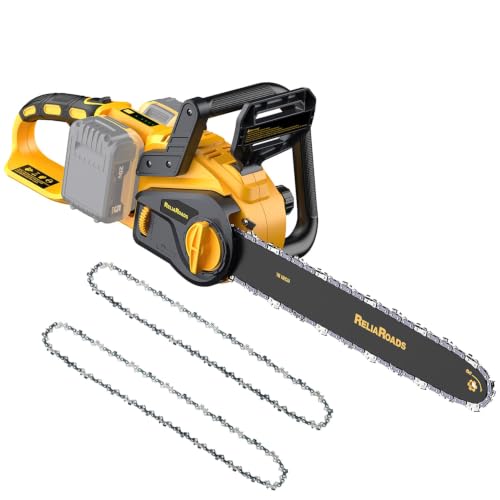
ReliaRoads 16-Inch 40V Brushless Cordless Chainsaw for DeWalt 20V MAX
Picked as a relevant option in this category.
View on AmazonThis is the best value in the roundup for one specific buyer: someone who already owns DeWalt 20V MAX batteries and a charger. Because the tool ships without a battery, you skip the single most expensive component in a cordless saw kit and put packs you already own to work. It suits homeowners with a small woodpile, gardeners clearing overgrown boundaries, and anyone who wants a chainsaw in the truck for storm debris without committing to a new battery platform.
| Spec | Detail |
|---|---|
| Bar length | 16 in |
| Realistic single-pass cut | Roughly 12–14 in diameter |
| Motor | Brushless, cordless |
| Battery | Runs on DeWalt 20V MAX packs (tool only) |
| Weight class | About 8–10 lb with a pack fitted |
| Safety features | Chain brake, hand guard, throttle lockout |
The naming deserves a note, because it confuses buyers. The listing calls the saw 40V and also states it runs on DeWalt 20V MAX batteries. Third-party bare tools in this category often advertise a higher “voltage class” in the product name while physically accepting the DeWalt 20V MAX pack interface. Treat the battery compatibility line, not the headline voltage, as your buying criterion, and confirm which packs your charger and existing tools use before ordering.
The practical case for a bare-tool saw is cost per cut. If you already own two or three 5.0Ah packs, you are effectively adding a 16-inch brushless chainsaw to your kit for the price of the tool alone. Runtime depends entirely on which packs you own: a 5.0Ah pack at 20V MAX stores roughly 100 Wh, which at a load draw in the 600 to 900 W range works out to somewhere near 7 to 10 minutes of continuous cutting. With three packs in rotation you can clear a storm-damaged tree without stopping, which is exactly the job this saw is best at.
Build and maintenance are typical of the budget tier: functional plastics, a small oil reservoir, tool-free chain tensioning, and a brushless motor that should outlast the bar. Keep the chain sharp, keep the bar oil topped up, and do not run it with a flat pack — deep discharges shorten lithium battery life, and those packs are the expensive part of your kit.
Pros
- Bare tool pricing makes it the cheapest way into a 16-inch cordless saw if you own the batteries
- Brushless motor for efficiency and longer service life
- Uses packs you already own, so no new platform or charger
- 16-inch bar handles most storm and limbing work in one pass
- Light enough for extended use compared with a gas saw
Cons
- No battery or charger in the box, so total cost depends on what you already own
- The 40V naming versus 20V MAX compatibility can be confusing
- Runtime is capped by your existing pack sizes
- Budget-tier build and oiler compared with premium brands
- Not intended for felling large trees
Against the DDKUN 16-inch saw for DeWalt 20V MAX batteries, the two are aimed at exactly the same buyer and both ship without a battery. The deciding factors are small: bar and chain class, whether tensioning is tool-free, and whether the oiler is automatic. Against the SEESII 40V 16-inch cordless, the trade is platform versus kit — the ReliaRoads saves money if you are already in the DeWalt ecosystem, while the Seesii gives you a matched battery and charger setup out of the box.
8. DDKUN 40V 16-Inch Chainsaw for DeWalt 20V Batteries – Best for a Low-Cost Second Cordless Saw

DDKUN 40V 16-Inch Chainsaw for DeWalt 20V Batteries(Battery not included)
Picked as a relevant option in this category.
View on AmazonThis is the budget cordless option for DeWalt 20V MAX owners who want a second saw — one to keep in the shed, one in the truck, or one for a family member to use without borrowing the good saw. It suits light-duty users whose jobs are pruning, limbing and cutting fallen branches up to about a foot across. It does not suit anyone expecting gas-saw endurance or professional build quality.
| Spec | Detail |
|---|---|
| Bar length | 16 in |
| Realistic single-pass cut | Roughly 12–14 in diameter |
| Battery | Runs on DeWalt 20V MAX packs (battery not included) |
| Weight class | About 8–10 lb with a pack fitted |
| Safety features | Chain brake, hand guard, throttle lockout |
| Chain class | Low-profile, 0.050 in gauge class |
The value proposition is straightforward: this is the lowest entry cost in the roundup if you already own compatible packs. There is no battery, no charger and no fuel system to maintain. You charge what you have, fit a pack, tension the chain, fill the oiler and cut. For someone whose annual cutting is measured in a few wheelbarrows of storm debris, that is entirely sufficient — and far better than doing the same job with a handsaw or loppers.
As with any bare-tool listing, verify battery compatibility before you buy. The saw is specified for DeWalt 20V MAX packs, and the “40V” in the product name refers to the saw’s advertised voltage class rather than a separate battery system. If your packs are a different brand or a different voltage platform, this saw is not for you — no adapter makes that a good idea, because voltage and current mismatches can damage both the tool and the pack.
Realistic expectations matter. A 16-inch bar on a budget cordless powerhead will cut 12-inch softwood without complaint and will slow noticeably in dry hardwood. Keep the chain sharp, use light pressure and let chain speed do the work. Budget-tier saws punish forcing more than premium ones do, because the motor controller protects itself by cutting power when the load spikes. Consumables are standard low-profile chain and bar oil, both cheap and widely available.
Pros
- Lowest-cost route to a 16-inch cordless saw if you already own DeWalt 20V MAX packs
- No fuel, no exhaust, no starting procedure and minimal maintenance
- 16-inch bar covers most limbing and light bucking jobs
- Light enough for one-handed work at moderate heights
- Standard low-profile chain keeps sharpening and replacements cheap
Cons
- Battery and charger are not included
- Budget-tier motor and oiler compared with mid-range and premium saws
- Runtime depends entirely on the packs you own
- Slows noticeably in dry hardwood at the top of its cut range
- Voltage naming in the listing requires careful reading
Against the ReliaRoads 16-inch brushless model, the DDKUN is the more budget-oriented of the two, and the brushless motor in the ReliaRoads is the better long-term bet for efficiency and motor life. Against the SEESII 40V 16-inch cordless, the DDKUN wins on upfront cost for DeWalt owners and loses on everything else — build, oiler, included batteries and overall refinement. If you already own the packs and want a spare, it is a sensible buy; if you are starting from zero, a kit with batteries is usually the better value.
9. Seesii 6-Inch Mini Cordless Chainsaw with 2 Batteries – Best for Garden Pruning and Light Limb Work

Seesii Mini Chainsaw, 6-inch Mini Chainsaw Cordless, Handheld Electric Power Chain Saw with 2 Batteries, for Tree Trimming Wood Cutting, Best Gifts for Father, Dad, Husband, Men
Chosen because it specifies 6-inch Mini Chainsaw Cordless and Handheld Electric Power Chain Saw with 2 Batteries.
View on AmazonThis is the smallest tool in the roundup and the easiest to live with for pure garden work. A 6-inch bar and a handheld body, supplied with two batteries, make it a practical replacement for a pruning saw on branches up to about 4 inches. It suits gardeners, allotment owners, caravanners and anyone who wants to tidy a hedge line or break down prunings without the weight and noise of a full chainsaw. It is not a firewood tool.
| Spec | Detail |
|---|---|
| Bar length | 6 in |
| Realistic single-pass cut | Roughly 3–4 in diameter |
| Batteries | Two packs included |
| Weight class | About 2–3 lb with a pack fitted |
| Operation | One-handed, handheld body |
| Safety features | Hand guard, trigger lockout, tool-free chain tensioning |
Two batteries in the box is the detail that makes this a workable tool rather than a novelty. A mini saw’s pack is small, so runtime per charge is short; having a second pack means you can keep working while the first cools. Cooling between discharges is not just convenience — lithium packs that go straight from a hot tool onto a charger degrade faster, so rotation is a genuine longevity habit, not fussiness.
The right way to use a 6-inch mini saw is with patience and a sharp chain. Its chain is small, so it dulls faster than a full-size chain, particularly if you cut near the ground where grit is unavoidable. Keep a spare chain, learn to touch it up with the correct small file, and the tool stays useful for years. Push it hard with a dull chain and the motor stalls, the pack overheats, and the saw feels far weaker than it is.
Where it excels is reach and control. At roughly 2 to 3 lb, it is light enough to hold overhead while you take out a broken branch, and small enough to use inside a shrub where a full-size saw cannot reach. Battery-powered operation also means you can use it in a garden without waking the neighborhood, and there is no fuel to store or go stale between uses.
Pros
- Two batteries included, which keeps a small tool genuinely usable
- Very light and easy to control one-handed
- No fuel, no exhaust, quiet enough for suburban gardens
- Budget tier pricing makes it an inexpensive addition to a tool kit
- Tool-free chain tensioning keeps setup quick
Cons
- Cut capacity stops around 4 inches
- Small chains dull quickly and need frequent attention
- Short runtime per battery
- Not suitable for firewood or felling
- One-handed use requires care to avoid kickback
Against the SEESII Flagship 8-inch brushless mini, the 6-inch model is lighter and cheaper but less capable and less efficient — the brushless motor in the 8-inch version delivers more cutting per charge and a longer motor life. Buy the 6-inch if your cuts are consistently small and portability is everything; buy the 8-inch if you regularly cut branches in the 4- to 6-inch range. Against any full-size saw in this list, both minis are complements, not replacements.
10. VEVOR 20-Inch 62cc Gas Chainsaw, 3.8 HP – Best for Big Logs on a Budget
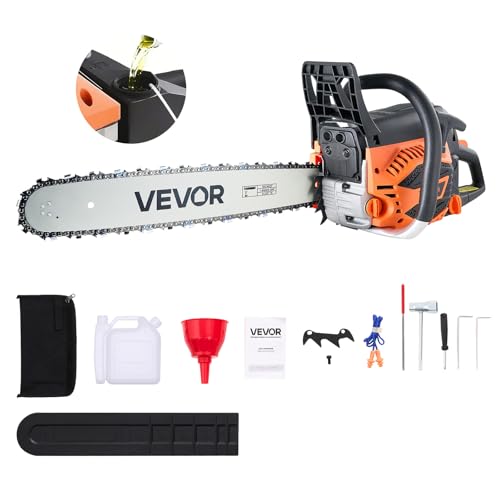
VEVOR 20inch 62CC Gas Powered Chainsaw, 3.8 HP 2 Stroke Engine Gas Power Chainsaws with Non-Slip Handle, Gas Chainsaws with Dual Fuel Tanks, For Wood Cutting, Tree Trimming, and Land Clearing
Chosen because it specifies Gas Chainsaws with Dual Fuel Tanks and For Wood Cutting.
View on AmazonThis is the largest-displacement saw in the roundup and the one to consider if your problem is big wood and your budget is not. A 62-cc two-stroke engine rated in the 3.8 HP class driving a 20-inch bar gives you genuine capacity for bucking large logs, milling-sized trunks and storm-f
More from Amazon
Programs that pair well with the guide above. Offers and eligibility are set by Amazon and may change.
Free shipping on eligible items, Prime Video and more. Eligible new members can start with a free trial.
Start a Prime free trialA Prime membership for ages 18-24 with a trial period. Eligibility is set by Amazon.
See Prime for Young AdultsAudiobooks and podcasts to listen to on the go. Eligible new members can start with a free trial.
Try Audible freeAd-free music streaming. Eligible new subscribers can start with a free trial.
Try Music Unlimited freeAs an Amazon Associate we earn from qualifying purchases.





Write Your Review
No reviews yet. Be the first to share your experience!