
Our Top Picks
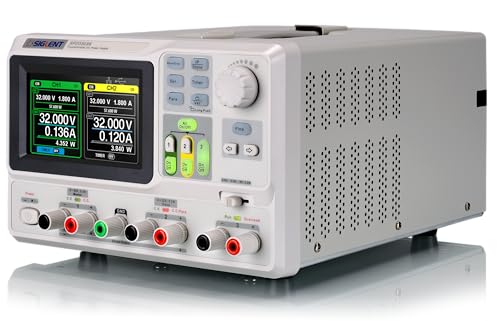 Siglent Technologies SPD3303X-E Triple Output Power Supply16 x 14 x 11 inches17.6 PoundsCheck on Amazon
 MATRIX MPS-3033X Triple Output Programmable 198W Linear Bench10-inch, 4.3inch, 15inch10 x 15 x 4.3 inches18.7 poundsCheck on Amazon
Shopping for a triple output programmable bench power supply, the Siglent SPD3303X-E is the best overall pick for most readers: three genuinely independent channels, a tracking mode that ties the two main outputs together, series and parallel modes for more voltage or more current, and a linear topology that keeps switching noise off your rails — all at a budget-tier price. It suits students, makers, repair techs and small labs that need two adjustable rails plus a fixed logic rail without paying premium money. If scripting and a network port matter more than anything else, the Rigol DP832 is the stronger budget-tier buy; if calibration paperwork and long-term support matter more than price, the B&K Precision 9129B is the premium answer. For high-current work — motors, solenoids, high-power LED strings — the MATRIX MPS-3063XP and its 6 A channels are the outlier worth paying for. Everything below is organised by the job you actually need done, not by spec-sheet length.
Top 3 Picks
Best overall: Siglent SPD3303X-E
Two adjustable 32 V/3.2 A class channels plus a selectable 2.5 V / 3.3 V / 5 V third rail covers the overwhelming majority of bench work, and independent, tracking, series and parallel modes mean you can reconfigure instead of buying a second supply. It is the best value in the roundup for anyone who wants real programmable behaviour without a premium budget.
Best budget: Rigol DP832
Three channels at a 195 W total budget, a 5 V/3 A logic rail, and the full Rigol SCPI interface set with USB, LAN and RS232. If you are automating measurements with a script or a Python library, this is the cheapest way into a proper programmable bench supply with a network port.
Best premium: B&K Precision 9129B
Built for people who need documented accuracy, a mature remote command set and a support and calibration path that lasts a decade. It costs premium-tier money and is worth it when a failed measurement costs more than the instrument.
Quick Comparison
Every unit below is a real, currently listed product. Price tiers are general market bands — budget sits at the entry end, mid-range covers the programmable sweet spot, premium covers calibration-grade and high-power instruments. Street prices move constantly, so treat the tiers as a guide and check current listings.
| Product | Best for | Key specs (as listed) | Price tier |
|---|---|---|---|
| Siglent SPD3303X-E | Best overall for most benches | 3 outputs; 2 × 0–32 V/3.2 A class; 3rd rail 2.5/3.3/5 V; independent, tracking, series, parallel modes; linear | Budget |
| MATRIX MPS-3033X | Mid-range builds needing a low-voltage rail | 30 V/3 A + 30 V/3 A + 6 V/3 A; 198 W total; linear; three programmable channels | Mid-range |
| Tekpower TP-3005D-3 | Analog-style hobby and repair work | 2 × 0–30 V/0–5 A adjustable; 3rd fixed logic output; linear; coarse-resolution displays | Budget |
| Rigol DP932U | Automated benches and scripted test | 32 V/3 A + 32 V/3 A + 6 V/3 A; ~210 W class total; linear; USB/LAN remote control | Mid-range |
| Rigol DP832 | Best budget programmable triple output | 3 channels; 30 V/3 A + 30 V/3 A + 5 V/3 A; 195 W total; USB, LAN, RS232 | Budget |
| B&K Precision 9129B | Premium accuracy and support life | Triple output linear; dual 0–30 V/3 A class adjustable channels plus a low-voltage logic rail; USB remote control | Premium |
| MATRIX triple output (0–30 V / 0–6 V class) | Tightest budgets and single-purpose builds | Triple output linear; 0–30 V class main channel, 0–6 V class low-voltage channel, 3 A class current | Budget |
| ITECH IT6302 | Mid-range with a clean 5 V logic rail | 30 V/3 A/90 W + 30 V/3 A/90 W + 5 V/3 A/15 W; 195 W total; programmable; list mode | Mid-range |
| MATRIX MPS-3063XP | High-current loads at 6 A per channel | 30 V/6 A class triple output; 540 W total; linear; programmable | Premium |
| MATRIX 350 VA AC source | AC-input devices and frequency testing | Single-phase SPWM AC source; 300 V, 3 A, 45–250 Hz; 350 VA | Mid-range |
| NURII benchtop DC supply (E36312A family format) | Premium multi-rail logic and analog work | Three-output architecture referenced to the E36311A/E36312A/E36313A family; 6 V high-current channel plus bipolar rails in the 80 W class | Premium |
| ITECH IT6332A | Premium high-current plus 5 V rail | 30 V/6 A/180 W + 30 V/6 A/180 W + 5 V/3 A/15 W; 375 W total; programmable | Premium |
How We Chose
This roundup is built from published manufacturer specifications, listing data and category standards rather than bench testing. We did not measure, disassemble or own any of these units. Instead, each product was judged against five criteria that decide whether a triple output supply is actually useful five years after purchase.
First, output independence: does the third channel work as a real rail, or is it slaved to the main pair? Second, the voltage and current envelope — a 30 V/3 A class channel covers most analog and digital prototyping, while 6 A channels open up motors and solenoids. Third, programming: SCPI support, USB-TMC, LAN/LXI, RS232 or GPIB, plus whether the vendor publishes a documented command set and drivers. Fourth, display and readback resolution, because a supply that sets in 10 mV steps is a different instrument from one that sets in 1 mV steps. Fifth, protection: overvoltage, overcurrent, overpower and over-temperature shutdown, plus how the supply behaves when a load faults. We also weighted category fit and upgrade path — whether the unit can grow with a bench, or will be the first thing replaced.
1. Siglent SPD3303X-E – Best for first benches and teaching labs
Siglent Technologies SPD3303X-E Triple Output Power Supply
Picked as a relevant option in this category.
View on AmazonThe SPD3303X-E is the instrument most people should buy first. It gives you two adjustable 32 V/3.2 A class channels and a third rail that switches between 2.5 V, 3.3 V and 5 V — the three voltages that show up on nearly every microcontroller, sensor and logic board. It suits students, makers, repair technicians and small product-development labs that need a supply which behaves predictably and can be reconfigured rather than replaced.
Key specs as listed
- Three outputs: two adjustable channels in the 0–32 V / 3.2 A class, plus a selectable 2.5 V / 3.3 V / 5 V logic rail
- Operating modes: independent, tracking (CH1 and CH2 move together), series for higher voltage, parallel for higher current
- Linear regulation — no switching ripple to contaminate low-level measurements
- Setting and readback resolution in the 10 mV / 1 mA class on the -E variant (the non-E SPD3303X steps finer)
- USB connectivity as standard; confirm the exact interface list for the specific SKU if you need LAN
- Timer and output sequencing functions on the X-series firmware
The strength of this unit is mode flexibility. Series mode stacks the two main channels to reach roughly double the voltage; parallel mode combines them for roughly double the current; tracking mode keeps a symmetric ±rail locked together, which is exactly what op-amp and audio work needs. Because the third rail is set with a button rather than a dial, wiring a logic board takes seconds. The linear topology is the other quiet advantage: at low output currents there is no high-frequency switching residue riding on the DC, so a 1 mV signal is still a 1 mV signal.
Pros
- Four operating modes from one chassis — very few budget supplies offer series, parallel and tracking together
- Fixed 2.5/3.3/5 V third rail covers most logic-level work without a second instrument
- Linear output suits sensitive analog measurement
- Compact footprint for a three-channel linear supply
- Strong community documentation and SCPI examples
Cons
- 10 mV / 1 mA class resolution on the -E is coarser than the premium tier and than some mid-range rivals
- No four-wire remote sense, so lead resistance is uncompensated at higher currents
- Third channel is a fixed-select rail rather than a fully variable output
- Total power is modest — you cannot run both main channels at maximum into heavy loads indefinitely
Against the Rigol DP832, the choice is about priorities rather than quality. The DP832 gives you a fully variable 5 V/3 A third channel and a broader remote interface set including LAN and RS232, which matters if scripting is central. The SPD3303X-E counters with tracking mode and a selectable logic rail that is faster to use by hand. If you spend more time at the bench with your hands than in a terminal, the Siglent is the friendlier instrument; if you spend more time writing test scripts, the Rigol pulls ahead. Against the Tekpower TP-3005D-3, the Siglent costs a tier more but adds programmable set points and real resolution — the Tekpower’s coarser displays are a step back for anything precision-related.
2. MATRIX MPS-3033X – Best for mid-range builds that need a dedicated low-voltage rail
MATRIX MPS-3033X Triple Output Programmable 198W Linear Bench DC Power Supply, 30V 3A, 30V 3A, 6V 3A, 3 Channel Independent and Isolated Outputs, 1mV 1mA Resolution
Chosen because it specifies 30V 3A and 30V 3A.
View on AmazonThe MPS-3033X is aimed at the builder who has outgrown an entry-level supply but does not need calibration-grade instrumentation. It delivers two 30 V/3 A class channels and a third 6 V/3 A channel, for a listed 198 W total across three programmable outputs in a linear design. It suits embedded developers, robotics teams and small production benches that routinely power a 5 V or 3.3 V logic rail alongside one or two higher-voltage analog rails.
Key specs as listed
- Three channels: 30 V/3 A + 30 V/3 A + 6 V/3 A
- 198 W total output power
- Linear regulation with programmable set points on all three channels
- Independent channel operation with per-channel voltage and current limits
- Front-panel keypad and display for set point entry, plus remote control via the standard serial interface on this class of instrument
The 6 V third channel is the differentiator. Where the Siglent gives you three discrete logic voltages, the MPS-3033X gives you a continuously variable low-voltage rail — useful when a board wants 4.2 V for a lithium cell emulation, 3.6 V for a radio module, or a slow ramp from 0 V to 5 V while you watch inrush current. Because it is a separate channel with its own current limit, a short on the logic rail does not disturb whatever the main channels are doing.
Linear regulation at this power level means real heat. Expect a fan, expect warmth, and expect the chassis to need clearance at the rear. In exchange you get low output ripple, which matters when you are measuring microvolt-level signals or characterising a low-noise amplifier. Current limiting is set per channel, so you can protect a delicate sensor on one rail while running a motor driver on another.
Pros
- Continuously variable 6 V third channel is more flexible than a fixed-select logic rail
- Three fully programmable channels at a mid-range price tier
- 198 W total supports realistic multi-rail prototypes
- Linear topology keeps ripple low for sensitive analog work
- Per-channel current limiting protects downstream hardware
Cons
- Fans and heat are unavoidable with a linear supply of this power class
- No remote sense in this tier, so long leads cost you accuracy at 3 A
- Interface options vary by variant — verify SCPI, LAN and driver support before buying
- Heavier and bulkier than a switching supply of similar ratings
Compared with the ITECH IT6302, both units land in the mid-range tier with a similar three-channel concept, but the IT6302 uses a 5 V/3 A/15 W fixed third rail while the MPS-3033X offers a variable 6 V/3 A channel. If you need exactly 5 V and nothing else, the ITECH is the more literal fit; if you want to sweep a low-voltage rail during development, the MATRIX is the better tool. Against the premium MPS-3063XP in this list, the 3033X gives up half the current per channel — 3 A versus 6 A — which is the single biggest decision point between them.
3. Tekpower TP-3005D-3 – Best for budget analog and repair benches

Tekpower TP-3005D-3 Digital Variable Triple Outputs Linear-Type DC Power Supply, 0-30 Volts @ 0-5 Amps
Chosen because it specifies 0-30 Volts @ 0-5 Amps.
View on AmazonThe TP-3005D-3 is the traditional workhorse: two adjustable linear channels at 0–30 V and 0–5 A, plus a third fixed logic output, in a chassis that has been a fixture of hobby benches and repair shops for years. It suits people who want knobs, coarse set points and a supply that can push 5 A into a load without complaining — battery charging experiments, motor testing, automotive 12 V work and general troubleshooting.
Key specs as listed
- Two adjustable linear outputs, 0–30 V at 0–5 A each
- Third fixed logic output for 5 V-class digital work
- Independent and tracking operation on the two main channels
- Coarse-resolution panel meters — typically in the 0.1 V / 0.01 A class rather than millivolt resolution
- No SCPI programming interface in this class; set points are entered by hand
What the Tekpower does well is deliver current cheaply. A 5 A ceiling on both main channels is generous at this price tier, and the linear design means the output is quiet. For charging a battery pack, driving a brushed motor, or finding a short on a vehicle harness, a supply that simply holds 13.8 V at several amps is more useful than a precise instrument with a 3 A limit. The tracking mode ties the two channels together for split-rail work, which covers most op-amp experiments.
The trade-off is measurement quality. Coarse panel meters mean you are reading roughly where you set, not exactly where you set, and there is no remote readback to correct it. If your work depends on knowing the output is 3.300 V rather than 3.3 V, this is the wrong instrument. If your work depends on pushing 4 A into something warm, it is the right one.
Pros
- 5 A per main channel is unusually high for the budget tier
- Two adjustable channels plus a logic output in one chassis
- Linear output with low ripple
- Simple, knob-driven operation with nothing to configure
- Robust, repairable construction typical of this class
Cons
- No programmable interface — no SCPI, no scripting, no automated logging
- Coarse display resolution limits precision work
- Third channel is fixed rather than variable
- Bulkier and heavier than programmable rivals at the same rating
Versus the MATRIX budget triple output later in this list, the Tekpower wins on current headroom — 5 A versus a 3 A class third channel and 3 A class main channels — while the MATRIX unit wins on set-point granularity and programmable behaviour. Versus the Rigol DP832, the split is stark: the DP832 gives you millivolt-class set points and a network port, and the Tekpower gives you two extra amps per channel. Pick by whether you are chasing precision or power.
4. Rigol DP932U – Best for automated benches and scripted test
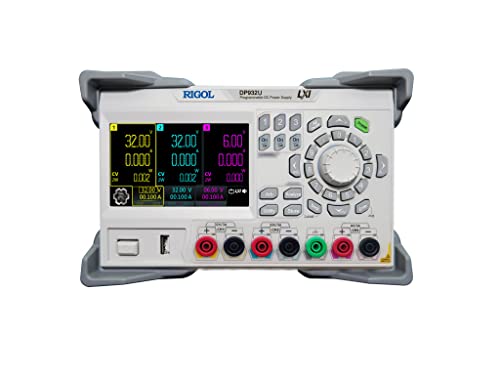
Rigol DP932U Programmable DC Power Supply, Triple Output Linear Bench Power Supply, 32V/3A + 32V/3A + 6V/3A, 210W, Low Ripple, USB/LAN, Safety Terminals for Lab, Education, Testing and Repair
Chosen because it specifies Triple Output Linear Bench Power Supply and 32V/3A + 32V/3A + 6V/3A.
View on AmazonThe DP932U is a modern programmable triple output supply built around remote control. Its three channels are rated 32 V/3 A, 32 V/3 A and 6 V/3 A, for roughly 210 W of total output in the class, and it is designed to sit inside an automated test setup rather than only on a bench. It suits engineers building repeatable test sequences, production verification stations and labs where the supply is one instrument in a rack of them.
Key specs as listed
- Three channels: 32 V/3 A + 32 V/3 A + 6 V/3 A, approximately 210 W class total
- Linear regulation for low-noise output
- SCPI command set with USB and LAN connectivity for remote programming and data logging
- Per-channel voltage and current set points with programmable protection limits
- High-resolution front-panel display with graphical readout of channel state
- Timing and sequence functions for ramps and step tests
The reason to choose the DP932U over a cheaper programmable supply is the quality of its remote interface. A documented SCPI command set, stable LAN behaviour and drivers that work with common instrumentation environments mean you can script a test once and run it a thousand times without babysitting. When a supply drops a command or returns an ambiguous reading, the whole measurement is suspect — and that reliability is what you are paying for in this tier.
The 6 V third channel is a genuine advantage for modern digital hardware. Boards that boot at 5 V and settle at 3.3 V, or that need a 4.2 V lithium-cell emulation, cannot be tested properly on a fixed 5 V rail. Being able to sweep that channel while logging current gives you inrush and sleep-current data that a fixed rail simply cannot produce.
Pros
- Reliable SCPI over USB and LAN — ideal for automated sequences
- Variable 6 V third channel covers lithium and low-voltage logic testing
- Higher main-channel voltage than the 30 V class, useful for 24 V systems with margin
- Linear output keeps measurement noise low
- Timing and sequence functions reduce the need for external control hardware
Cons
- Costs more than the budget-tier programmable options for similar channel counts
- 3 A per main channel is not enough for motor or solenoid work
- No four-wire remote sense in this class
- Interface options and firmware features vary by variant — confirm before buying
Against the Rigol DP832, the DP932U is the newer, higher-voltage, more automation-focused sibling: 32 V instead of 30 V, a 6 V instead of 5 V third channel, and roughly 210 W instead of 195 W total. The DP832 remains the better value if you simply want a programmable triple output and do not need the extra headroom. Against the ITECH IT6302, the DP932U wins on the variable third channel and the broader tooling ecosystem, while the IT6302 is the more literal 5 V logic-rail machine.
5. Rigol DP832 – Best for value-focused programmable triple output

Rigol DP832 Programmable Linear Dc Power Supply,3 Channels,195W Total Power,Maximum Output Range 30V/3A || 30V/3A, 5V/3A
Chosen because it specifies 3 Channels and 195W Total Power.
View on AmazonThe DP832 is the value benchmark in programmable triple output supplies: three channels rated 30 V/3 A, 30 V/3 A and 5 V/3 A with a 195 W total power budget, a clear front-panel display and a full remote interface set. It suits anyone who wants to automate a bench on a budget — students building a first scripted test rig, small labs standardising on one supply, and makers who want logging without paying mid-range money.
Key specs as listed
- Three independent channels: 30 V/3 A + 30 V/3 A + 5 V/3 A
- 195 W total output power
- Linear regulation with millivolt/milliamp class setting resolution on the family specification
- USB, LAN and RS232 interfaces with SCPI remote programming
- Per-channel overvoltage and overcurrent protection settings
- Bright front-panel display with per-channel voltage, current and power readout
What makes the DP832 remarkable is how much of the professional workflow it delivers at a budget tier. You get set-point resolution fine enough for logic-level work, current limiting that protects your circuit rather than your supply, and a LAN port that lets you run a long-duration test from another room while logging to a file. Series and parallel combinations are available for higher voltage or current when a single channel is not enough.
Total power is the constraint to plan around. With 195 W across three channels, running both 30 V channels at full 3 A into heavy loads at the same time is close to the ceiling; you are not buying unlimited simultaneous output. In practice most bench work is one or two channels at a few hundred milliamps, so the budget is comfortable — but if your plan is three simultaneous high-current loads, step up to a higher-power unit like the MPS-3063XP or IT6332A.
Pros
- Genuinely programmable with USB, LAN and RS232 at a budget-tier price
- Millivolt/milliamp class resolution for logic-level precision
- Per-channel protection settings protect both the load and the instrument
- Series and parallel modes extend the usable envelope
- Widely documented SCPI command set with third-party library support
Cons
- 5 V fixed third channel is less flexible than a variable 6 V rail
- 195 W total is easily reached if all channels run hard
- 3 A per channel rules out high-current motor work
- No remote sense terminals in this class
Against the Siglent SPD3303X-E, the DP832 is the more automation-friendly instrument: three fully variable channels including the 5 V rail, plus a broader interface set. The Siglent counters with tracking mode and a selectable 2.5/3.3/5 V rail that is quicker by hand. Against the DP932U, the DP832 gives up a little voltage headroom and the variable 6 V channel, but stays comfortably in the budget tier — which is exactly why it is the pick for readers who want programmability first and maximum flexibility second.
6. B&K Precision 9129B – Best for premium accuracy and long support life

B&K Precision 9129B Triple Output Power Supply
Picked as a relevant option in this category.
View on AmazonThe 9129B is a triple output linear supply from a manufacturer whose instruments are specified, documented and supported for the long haul. It provides two adjustable 0–30 V/3 A class channels plus a low-voltage logic output, with USB remote control and a command set designed for integration. It suits professional labs, calibration-sensitive work, educational institutions and anyone who has been burned by an instrument that died or fell out of support after three years.
Key specs as listed
- Triple output linear design: two adjustable channels in the 0–30 V / 3 A class plus a low-voltage logic rail
- Independent, series, parallel and tracking operation on the adjustable pair
- USB interface with SCPI remote programming
- Full protection set: overvoltage, overcurrent and over-temperature protection with front-panel indication
- Documented accuracy specifications and a published calibration procedure
The premium here is not extra channels or extra amps — it is certainty. When a specification sheet states accuracy as a percentage plus a fixed offset, and the manufacturer publishes the calibration method and supports the instrument with service documentation, you can build a measurement uncertainty budget around it. That matters in regulated environments, in education where instruments are used for years, and in any lab where a wrong reading leads to a wrong decision.
Ownership realities also favour this tier. Premium bench supplies typically use higher-grade binding posts, better thermal design and more conservative component derating, which translates into longer service intervals. Fans remain the first wear item, followed by electrolytic capacitors in the output stage and mechanical wear in front-panel controls — but a well-built linear supply can stay in service for a decade or more with occasional calibration.
Pros
- Documented accuracy and calibration path — rare at this level of clarity
- Full protection set including over-temperature shutdown
- Long-term manufacturer support and service documentation
- Tracking, series and parallel modes for flexible rail generation
- Built for continuous duty in a rack rather than occasional hobby use
Cons
- Premium-tier pricing is hard to justify for occasional hobby use
- 3 A per channel still limits motor and solenoid testing
- Larger and heavier than budget rivals with similar ratings
- Third channel is a low-voltage logic rail, not a third full-range supply
Against the Rigol DP932U, the 9129B trades a variable 6 V third channel and a lower price for documented accuracy, a formal calibration path and longer support life. If you need to prove your measurement, the B&K is the safer instrument; if you need flexibility and automation on a mid-range budget, the Rigol is the practical pick. Against the ITECH IT6332A, the comparison is current versus certainty — the ITECH gives you 6 A channels and 375 W, while the 9129B gives you specification confidence at 3 A.
7. MATRIX Programmable Linear DC Power Supply (Triple Output) – Best for the tightest budgets

MATRIX Programmable Linear DC Power Supply Variable, Triple Output Bench Power Supply 0~30V/0~6V/0~3A, Adjustable Power Supply High Precision 1mV/1mA Resolution Low Ripple and Noise, MPS-3033X
Chosen because it specifies Triple Output Bench Power Supply 0~30V/0~6V/0~3A and MPS-3033X.
View on AmazonThis MATRIX unit is the entry point into triple output linear supplies: a main channel in the 0–30 V class, a low-voltage channel in the 0–6 V class, and a 3 A class current ceiling, in a programmable bench format. It suits readers who need three rails on a strict budget — students, first-time buyers, and anyone equipping a spare bench where the supply will spend most of its life powering one small board at a time.
Key specs as listed
- Triple output linear design with a 0–30 V class main channel and a 0–6 V class low-voltage channel
- 3 A class current capability
- Programmable set points with front-panel control
- Adjustable voltage and current limits for load protection
- Compact benchtop chassis with digital readout
The value proposition is straightforward: you get the channel count and the linear output that make a bench workable, and you give up resolution, interface options and power headroom. For a student learning to bias a transistor, or a hobbyist powering an Arduino and a sensor board, that trade is entirely reasonable. The low-voltage channel handles logic rails without needing a second instrument, and the adjustable current limit means a wiring mistake usually costs you a fuse rather than a microcontroller.
Where this class of supply shows its limits is in precision and automation. Expect coarser set-point granularity than the mid-range and premium instruments, and do not expect a polished SCPI ecosystem for scripted testing. If your plan is to log current draw over a twelve-hour battery test, this is not the right tool — a programmable mid-range unit with a LAN port will save you a great deal of frustration.
Pros
- Three outputs at the lowest price tier in this roundup
- Linear regulation for low-noise rails
- Adjustable current limiting protects the device under test
- Small footprint suits a crowded bench or a dorm desk
- Low-voltage channel covers common logic rails
Cons
- Coarser resolution than mid-range and premium rivals
- Limited remote programming compared with the SCPI-equipped options
- 3 A class current rules out motors and high-power loads
- No remote sense, so lead drop affects accuracy at full current
Against the Tekpower TP-3005D-3, the decision comes down to precision versus current: the Tekpower offers 5 A per main channel with coarse meters, while this MATRIX unit offers finer set points at 3 A class. Against the Rigol DP832, the gap is interface and resolution — the DP832 costs more but gives you millivolt-class set points, USB, LAN and RS232, which is what turns a supply into a test instrument. Buy this one if budget is the binding constraint; buy the DP832 if it is not.
8. ITECH IT6302 – Best for mid-range benches with a defined 5 V rail

ITECH IT6302 Triple Output Power Supply 30V/3A/90W, 30V/3A/90W, 5V/3A/15W Programmable DC Bench Power Suppy 3 Independent and Isolated Outputs
Chosen because it specifies 30V/3A/90W.
View on AmazonThe IT6302 is a triple output programmable DC supply rated 30 V/3 A/90 W on two channels plus 5 V/3 A/15 W on the third, for 195 W total. It suits engineers who know their logic rail is 5 V and want a clean, well-behaved supply for mixed-signal prototyping, sensor development and small production test, with programming available when they need it.
Key specs as listed
- Three channels: 30 V/3 A/90 W + 30 V/3 A/90 W + 5 V/3 A/15 W
- 195 W total output power
- Programmable set points with remote control over standard serial and USB interfaces
- List mode for sequenced voltage and current steps
- Per-channel overvoltage and overcurrent protection
The IT6302’s appeal is predictability. The channel ratings are explicit — 90 W, 90 W, 15 W — so you can plan a power budget without guesswork. The 5 V rail is exactly 5 V, which suits boards that expect USB-level supply, and list mode lets you step through a voltage sequence without external control hardware. For repetitive bench checks, that combination removes a surprising amount of manual dial-twisting.
The instrument also behaves well as a bench companion rather than a rack instrument. It is designed for hands-on use with clear per-channel readouts, and the protection settings mean a shorted rail trips rather than cooks. For mixed-signal work where you are powering a 5 V digital section and a ±15 V analog section at the same time, the two 30 V channels can be configured to give you the bipolar pair while the third rail feeds the logic.
Pros
- Clearly specified 90 W + 90 W + 15 W power distribution
- Dedicated 5 V/3 A logic rail matches USB-powered hardware
- List mode enables sequenced testing without extra hardware
- Programmable with standard remote interfaces
- Per-channel protection settings protect sensitive loads
Cons
- Third channel is fixed at 5 V, so lithium and 3.6 V testing is awkward
- 3 A per channel limits motor and high-current work
- No remote sense in this class
- Interface and option sets vary by configuration — verify before purchase
Against the MATRIX MPS-3033X, the two are close in tier and channel count, but the third channel differs meaningfully: the ITECH gives you a fixed 5 V/3 A/15 W rail, the MATRIX a variable 6 V/3 A channel with 198 W total. If your target hardware is 5 V and always will be, the ITECH is the cleaner match. If you need to sweep a low-voltage rail or emulate a battery, the MATRIX unit is the better instrument. Against the Rigol DP932U, the ITECH gives up the variable third channel and some automation polish but holds its own on channel ratings.
9. MATRIX MPS-3063XP – Best for high-current loads at 6 A per channel

MATRIX Programmable DC Power Supply Variable, MPS-3063XP 30V 6A Triple Output Bench Power Supply 540W, Adjustable Lab DC Power Supply with 3 Channels, 1mV/1mA Resolution with LAN, SENSE, RS232 and USB
Chosen because it specifies MPS-3063XP 30V 6A Triple Output Bench Power Supply 540W and Adjustable Lab DC Power Supply with 3 Channels.
View on AmazonThe MPS-3063XP is the high-power option in the MATRIX line: a triple output linear supply with 30 V/6 A class channels and a listed 540 W total. It suits people driving real loads — DC motors, solenoids, relay banks, high-power LED arrays, Peltier elements and 24 V industrial hardware — where 3 A per channel is simply not enough.
Key specs as listed
- Triple output with 30 V/6 A class capability per channel
- 540 W total output power as listed
- Linear regulation
- Programmable voltage and current set points per channel
- Per-channel protection with adjustable limits
Doubling the current ceiling changes what a supply can do. A 6 A channel will start a small DC motor, hold a solenoid open indefinitely, drive a 100 W LED module at full brightness, or charge a large battery pack at a useful rate. The 540 W total also means you can run two channels hard simultaneously without immediately hitting the ceiling — a genuine limitation on 195 W units, where three simultaneous heavy loads are impossible.
The cost of that capability is heat, size and noise. A linear supply delivering 540 W dissipates a substantial fraction of what it draws as heat, which is why the chassis is large and the fan is audible. Plan for clearance around the rear and sides, and do not put it in a closed cabinet. The upside of the linear design is the same as everywhere else in this list: clean DC with no switching artifacts, which matters when you are measuring a load that is itself sensitive to supply noise.
Pros
- 6 A per channel unlocks motor, solenoid and high-power LED work
- 540 W total supports multiple heavy loads at once
- Linear output keeps noise low even at high current
- Programmable set points with adjustable protection limits
- Three high-current channels instead of one high-current and two weak rails
Cons
- Premium-tier pricing reflects the power capability
- Heavy, large and noticeably louder than lower-power units
- Overkill for logic-level and low-power analog prototyping
- Heat output demands real bench ventilation
Against the ITECH IT6332A, both are premium high-current triple output supplies, but the architectures differ: the MPS-3063XP lists 540 W across 30 V/6 A class channels, while the IT6332A lists 375 W as 180 W + 180 W + 15 W with a dedicated 5 V rail. If you need a clean 5 V logic rail alongside two heavy channels, the ITECH fits better; if you need three heavy channels, the MATRIX does. Against the 3 A MPS-3033X in the same family,









Write Your Review
No reviews yet. Be the first to share your experience!