
Our Top Picks
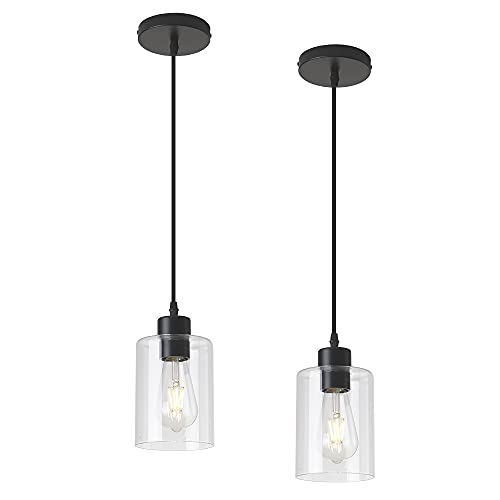 KLSS Modern Black Farmhouse Clear Glass Cylinder Pendantm5 x 4.7 x 4.7 inches3.3 poundsCheck on Amazon
 Daunton Vintage Kitchen Pendant Lights Over Sink Pendant9.45in9.45 x 9.45 x 46.26 inchesCheck on Amazon
Best Kitchen Pendant Lights for Any Room
The best kitchen pendant lights are chosen by matching the fixture’s width, hanging height, lumen output, color temperature, ceiling height, and island size to the room—not by appearance alone.
Quick Picks by Kitchen Situation
| Kitchen situation | Best pendant approach | Useful target specifications | Why it works |
|---|---|---|---|
| Small island or peninsula | One compact pendant or two small pendants | 8–12 inches wide; 600–900 lumens total | Provides focused light without visually crowding the work surface |
| Standard 6-foot island | Two medium pendants | 12–18 inches wide each; 800–1,200 lumens total | Balances even coverage and comfortable sight lines |
| Large island, 8 feet or longer | Three pendants or two larger fixtures | 12–20 inches wide; 1,200–2,000 lumens total | Reduces dark areas between seating and preparation zones |
| Low ceiling | Short, shallow, or semi-flush pendant | 10–16 inches of vertical fixture depth | Preserves headroom and reduces the chance of bumping the fixture |
| High or vaulted ceiling | Adjustable-rod or multi-stem pendant | 18–36 inches of adjustable drop | Brings the light source down to the useful working height |
| Open-plan kitchen | Glare-controlled, dimmable pendant | CRI 90 or higher; 2,700–3,000K; shaded or diffused light | Looks comfortable from adjoining rooms while preserving food color |
How Fixture Width Should Match the Island
Fixture width affects both light distribution and visual proportion. A pendant that is too small can create narrow pools of light and look lost above a large worktop. An oversized pendant can obstruct views across the kitchen and make a compact island feel crowded.
KLSS Modern Black Farmhouse Clear Glass Cylinder Pendant Light Fixture,Island Lights for Kitchen,Mini Pendant Lighting for Kitchen Island Decor - 4.75 Inch Shade 58 Inch Cord (Black 2 Pack)
Chosen because it specifies Island Lights for Kitchen and Mini Pendant Lighting for Kitchen Island Decor.
View on Amazon
Govee Pendant Lights for Kitchen Island, Three-Layer RGBIC Smart Lighting
Chosen because it specifies Three-Layer RGBIC Smart Lighting.
View on Amazon
EDISHINE Pendant Light Kitchen Island Grey Marble Glass Brushed Nickel
Picked as a relevant option in this category.
View on AmazonDaunton Vintage Kitchen Pendant Lights Over Sink Pendant Lights for Kitchen
Picked as a relevant option in this category.
View on AmazonFor a single pendant, a practical starting point is a fixture about one-third to one-half the width of a small island or peninsula. For multiple pendants, calculate the total fixture width and leave clear space between them. Two 14-inch pendants, for example, occupy 28 inches of fixture width before accounting for gaps and end clearances.
Keep the outer pendants at least 6–12 inches inside the island’s ends. On a 72-inch island with two fixtures, a useful layout is to center each pendant roughly 18–22 inches from the island’s midpoint, then adjust for seating, sinks, and sight lines. The exact centers matter less than maintaining balanced spacing and avoiding a pendant directly over a person’s face.
Single, Pair, or Three-Pendant Layout?
- One pendant: Best for islands up to about 48 inches long, especially when the fixture is wide or visually prominent.
- Two pendants: The most versatile choice for islands around 60–84 inches long.
- Three pendants: Usually appropriate for islands at least 84 inches long, provided the ceiling and room width can support them.
- Linear pendant: Useful when you want one continuous fixture over a long island, but choose a model with diffusers or multiple light sources for even illumination.
Choose Hanging Height Before Choosing Style
The usual starting point is to position the bottom of the pendant about 30–36 inches above the countertop. This range keeps the light close enough for useful task illumination while preserving conversation and sight lines. If tall household members frequently work at the island, the fixture may need to sit closer to 36–40 inches.
Measure from the finished countertop, not from the floor. A pendant’s total drop includes the canopy, cord or rod, and shade. A fixture with a 12-inch shade installed 34 inches above the counter needs a drop of approximately 46 inches from the ceiling to the bottom of the shade.
For a 9-foot ceiling, this is usually easy to achieve. With a 10- or 12-foot ceiling, select an adjustable suspension system or add a suitable extension rod. Avoid improvising with incompatible rods or cords; the mounting hardware must support the fixture’s weight and the electrical box must be properly secured.
Lumens: How Much Light Do Kitchen Pendants Need?
Wattage describes energy use, not brightness. Look for lumens, then consider whether the pendant has an open shade, an opaque shade, or a diffuser. A 900-lumen LED fixture may deliver less useful countertop light than an equally bright fixture with a transparent diffuser if much of its light is directed upward or absorbed by the shade.
For pendant lighting used as task lighting, plan on approximately 300–500 lumens per square meter of countertop area, with higher levels useful for detailed food preparation. This should supplement ceiling, under-cabinet, and ambient lighting rather than replace all of them.
Worked example: A 72-by-36-inch island has 18 square feet, or about 1.67 square meters, of surface area. At a target of 400 lumens per square meter, the island needs roughly 670 lumens reaching the worktop. Because shades and distance reduce delivered light, two pendants rated at 500–700 lumens each provide a sensible starting point. Dimming lets you lower the output during meals.
Color Temperature and Color Rendering
For most kitchens, 2,700–3,000K produces a warm, residential appearance. Choose 3,000–3,500K if you prefer a cleaner white that still feels comfortable. Around 4,000K can look crisp in a utility-focused kitchen, but it may feel harsh when the kitchen connects to a warm-toned dining or living area.
Color rendering matters when preparing food and choosing finishes. A pendant with a color rendering index of 90 or higher generally reveals food colors, wood tones, and countertop materials more accurately than a basic low-CRI lamp. If the kitchen already contains under-cabinet lights, keep their color temperature close to the pendants; mixing 2,700K and 4,000K can make the room look uneven.
Ceiling Height and Room Scale
Ceiling height determines how much vertical drop is available, but room width determines whether a pendant feels intrusive. In a narrow galley kitchen, shallow cylindrical or dome-shaped fixtures are safer than large lanterns with wide projections. In a spacious kitchen, larger shades can add presence without blocking circulation.
- 8-foot ceiling: Favor compact pendants, shallow shades, and a 30–34-inch countertop clearance.
- 9-foot ceiling: Most standard pendants work well, including fixtures with moderate drops.
- 10-foot ceiling: Use adjustable cords or rods so the light does not remain too close to the ceiling.
- Vaulted ceiling: Confirm that the canopy is compatible with a sloped ceiling, or specify an angled adapter.
Materials, Maintenance, and Ownership Reality
Glass shades provide broad, attractive illumination but show fingerprints, grease film, and dust. Metal shades are easier to wipe down, although dark finishes can reveal dust quickly. Fabric shades are generally less suitable directly above a cooking area because airborne grease is difficult to remove. Wood and woven materials can add warmth but may require gentler cleaning and more clearance from steam and splatter.
The parts most likely to cause trouble are usually not the shade itself. LED drivers, dimmer compatibility, loose decorative hardware, and brittle cord coverings can affect long-term satisfaction. Check that the fixture is rated for dimming if dimmer control matters, and verify that the dimmer is compatible with the fixture’s driver.
Clean glass and metal shades with the power switched off and the fixture cool. Use a soft, slightly damp cloth rather than spraying cleaner upward into the socket or canopy. For kitchens with frequent frying, clean exposed surfaces every few weeks to prevent a sticky film from collecting dust. Replaceable LED lamps make future maintenance simpler, while integrated LEDs can offer a slimmer design but may require replacing the entire fixture if the driver fails.
Common Buying Mistakes to Avoid
- Choosing by wattage alone: Compare lumens, beam direction, and diffuser design.
- Ignoring glare: Bare bulbs at eye level can be uncomfortable from nearby seating; use frosted lamps, diffusers, or shaded designs.
- Installing too low: A dramatic low pendant can interfere with conversation and movement around the island.
- Forgetting the island’s function: A sink, cooktop, or seating overhang may require lights to shift slightly from the geometric center.
- Mixing incompatible whites: Match pendant and under-cabinet color temperatures as closely as possible.
- Skipping the junction-box check: Heavy fixtures may need reinforced mounting rather than attachment to drywall alone.
Final Buying Checklist
Before ordering, measure the island length and width, ceiling height, and distance from the ceiling to the countertop. Select the number of pendants, calculate their total width, and confirm that the installation leaves clear end margins. Then check lumens, dimming compatibility, color temperature, CRI, shade material, and cleaning access. If the wiring or mounting point is uncertain, have a qualified electrician verify the installation before work begins.




Write Your Review
No reviews yet. Be the first to share your experience!