
Key takeaways
- Balanced: Mass is distributed closer to the hands. Choose this for quick swings, contact, and developing mechanics.
- End-loaded: More weight sits toward the barrel. Choose this for power only when the player can keep the barrel on plane.
- Overall bat weight: The number printed on the bat does not tell the entire story. Two bats with identical length and weight can have noticeably different swing weights.
- Handle design: A thinner handle may feel whippier, while a stiffer handle can provide a more solid response. Comfort and control matter more than a fashionable profile.
The best softball bats for power and control are usually a two-piece composite fastpitch bat for maximum barrel feel, a balanced alloy bat for quicker swings and value, or an end-loaded slowpitch bat when extra mass behind the barrel matters more than rapid bat speed.
Quick picks by player and playing situation
| Player or situation | Best starting choice | Useful specifications | Why it fits |
|---|---|---|---|
| Developing fastpitch hitter | Balanced alloy | 30–32 inches, drop -11 to -10, 2 1/4-inch barrel | Lower cost, immediate performance, and a predictable swing weight |
| Experienced fastpitch power hitter | Two-piece composite | 31–34 inches, drop -10 to -8, 2 1/4-inch barrel | Larger effective hitting area and more mass toward the barrel |
| Contact hitter or player who values quick hands | Balanced alloy or balanced composite | 30–33 inches, drop -11 to -10 | Fast acceleration and easier adjustment to inside pitches |
| Slowpitch power hitter | End-loaded two-piece composite | 32–34 inches, 26–28 ounces, 2 1/4-inch barrel | Extra barrel mass can increase drive when the hitter controls the load |
| Shared team or practice bat | Durable alloy | 31–33 inches, drop -10 or -9 | Less vulnerable to cold-weather damage and repeated use |
Fastpitch and slowpitch bats are not interchangeable
Start by identifying the game format. Fastpitch bats are commonly measured in drop weight, such as -10 or -8, and are designed for faster pitching and quicker swings. Slowpitch bats are commonly described by their length and ounce weight, such as a 34-inch, 27-ounce bat. A slowpitch model may feel too heavy and slow for a fastpitch player, while a fastpitch bat may not meet the construction or certification requirements of a slowpitch league.

Easton | 2026 | Ghost Unlimited Fastpitch Softball Bat | Approved for All Fields | -10 Drop | 33 Inch
Chosen because it specifies 2026 and Ghost Unlimited Fastpitch Softball Bat.
View on Amazon
Easton | CYCLONE Fastpitch Softball Bat | -10 | 31"
Chosen because it specifies CYCLONE Fastpitch Softball Bat and 31".
View on Amazon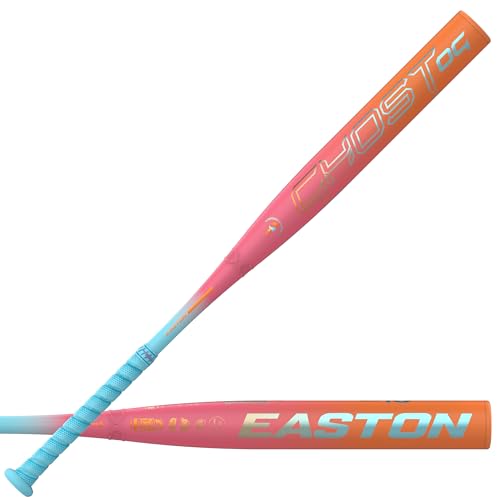
Easton | Ghost OG Rainbow Sherbert Fastpitch Softball Bat | Approved for All Fields | -10 Drop | 33 Inch
Chosen because it specifies Ghost OG Rainbow Sherbert Fastpitch Softball Bat and Approved for All Fields.
View on Amazon
Easton | HAMMER Slowpitch Softball Bat | All-Association | Loaded | 12" Barrel | 33"x26 oz.
Chosen because it specifies HAMMER Slowpitch Softball Bat and All-Association.
View on AmazonFastpitch barrels are generally 2 1/4 inches in diameter. Slowpitch barrels are also often 2 1/4 inches, but the barrel profile, weighting, and permitted performance standards can differ. Check the league rulebook before comparing performance claims or ordering a bat.
How length and drop weight affect control
Drop weight is calculated as length minus weight. A 32-inch, 22-ounce bat is a drop -10 bat; a 33-inch, 25-ounce bat is a drop -8. The lower the negative number, the heavier the bat is relative to its length.
A lighter drop, such as -11, is easier to start and redirect. That helps younger players, contact hitters, and anyone who is late on faster pitching. A -10 bat is a common all-purpose fastpitch choice. A -9 or -8 can produce a heavier collision and more potential power, but only if the hitter can maintain bat speed and a controlled path.
Do not choose length solely by height. A bat that is too long can create late contact and barrel drag. A bat that is too short may limit plate coverage. As a practical check, the player should be able to hold the bat extended to the side for approximately 20–30 seconds without the barrel dropping sharply. This is not a substitute for a coach’s fitting assessment, but it can eliminate obviously oversized options.
A simple weight comparison
Suppose a player is choosing between a 32-inch, 22-ounce drop -10 bat and a 32-inch, 24-ounce drop -8 bat. The second bat is about 9% heavier by scale weight: 24 divided by 22 equals 1.09. Its swing weight may feel more than 9% heavier if extra mass is placed toward the barrel. Choose the -8 only if the hitter can repeatedly square up the ball without losing timing.
Composite versus alloy: which construction is better?
Two-piece composite
Composite bats use layered carbon-fiber materials. Many two-piece designs separate the barrel from the handle with a connector, reducing harsh vibration and allowing the barrel to flex. They often provide a larger-feeling sweet spot and a smoother sensation on mishits. A balanced composite model favors control; an end-loaded model places more mass toward the barrel for power.
The trade-offs are price, break-in, and temperature sensitivity. A composite barrel may need a controlled break-in period before it reaches its intended feel. Avoid using it in very cold conditions unless the manufacturer specifically permits that use. Cold impacts can increase the risk of cracking. Never break in a composite bat by hitting hard objects, rolling it, or using a high-speed pitching machine outside the stated guidance.
One-piece or two-piece alloy
Aluminum alloy bats are typically ready to use immediately and offer a crisp, responsive feel. One-piece alloy bats transfer feedback directly through the handle, which some hitters prefer for precise barrel awareness. Two-piece alloy designs can reduce vibration and tune the flex between the handle and barrel.
Alloy is usually the better ownership choice for frequent team use, batting cages, and lower budgets. It can dent rather than crack, but a deep dent, rattling sound, loose end cap, or visibly damaged connection means the bat should be removed from play. Rotate the bat during cage work so repeated impacts do not concentrate in one area.
Barrel size, swing feel, and power
Most legal fastpitch and slowpitch bats use a 2 1/4-inch barrel, so the important difference is often barrel length and weighting rather than diameter. A longer barrel can make it easier to cover the plate but may feel slower. A compact barrel can improve maneuverability, especially for a hitter who attacks inside pitches.
- Balanced: Mass is distributed closer to the hands. Choose this for quick swings, contact, and developing mechanics.
- End-loaded: More weight sits toward the barrel. Choose this for power only when the player can keep the barrel on plane.
- Overall bat weight: The number printed on the bat does not tell the entire story. Two bats with identical length and weight can have noticeably different swing weights.
- Handle design: A thinner handle may feel whippier, while a stiffer handle can provide a more solid response. Comfort and control matter more than a fashionable profile.
Certification is a buying requirement, not a bonus
Before purchasing, identify the exact organization governing the games. Fastpitch leagues may require a visible USA Softball certification mark, while some tournaments allow bats carrying USSSA, NSA, or ISA approval. College and high-school competition may follow separate rules, and slowpitch associations can have different lists or limits.
Do not assume that a bat is legal because it is advertised as “USSSA approved” or because it has a familiar brand name. Check the current league-approved list, the required stamp, barrel diameter, length-to-weight limit, and any restrictions on altered or reused bats. A bat can be high-performing and still be ineligible for a particular event.
Composite break-in and maintenance
- Confirm the bat is legal for the intended league before using it.
- Inspect the barrel, end cap, knob, and connection for cracks, dents, rattles, or looseness.
- For a composite bat, use approved baseballs or softballs and moderate-speed front toss or tee work according to the manufacturer’s instructions.
- Rotate the bat about one-quarter turn after several hits to distribute wear.
- Keep composite bats at room temperature and do not leave them in a hot car or freezing equipment bag.
- Clean surface marks with a soft, damp cloth; avoid solvents, abrasive pads, and stickers that cover damage.
Break-in is not a license to use a composite bat in a way that creates unnecessary stress. A bat that develops a long crack, structural separation, or abnormal rattle should not be passed around the team. Warranty coverage commonly depends on proof of purchase and compliance with use instructions, so retain the receipt and note the model and serial information.
What to spend
General market ranges vary by season and certification, but alloy fastpitch bats commonly occupy the lower-to-middle price range, while premium two-piece composites are usually more expensive. A budget alloy bat can be the better value if it will be shared, used in cold weather, or carried to frequent practice. A premium composite can justify its cost when one player uses it regularly, benefits from its swing feel, and can protect it from temperature and impact abuse.
For example, a $120 alloy bat used 60 times costs about $2 per use. A $350 composite bat used 175 times costs the same $2 per use, before considering warranty, resale, or damage risk. The more often the bat is used by the same hitter, the easier it is to justify paying for a specific fit rather than buying the most expensive model available.
Final buying decision
Choose the lightest bat that still gives the player enough barrel coverage and solid contact, then select construction based on use. Pick alloy for immediate readiness, durability, and value; pick two-piece composite for a softer feel and a larger-performing barrel after proper break-in. Finally, confirm certification before paying. The best softball bats are not simply the longest, heaviest, or most expensive—they are legal for the league, matched to the hitter’s strength, and light enough to control through the entire swing.










Write Your Review
No reviews yet. Be the first to share your experience!