
Our Top Picks
Best Premium Large-Capacity Smart Washer and Dryer Pairs with Wi-Fi
The best premium large capacity smart washer and dryer pairs with Wi-Fi are the LG 5.2-cubic-foot front-load pair for maximum everyday capacity, the Samsung Bespoke 5.3-cubic-foot pair for app-driven automation, and the GE Profile front-load pair for households that value cycle customization and service diagnostics.
Large capacity does not automatically mean better performance. The useful questions are whether the washer can handle your largest loads without overpacking, whether the dryer has enough drum volume to tumble those loads freely, whether the pair fits through the home and into the laundry room, and whether its connected features solve a real problem rather than simply adding notifications.
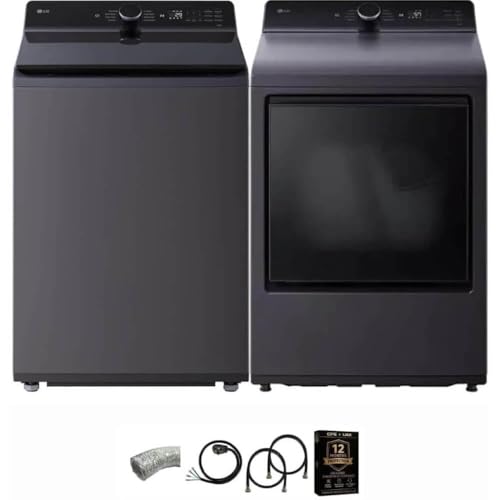
LG Matte Black Mega Capacity Top Load Washer and Dryer Pair with TurboWash Technology SmartThinQ WiFi Connectivity Steam Dry Sensor Dry Dryer Vent Power Cable and 12 Month CPS Protection Plan (Black)
Picked as a relevant option in this category.
View on Amazon
LG 5.0 cu. ft. Mega Capacity Smart Front Load Electric All-in-One Washer Dryer Combo with TurboWash360 WiFi in Black Steel
Picked as a relevant option in this category.
View on AmazonQuick comparison of premium large-capacity pairs
| Pair or platform | Washer capacity | Dryer capacity | Approximate width | Smart features | Best suited to |
|---|---|---|---|---|---|
| LG WM8900HBA and DLGX8901B | 5.2 cu. ft. | 9.0 cu. ft. | 29.6 in. | LG ThinQ Wi-Fi, remote control, cycle downloads, alerts, energy monitoring | Large weekly loads and bulky bedding |
| Samsung WF53BB8700 series and DVE53BB8700 series | 5.3 cu. ft. | 7.6 cu. ft. | 27 in. | SmartThings Wi-Fi, remote monitoring, cycle management, maintenance alerts | Premium features in a narrower footprint |
| GE Profile PFW950SPTDS and PFD95ESPTDS | 5.3 cu. ft. | 7.3 cu. ft. | 28 in. | SmartHQ Wi-Fi, cycle notifications, diagnostics, downloadable cycles | Families wanting flexible controls and service information |
| Electrolux ELFW7637AT and ELFE7637AT | 4.5 cu. ft. | 8.0 cu. ft. | 27 in. | App-enabled features vary by configuration; cycle selection and notifications are the focus | Careful fabric treatment over maximum washer volume |
Dimensions are representative published cabinet dimensions and should not replace the installation drawings for the exact finish and model number. Add clearance for doors, hoses, ventilation, leveling, and service access.
Head-to-head: which pair fits your household?
Best for the largest practical loads: LG WM8900HBA pair
LG’s 5.2-cubic-foot washer and 9.0-cubic-foot electric or gas dryer combination offers an unusually large dryer drum. The washer is suited to multiple baskets of clothing, towels, and most household bedding, while the dryer has more room to separate damp items as they tumble.
ThinQ connects the machines to a phone for cycle notifications, remote start where permitted, downloadable cycles, and troubleshooting information. The useful feature is the ability to receive an alert when a cycle ends or when a maintenance issue is detected. Remote start is less valuable if you still need to load detergent, open a water valve, or comply with local safety restrictions.
The trade-off is physical size. At nearly 30 inches wide and more than 33 inches deep before accounting for hoses and door clearance, this is not a good choice for a narrow alcove or a difficult stairway. Measure the delivery route, not only the final laundry-room opening.
Best for a narrower premium footprint: Samsung Bespoke pair
The Samsung 5.3-cubic-foot front-load washer and 7.6-cubic-foot dryer pair provides large household capacity in a cabinet approximately 27 inches wide. That difference can determine whether the machines fit between walls, beside a utility sink, or through a tight interior doorway.
SmartThings provides remote status, notifications, cycle recommendations, and maintenance information. Samsung’s AI-oriented cycle suggestions can be useful for households that wash mixed loads frequently, although recommendations still depend on correct sorting and loading. The dryer capacity is smaller than LG’s 9.0-cubic-foot model, so very bulky comforters may need more careful loading.
These models are attractive when width matters more than maximum dryer volume. Check the exact depth, because front doors, control panels, and rear connections can make the installed footprint deeper than the cabinet specification suggests.
Best for cycle control and diagnostics: GE Profile pair
The GE Profile 5.3-cubic-foot washer and 7.3-cubic-foot dryer pair emphasizes a broad range of cycle adjustments, stain-oriented options, and connected diagnostics. SmartHQ can send completion alerts and help identify basic problems before a service visit.
This combination makes sense for a household that washes different fabrics frequently: work clothes, sportswear, towels, bedding, and delicate garments. More settings are only beneficial if the household will use them; otherwise, a simpler interface may be easier for everyone to operate consistently.
The 28-inch width is a middle ground. Capacity is substantial, but the dryer does not offer the same extra tumbling space as LG’s 9.0-cubic-foot model.
Decision matrix by real buying situation
| Your situation | Strongest fit | Why | Main compromise |
|---|---|---|---|
| Four or more people, frequent towels and bedding | LG 5.2/9.0 pair | Large washer and exceptionally roomy dryer | Requires more width and depth |
| Large loads but only about 27 inches of width | Samsung 5.3/7.6 pair | High washer capacity in a narrower cabinet | Less dryer volume for bulky items |
| Many fabric types and a desire for diagnostics | GE Profile 5.3/7.3 pair | Flexible cycles and SmartHQ troubleshooting tools | More controls to learn |
| Fabric care matters more than maximum washer capacity | Electrolux 4.5/8.0 pair | Strong focus on wash options and a roomy dryer | Smaller washer tub |
| Infrequent laundry and limited installation budget | A simpler non-premium pair | Fewer connected components and lower purchase cost | Less automation and fewer remote features |
Capacity: calculate whether “large” is large enough
Washer capacity is measured in cubic feet, but usable capacity depends on fabric type. Dense towels and jeans need more free space than lightweight shirts. A practical rule is to fill the drum loosely rather than compressing clothing; the load should be able to move and allow water to circulate.
Consider a household that produces five standard loads each week, including one towel load and one bedding load. If a 4.5-cubic-foot washer requires the bedding to be split into two loads, the weekly total may become six cycles. A 5.2- or 5.3-cubic-foot washer may complete the same work in five cycles. At an average of 45 minutes per wash cycle, that saves approximately 45 minutes of machine time each week, before drying is considered.
The dryer should not be judged by matching numbers. Dryers generally need more drum volume because warm air and tumbling space help moisture escape. A 9.0-cubic-foot dryer has about 18% more nominal volume than a 7.6-cubic-foot dryer, calculated as (9.0 − 7.6) ÷ 7.6. That difference is most noticeable with comforters, towels, and mixed loads.
Wi-Fi features worth paying for
- End-of-cycle alerts: Useful when laundry is in a basement, garage, or separate floor.
- Remote diagnostics: Can help distinguish a blocked filter, unbalanced load, or connection issue from a service problem.
- Cycle downloads: Helpful for specialized items, but not essential for ordinary clothing.
- Energy and usage tracking: Valuable if you want to compare cycles or reduce high-temperature drying.
- Remote start: Convenient, but it does not remove the need to check pockets, lint screens, detergent, and the area around the machine.
Connectivity also creates ownership tasks: app permissions, firmware updates, a stable 2.4-GHz network in some installations, and account setup. If you do not want those responsibilities, choose based on mechanical features and cycle performance instead.
Installation requirements buyers often miss
- Measure the complete route. Record doorway, hallway, stairway, and elevator widths. Remove doors only if the installer permits it and the frame can be safely protected.
- Confirm utilities. A pair normally needs hot and cold water connections, a drain standpipe or laundry sink, a grounded electrical outlet, and a proper dryer connection.
- Choose the dryer fuel first. Electric models require the correct high-voltage circuit. Gas models require an approved gas connection and external venting.
- Plan venting. A vented dryer needs a short, smooth, properly terminated duct. Excessive bends reduce airflow and increase drying time. Ventless models avoid exterior ducting but may use longer cycles.
- Reserve working clearance. Leave room to open the washer door, clean the lint filter, reach shutoff valves, and remove the drain pump filter where applicable.
Durability and maintenance realities
On front-load washers, the door gasket, drain-pump filter, inlet screens, and dispenser are common maintenance points. Wipe the gasket regularly, leave the door ajar after use, and run the manufacturer’s tub-clean cycle. Excess detergent can create residue and odor even when the detergent is labeled high-efficiency.
On dryers, the lint screen should be cleaned after every load. The vent should be inspected periodically, especially if drying times increase. Do not overload the dryer simply because the drum is large; wet, tightly packed fabrics may still dry unevenly.
Smart electronics add convenience but also mean that a machine can be affected by network changes or app support. Before buying, verify that the model has a usable manual control panel and that essential washing and drying functions remain available without Wi-Fi.
Bottom line
Choose the LG pair when maximum dryer space and very large household loads matter most. Choose Samsung when a 27-inch-wide cabinet and polished app integration are priorities. Choose GE Profile when cycle flexibility and diagnostics are more important than the largest drum. Consider Electrolux when fabric-care options outweigh the need for a 5.2- or 5.3-cubic-foot washer.
Whichever pair you select, the correct installation measurements, realistic loading habits, and regular cleaning will matter more to long-term satisfaction than the number of Wi-Fi features listed on the specification sheet.










Write Your Review
No reviews yet. Be the first to share your experience!