
Our Top Picks
 Kawai DG30 88-Key Digital Grand Piano w/Responsive Hammer35 x 58 x 34.25 inches58 x 35 x 34.25 InchesCheck on Amazon
The best grand pianos for most buyers are Yamaha C-Series and Kawai GX-Series for consistent action and value in medium rooms, Steinway Model B and Mason & Hamlin Model BB for serious performance in larger homes, and Steinway Model D or Bösendorfer 280VC for concert settings where power and sustain matter most, while baby grands under 5’6″ only make sense when space is severely limited.
How to Choose the Right Grand Piano Size
Grand piano size directly determines string length, soundboard area, and tone. A longer piano is not just louder, it produces richer bass, longer sustain, and more tonal complexity because the strings can vibrate more freely. Size categories break down like this:

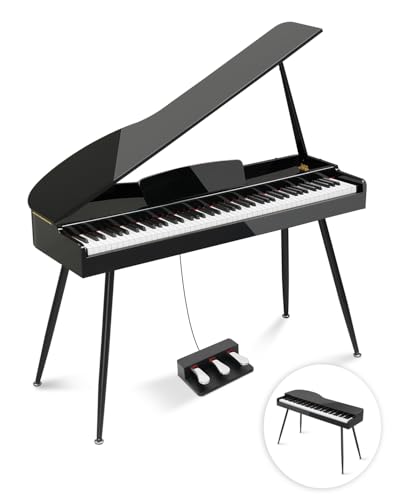
Ktaxon Grand Piano 88 Key Weighted Keyboard, Digital Piano, Upright Piano
Chosen because it specifies Digital Piano and Upright Piano.
View on Amazon
Ktaxon Grand Piano 88 Key Weighted Keyboard, Digital Piano, Upright Piano
Chosen because it specifies Digital Piano and Upright Piano.
View on AmazonKawai DG30 88-Key Digital Grand Piano w/Responsive Hammer III, Ebony Polish
Chosen because it specifies Ebony Polish.
View on Amazon- Baby Grand (4’11” – 5’6″): Compact footprint for apartments and small living rooms. Compromised bass and shorter sustain due to shorter strings and smaller soundboard.
- Medium / Classic Grand (5’7″ – 6’2″): The sweet spot for serious homes, studios, and small venues. Noticeably better low-end clarity and dynamic range than baby grands without requiring a concert hall.
- Parlor / Semi-Concert Grand (6’3″ – 7’6″): Professional-grade instruments for large homes, recording studios, and recital halls. Full tonal depth and projection.
- Concert Grand (8’11” – 9’6″): Built for large concert stages. Maximum power, sustain, and tonal color.
Grand Piano Size and Spec Comparison
Use this table to match size to your room and understand what you actually get as the instrument grows. Weight and lid dimensions matter for delivery, flooring, and moving costs.
| Category | Example Models | Length | Approx. Weight | Soundboard Area (approx.) | Minimum Recommended Room Size | Ideal Ceiling Height |
|---|---|---|---|---|---|---|
| Baby Grand | Yamaha GB1K, Kawai GL-10 | 4’11” (150 cm) | 620-700 lbs (281-318 kg) | ~5.8 sq ft | 120 sq ft (11 sq m) / 12×10 ft | 8 ft + |
| Baby Grand | Steinway Model S | 5’1″ (155 cm) | ~670 lbs (304 kg) | ~6.1 sq ft | 150 sq ft (14 sq m) / 12×13 ft | 8 ft + |
| Classic Grand | Yamaha C2X, Kawai GX-2 | 5’8″ (173 cm) | 730-760 lbs (331-345 kg) | ~7.4 sq ft | 180 sq ft (17 sq m) / 13×14 ft | 8.5 ft + |
| Classic Grand | Yamaha C3X, Kawai GX-3 | 6’1″ (186 cm) | 860-910 lbs (390-413 kg) | ~8.6 sq ft | 220 sq ft (20 sq m) / 14×16 ft | 9 ft + |
| Semi-Concert | Steinway Model B, Mason & Hamlin BB | 6’11” (211 cm) | 1,100-1,200 lbs (499-544 kg) | ~10.2 sq ft | 300 sq ft (28 sq m) / 16×19 ft | 10 ft + |
| Concert Grand | Steinway Model D, Bösendorfer 280VC, Fazioli F308 | 8’11” – 9’2″ (272-280 cm) | 1,300-1,560 lbs (590-708 kg) | ~12.5-13.8 sq ft | 600+ sq ft (56+ sq m) | 12 ft + |
A good rule of thumb: allow at least 2 feet of clearance around the tail and keyboard end for the lid to open fully and for sound to project, plus 5 feet for the bench. In a room smaller than recommended, even a high-quality 7-foot piano will sound boomy and overpowering.
What Actually Changes Sound and Touch
1. Action Quality and Touch Response
The action is the mechanical assembly that translates key press to hammer strike. Not all grand actions are equal.
- Baby grands often use shorter keys and a more compact action. This leads to a faster fall-off in leverage toward the back of the key, making it harder to control pianissimo playing and rapid repetition.
- Medium and larger grands from Yamaha, Kawai, Steinway, and Bechstein use longer keys with a more even touch weight. Yamaha and Kawai use composite and carbon-fiber reinforced action parts in their CX and GX series to improve repetition speed and stability in humidity changes. Steinway and Mason & Hamlin use traditional wooden actions with accelerated action geometry for greater power.
- Repetition lever and double escapement: All modern grands have it, but the regulation quality matters. A well-regulated medium grand will allow 7-8 repetitions per second, while a poorly regulated baby grand may feel sluggish at 5-6.
If touch control is your priority, a 5’8″ Yamaha C2X or Kawai GX-2 will feel more precise and consistent than a cheaper 5’1″ piano, even if the smaller piano has a prestigious name.
2. Soundboard Materials and Construction
The soundboard is the heart of the tone. It amplifies the strings’ vibration.
- Solid Spruce: Virtually all quality grands use solid Sitka or European white spruce, quarter-sawn and tapered from 8-9mm in the center to 6mm at the edges. This allows it to vibrate freely while withstanding 18-20 tons of string tension.
- Laminated vs. Solid: Entry-level baby grands from some budget builders may use laminated soundboards to cut costs. They are more crack-resistant but dampen high frequencies and reduce sustain by 15-25%.
- Ribs and Bridges: Hand-notched maple or beech ribs and vertically laminated hardwood bridges transfer energy more efficiently. Brands like Fazioli and Bösendorfer emphasize hand-selected, close-grained spruce and extended resonance in the treble.
3. Scale Design and String Length
Bass strings need length to sound clear. In a 4’11” piano, the lowest A string is only about 4 feet long and must be very thick and copper-wound to reach pitch, which creates inharmonicity and a muddy tone. In a 6’1″ piano that same string is nearly 6 feet long, thinner, and produces far clearer harmonics. This is why a larger piano sounds better even at a soft volume.
Decision Matrix: Which Grand Piano Fits Your Situation
| Your Situation | Recommended Size | Models to Consider | Why This Choice |
|---|---|---|---|
| Small apartment / condo, casual to intermediate player, budget $15,000 – $30,000 | Baby Grand 4’11” – 5’3″ | Yamaha GB1K, Kawai GL-10, Boston GP-156 | Fits through doorways and elevators, adequate for practice, lower ownership cost |
| Dedicated music room 180-250 sq ft, advancing student or teacher, budget $30,000 – $70,000 | Classic Grand 5’8″ – 6’1″ | Yamaha C2X / C3X, Kawai GX-2 / GX-3, Boston GP-178 | Best price-to-performance ratio for touch, tone, and dynamic range |
| Large home, professional or university-level pianist, budget $70,000 – $140,000 | Semi-Concert 6’7″ – 7’0″ | Steinway Model B, Mason & Hamlin Model BB, C. Bechstein B 212, Shigeru Kawai SK-6 | Concert-like power and color without requiring a hall, holds value well |
| Performance venue, recording studio, or luxury estate 600+ sq ft | Concert Grand 9′ | Steinway Model D, Bösendorfer 280VC, Fazioli F308 | Maximum projection, sustain over 30 seconds in mid-range, built for heavy use |
Ownership Costs: What to Budget Beyond the Purchase Price
A grand piano is a long-term maintenance instrument. Here is a realistic worked calculation for a mid-range 5’8″ – 6’1″ grand kept in a climate-controlled home.
10-Year Cost Example
- Tuning: 2 times per year at $150 – $250 per tuning = $300 – $500 annually. New pianos need 3-4 tunings in the first year as strings stretch. 10-year total: $3,200 – $5,200
- Regulation and Voicing: Action regulation every 3-5 years ($800 – $1,800) and voicing to soften or brighten hammers ($400 – $900). Assume one regulation and one voicing in 10 years: $1,200 – $2,700
- Climate Control: A Dampp-Chaser humidity control system installed inside the piano costs $500 – $800 installed plus electricity. Without it, soundboards can crack below 30% humidity and tuning stability drops significantly. Highly recommended if indoor humidity swings more than 35-65%.
- Moving and Insurance: Professional grand piano moving costs $600 – $1,500 locally due to specialized boards, padding, and disassembly of legs and lyre. Annual instrument insurance riders are typically 0.5-1% of value.
Total 10-year ownership add-on: Approximately $5,000 – $9,000 for a mid-size grand, not including major repairs. For a concert grand in institutional use, annual maintenance can exceed $2,000 per year.
Durability and What Wears First
- Hammers and Felts: The first components to show wear. Grooves form where hammers strike strings after 2-4 years of heavy daily practice. Voicing and eventually hammer replacement are normal.
- Strings: Bass copper-wound strings lose brightness after 10-15 years and may become false. Treble steel strings last 20-30 years but will rust if humidity is high.
- Dampers and Pedal Felts: Harden and compress, leading to buzzing or incomplete damping. Replacement is inexpensive but requires technician skill.
- Finish and Keys: High-gloss polyester finishes show scratches easily. Close the lid when not playing and avoid placing drinks, direct sunlight, or HVAC vents blowing directly on the piano.
- Common Mistakes: Placing a grand against an exterior wall or window causes tuning instability. Using household cleaners on keys or lacquer damages the finish. Skipping tunings allows pitch to drift far from A440, requiring a more expensive pitch raise ($250 – $450 extra) at the next service.
Top Picks by Category in 2026
Best Baby Grand for Tight Spaces: Yamaha GB1K and Kawai GL-10
At 4’11” to 5’0″, these are the most practical entry points into a true grand action. They use solid spruce soundboards and Yamaha / Kawai’s proven actions. They will not match the bass of a larger piano, but they offer far better control than any upright in the same price range, which is typically $13,000 – $22,000 new.
Best Value Classic Grand: Yamaha C2X (5’8″) and Kawai GX-2 (5’11”)
This size class is where performance and footprint balance best. The C2X and GX-2 provide longer keys, greater soundboard area, and more refined hammer voicing than baby grands. Expect a clear, even tone across all registers and an action that supports advanced repertoire. Market range is roughly $35,000 – $55,000 new.
Best Professional Home Grand: Steinway Model B (6’11”) and Mason & Hamlin BB (7’0″)
Often called the perfect size for a residence, these semi-concert instruments approach concert grand character without needing a hall. The Steinway B is a long-standing standard for artists and institutions, while the Mason & Hamlin BB is known for its massive rim construction and powerful low end. Both are highly rebuildable and retain value over decades. Prices generally range from $90,000 to $150,000 new.
Best Concert Grand: Steinway Model D, Bösendorfer 280VC, and Fazioli F308
At just under 9 to over 10 feet, these are built for 1,000+ seat halls. The Steinway D is the global concert standard, the Bösendorfer 280VC offers extended bass and Vienna-made resonance, and the Fazioli F308 delivers exceptional clarity and a four-pedal system including a soft pedal that brings the hammers closer to the strings. These instruments require professional space and maintenance budgets and are priced in the $180,000 – $300,000+ range.
Final Buying Checklist Before You Order
- Measure doorways (minimum 36″ width for most grands on their side), stair turns, and elevator depth. Provide these measurements to the mover before purchase.
- Check floor load: a 1,200 lb piano with player and bench concentrates over 400 lbs per leg. Ensure your floor, especially above-basement wood framing, can support it. A thick rug under the piano helps distribute weight and control reflections.
- Play the exact piano you will buy, not just the model line. Sound varies significantly between individual instruments due to hand voicing.
- Budget for a pre-purchase inspection by an independent Registered Piano Technician, typically $150 – $300, for any used instrument. They will check pinblock tightness, soundboard cracks, and action wear that is not visible to buyers.
Frequently Asked Questions
Is a baby grand better than a high-end upright?
For touch, yes. Even a 4’11” grand has a horizontal, gravity-based action with faster repetition and better control than the best upright action. For tone in a small room, a premium upright like a Yamaha U3 or Kawai K-800 may actually produce a clearer bass than a cheap baby grand because its taller height allows longer bass strings. If space is very tight, test both side by side.
How often does a grand piano need tuning?
Twice a year is the standard for a home piano kept at 68-72 degrees and 40-55% humidity. Studios and performance venues tune quarterly or before every major performance. If the piano goes more than a year without tuning, the pitch may drop 20-40 cents and require a pitch raise before a fine tuning.
Do grand pianos hold their value?
High-quality instruments from Steinway, Bösendorfer, C. Bechstein, Mason & Hamlin, Shigeru Kawai, and Yamaha C-series can retain 60-80% of their value after 10 years if well-maintained, with Steinway B and D models often appreciating when rebuilt. Entry-level laminated baby grands depreciate faster, similar to other consumer instruments.










Write Your Review
No reviews yet. Be the first to share your experience!