
Our Top Picks
 6Ft x328Ft Galvanized Wire Fencing Livestock Fence Zinc5.9FT X 328FT3936 x 71 x 0.1 inches1 poundsCheck on Amazon
The best cattle panels for most operations are 16-foot heavy-duty galvanized panels with 4-gauge or heavier wire, 52-inch height, and graduated spacing that is tighter at the bottom, with Behlen Country, Tarter, Priefert, and OK Brand offering the most reliable options for fencing, corrals, and handling systems in 2026.
For permanent perimeter fencing and cow-calf pastures, a 52-inch tall, 16-foot panel with hot-dip galvanized 4-gauge steel is the standard. For feedlot corrals, crowding tubs, and working alleys where impact loads are higher, step up to a 60 to 62-inch heavy-duty corral panel built with 1.75-inch to 2-inch oval or round tubing and welded vertical stays. For calves and smaller breeds, choose panels with 4-inch vertical spacing at the bottom to prevent stepping through.
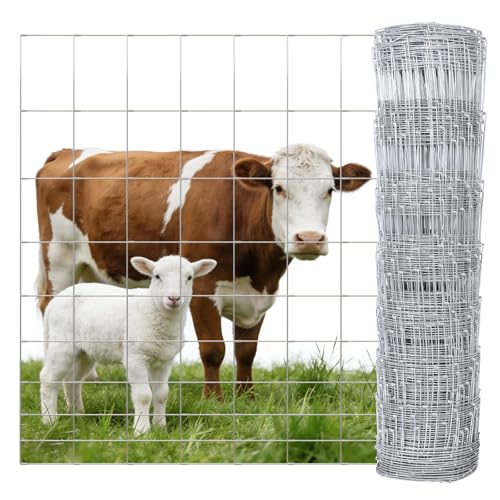
Cattle Panel 4ft x 328ft 14 Gauge Heavy Duty Galvanized Woven Wire Fence
Picked as a relevant option in this category.
View on Amazon
12 Gauge Heavy Duty Cattle Panels for Garden Trellis, 4ftx100ft, Thickened Cattle Panels for Galvanized Farm Fence Chicken Wire Fencing, Durable Goat Fence, Ideal for Farm and Field Protection
Chosen because it specifies 4ftx100ft and Durable Goat Fence.
View on Amazon6Ft x328Ft Galvanized Wire Fencing Livestock Fence Zinc Coated Cattle Panel
Picked as a relevant option in this category.
View on Amazon
Cattle Fence, Farm Fence 4ft x 164ft - 14 Gauge Galvanized Wire Fence
Chosen because it specifies Farm Fence 4ft x 164ft and 14 Gauge Galvanized Wire Fence.
View on AmazonHow to Choose the Best Cattle Panels: 6 Specs That Matter
1. Height and Length
Most cattle panels are 16 feet long, which balances transport and coverage. Height determines containment:
- 50 to 52 inches: Standard for mature beef cattle and general pasture fencing. Works with T-posts or wood posts on 8-foot centers.
- 60 to 62 inches: Corral and handling panels for bulls, feeders, and high-pressure areas. Also preferred when you need to keep cattle from reaching over.
- 34 to 40 inches: Hog and sheep/combo panels. Not recommended as standalone cattle fencing unless topped with additional rails.
Length alternatives exist for tight spaces: 8-foot and 10-foot panels from Tarter and Behlen Country are useful for gates, alley adjustments, and small pens where a full 16-foot panel is hard to maneuver.
2. Wire Gauge and Frame Construction
Gauge is inverse — lower number means thicker, stronger steel. For cattle, the critical threshold is 4-gauge:
- 4-gauge (0.225-inch diameter) and 5-gauge welded wire: Minimum for cattle. Resists bending when cattle rub, push, or crowd.
- 6-gauge and lighter: Utility or garden panels. They will bow and welds will pop under continuous cattle pressure.
- Corral panels: Instead of gauge, look at tubing — 14-gauge to 16-gauge oval or round steel tube (1.66-inch to 2-inch OD) with 6 to 8 horizontal rails. Priefert and Behlen Country heavy-duty corral panels use this construction and weigh 2 to 3 times more than wire panels.
3. Spacing and Opening Pattern
Graduated spacing is safer and stronger than uniform spacing. Common pattern on a 52-inch cattle panel is 4-inch spacing for the bottom 2 to 3 horizontal wires, widening to 6-inch and then 8-inch toward the top. This prevents calves from stepping through and adds rigidity at the bottom where pressure is highest. Combo panels (often sold as cattle/hog combo) use even tighter bottom spacing — around 3 to 4 inches for the first 12 inches — and are the better pick for cow-calf operations.
4. Weld Quality
Weld failure is the most common reason cattle panels are replaced. Look for continuous resistance welds at every intersection, not spot welds every other crossing. Powder coating over a poor weld hides the problem for one season. Indicators of better weld quality include uniform weld nuggets without burn-through, extra welds where vertical stays meet the top and bottom rails, and vertical stays that are notched or crimped into the horizontal wire before welding. Brands like OK Brand and Behlen Country typically weld every intersection on their 4-gauge utility and combo panels, while economy import panels often skip welds on intermediate wires.
5. Galvanized Finish
Three finishes dominate the market, and the difference shows after two winters:
- Hot-dip galvanized after welding (Gator Tough style galvanization): Thickest zinc coating, dull spangled finish, best rust resistance at weld points. Preferred for permanent outdoor fencing.
- Galvanized before welding: Shiny and even, but weld points burn off zinc and rust first. Often seen on lighter-duty panels.
- Painted or powder-coated over bare steel: Looks clean when new, but once scratched by cattle or T-post clips, rust spreads under the coating. Better for covered corrals or temporary pens that are stored indoors.
If panels will stay outside year-round near manure and moisture, choose hot-dip galvanized after welding and avoid painted panels.
6. Weight and Setup Options
Weight is a quick proxy for steel content. A true 16-foot x 52-inch 4-gauge cattle panel weighs 65 to 85 pounds. If a 16-foot panel weighs under 50 pounds, it is not 4-gauge throughout. Corral panels weigh 90 to 150 pounds for the same length due to tubular frames. Weight affects setup:
- T-post and clip installation: Standard for wire cattle panels. Use 6-foot or 7-foot T-posts driven 18 to 24 inches deep, spaced every 8 feet, with at least 5 wire clips per panel.
- Free-standing with panel stands or chaining to corral panels: Useful for rotational grazing, temporary pens, and calving pens. Look for panels with looped or pin ends that accept standard panel connectors.
- Wood post and lag system: Best for corners, gates, and high-pressure curves. Use 5-inch to 6-inch wood posts set 30 to 36 inches deep with panel brackets.
Best Cattle Panels Compared: Specs and Use Cases
| Panel Type / Example | Size (L x H) | Wire / Tube Spec | Opening Pattern | Weight (approx.) | Finish | Best For |
|---|---|---|---|---|---|---|
| Behlen Country Heavy-Duty Cattle Panel | 16 ft x 52 in | 4-gauge welded wire | Graduated: 4 in bottom, 8 in top | 78 lbs | Hot-dip galvanized after welding | Permanent pasture fence, cow-calf |
| Tarter American Cattle Panel | 16 ft x 52 in | 4-gauge welded wire | Graduated: 4 in bottom, 6-8 in top | 72 lbs | Galvanized before welding | General fencing, budget permanent |
| OK Brand Cattle Panel | 16 ft x 50 in | 4-gauge welded wire | 8 in uniform with 4 in bottom section | 68 lbs | Hot-dip galvanized | Range fencing, large acreage |
| CountyLine (Tractor Supply) Cattle Panel | 16 ft x 50 in | 4-gauge welded wire | Graduated 4 in to 8 in | 65 lbs | Galvanized | Small farms, replacement panels |
| Priefert Utility Bow Gate / Corral Panel (CP06 Series) | 12 ft x 60 in | 1.75 in 16-gauge oval tube, 6 rails | 6-rail corral, ~9 in rail spacing | 115 lbs | Powder-coated over galvanized | Crowding tub, alley, portable corral |
| Behlen Country Heavy-Duty Corral Panel | 16 ft x 62 in | 2 in 14-gauge round tube, 7 rails | 7-rail corral, ~7.5 in rail spacing | 148 lbs | Powder-coated | Bulls, feedlot, high-pressure handling |
Decision Matrix: Which Panel Fits Your Situation
Match your cattle type, pressure level, and budget to the right construction:
| Your Situation | Recommended Panel | Why |
|---|---|---|
| Cow-calf on pasture, permanent fence, 5+ year ownership | 52-inch 4-gauge graduated, hot-dip galvanized after welding | Tight bottom spacing keeps calves in, thick zinc prevents weld rust |
| Rotational grazing / temporary paddocks moved weekly | 52-inch 4-gauge galvanized 16 ft with pin/lug ends + step-in stands | Light enough for two people to move, clips not required |
| Working alley, squeeze chute lead-up, crowding tub | 60 to 62-inch tubular corral panel, 6 to 7 rail | Tubular frame absorbs impact without weld popping, height prevents jumping |
| Bulls or 1,400 lb+ feeders in confinement | 14-gauge 2-inch tube, 62-inch, chain connectors | Heavier wall tubing resists bending when cattle push shoulder-to-panel |
| Tight budget, large perimeter | 50-inch 4-gauge galvanized before welding | Lower cost per foot, acceptable if inspected and touch-up painted at welds annually |
| Small acreage / homestead with mixed livestock | Combo cattle/hog panel 16 ft x 52 in | Extra-tight bottom contains calves, goats, and hogs with one panel type |
Worked Calculation: How Many Panels and What It Costs Per Foot
Panel math prevents short orders and weak corners. For a rectangular 1-acre holding pen (208 ft x 208 ft):
- Perimeter = 832 linear feet. Divided by 16 ft per panel = 52 panels.
- Add 10% for overlap, gates, and cuts on uneven ground: 52 x 1.10 = 57.2, so order 58 panels.
- T-posts: One post per 8 feet plus one per panel joint = about 104 T-posts, plus 5-inch wood posts for 4 corners and 2 gate posts.
Cost per foot: In 2026, general market ranges are $45 to $75 for a 16-foot 4-gauge wire cattle panel and $180 to $350 for a 12 to 16-foot tubular corral panel. That puts wire panels at $2.80 to $4.70 per linear foot versus $15 to $22 per foot for heavy-duty corral panels. Wire panels are cost-effective for fence lines, but for any section where cattle will be pressed together, the higher per-foot cost of tubular panels pays back in fewer bend-outs and replacements.
To estimate freight: A full bundle of 25 wire panels weighs roughly 1,650 to 1,950 pounds and requires a 16-foot utility or flatbed trailer. Corral panels ship at lower counts per load due to bulk.
Durability and Ownership Realities
Panels rarely fail in the middle of the wire — they fail at the weld and at ground contact. What to expect:
- First to rust: Bottom wire and welds within 6 inches of soil and manure. Hot-dip galvanized panels delay this by 3 to 5 years compared to painted panels. Keep bottom wire 2 to 4 inches off soil with proper post height to slow corrosion.
- First to bend: Top rail where cattle reach over for forage, and any unsupported span over 8 feet. Add a center T-post or overlap panels by one square if cattle are fed over the fence.
- Weld pops: Happen when panels are forced into a curve or dropped. Do not bend a welded wire panel tighter than a 12-foot radius. For curves and tubs, switch to tubular corral panels designed to pin in an arc.
- Consumables: Plan for 5 to 6 T-post clips per panel per year for replacements, plus spare panel connectors and wire caps for sharp ends. Galvanized panels need no painting if zinc is intact; painted panels need annual touch-up at scratches with cold galvanizing spray.
- Cleaning: Scrape manure off bottom wires monthly in winter. Manure holds moisture and ammonia against zinc, accelerating white rust.
Common Mistakes to Avoid
- Using 6-gauge utility or garden panels for cattle because they are lighter and cheaper. They will sag within one season under a cow rubbing.
- Securing panels with tie wire only at top and bottom. This creates a hinge point. Clip every horizontal wire to the post.
- Mixing painted and galvanized panels in the same fence line without isolating them. The galvanized panel becomes anodic and corrodes faster where they touch in wet conditions. Use a plastic or rubber spacer or keep metals consistent.
- Setting panels directly on soil in low-lying areas. Even galvanized panels will heave and trap moisture. Raise them and ensure drainage away from the fence line.
Setup by Use Case
Permanent Pasture Fencing
Drive T-posts every 8 feet with the stud side facing the cattle. Hang the 52-inch panel so the tight 4-inch spacing is at the bottom. Overlap panels by one full vertical stay and clip both panels to the shared post. For corners, use wood posts with L-brackets and lag bolts, not T-posts.
Portable Corral and Handling System
Build in this order: 1) Set the crowding tub with 60 to 62-inch corral panels pinned in a half-circle, 2) connect to a straight alley 10 to 12 feet long using 12-foot panels for easier width control (26 to 30 inches inside width for mature cattle), 3) lead alley into the squeeze chute, 4) add wire cattle panels as outer holding pens. Pin connections should use drop pins with cotter keys, not bolts, so you can reconfigure quickly.
Hog and Calf-Proofing
If you already own standard cattle panels, add a 24-inch tall 2-inch x 4-inch welded wire liner wired to the inside bottom. This is cheaper than replacing all panels with combo panels and closes the bottom gap that calves exploit.
FAQ
Can cattle panels be used for bulls?
Only heavy-duty tubular corral panels rated for bull confinement should be used where bulls will crowd or fight. Standard 4-gauge 52-inch wire panels will bend and are not safe for bull pens or rutting season
What post spacing is needed for 16-foot cattle panels?
Every 8 feet is standard — one T-post in the middle and one at each joint so each panel is supported at three points. In high-pressure areas, add a fourth post or overlap panels by 12 inches.
Are galvanized or powder-coated panels better?
For permanent outdoor exposure, hot-dip galvanized after welding lasts longer because zinc protects welds and scratches. Powder-coated tubular panels are stronger structurally but need touch-up where coating chips, making them ideal for covered or portable corrals that can be stored dry.




Write Your Review
No reviews yet. Be the first to share your experience!