
Our Top Picks
The best 50 inch TV for the money in 2026 is the TCL QM6K for most buyers: it combines Mini-LED backlighting, a 144Hz gaming mode, strong HDR brightness, Google TV, and a midrange price that undercuts premium models. Choose the Hisense U6N if your budget is tighter, the Samsung QN90D if you watch in a bright room, or the Sony BRAVIA 3 if natural-looking movies and simple Google TV navigation matter most.
Best 50-inch TVs by situation
| Best for | Model | Typical market range | Key reason to buy | Main compromise |
|---|---|---|---|---|
| Best overall value | TCL QM6K 50-inch | $400–$550 | Mini-LED contrast, 144Hz gaming, Google TV | Viewing angles are narrower than OLED |
| Lowest sensible budget | Hisense U6N 50-inch | $300–$450 | Local dimming and Dolby Vision at a reasonable price | 60Hz panel and less capable gaming inputs |
| Bright room | Samsung QN90D 50-inch | $900–$1,300 | Very high brightness and excellent reflection handling | Expensive and no Dolby Vision |
| Movies and natural color | Sony BRAVIA 3 50-inch | $500–$700 | Good processing and restrained picture tuning | Not a high-end HDR or gaming display |
| Simple smart-TV experience | Roku Plus Series 50-inch | $350–$500 | Clear menus, easy search, and useful voice controls | 60Hz gaming and less HDR impact than Mini-LED sets |
1. TCL QM6K: best 50-inch TV for the money overall
The TCL QM6K is the strongest all-round pick because it spends money on the parts viewers notice most: contrast, HDR brightness, motion, and gaming responsiveness. Its Mini-LED backlight and local dimming produce deeper blacks than ordinary edge-lit LED televisions, while the 144Hz panel mode makes it more suitable for a PlayStation 5, Xbox Series X, or gaming PC.

TCL 50 Inch Class QM6K Series | Mini LED QLED 4K HDR | 50QM6K, Latest Model | 120HZ-144HZ High Brightness Smart Google TV Dolby Atmos Onkyo Audio | Voice Remote Alexa Gaming Streaming Television
Chosen because it specifies Mini LED QLED 4K HDR and 50QM6K.
View on Amazon
TCL 50-Inch F8D Series 120Hz 4K UHD QLED Smart Fire TV, HDR, 50F8D (2026)
Chosen because it specifies HDR and 50F8D (2026).
View on Amazon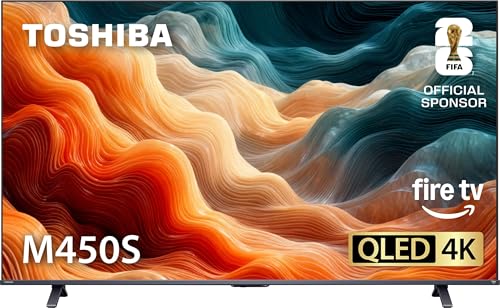
TOSHIBA 50" Class M450 Series QLED 4K UHD Smart Fire TV, Voice Remote with Alexa, Stream Live TV Without Cable
Chosen because it specifies Voice Remote with Alexa and Stream Live TV Without Cable.
View on AmazonIt supports 4K resolution, HDR10, Dolby Vision, and Google TV. Its high refresh-rate mode is useful for compatible PC games and selected console games, although consoles generally top out at 120 frames per second. Variable refresh rate and automatic low-latency features reduce tearing and controller delay when configured correctly.
The weakness is typical of LCD televisions: contrast and color become less consistent when you sit far to the side. For a sofa directly in front of the screen, that is rarely a serious problem. At around $400 to $550, it is the best balance of picture quality and features for most bedrooms, apartments, offices, and smaller living rooms.
Choose the TCL QM6K if:
- You want noticeably better contrast than a basic LED TV.
- You play games but do not want to pay OLED prices.
- You want one TV platform for streaming, live channels, and voice search.
2. Hisense U6N: best budget picture quality
The Hisense U6N is the value choice when your target price is closer to $350 than $500. Its Mini-LED backlight and local dimming give it a more convincing HDR image than inexpensive televisions with a single global backlight. Dolby Vision support is helpful for compatible streaming content, and Google TV provides a broad selection of apps.
The trade-off is its 60Hz panel. Movies and ordinary television look fine, but fast sports and games do not receive the same motion advantage as the TCL QM6K. It also has fewer reasons for a serious gamer to choose it: look for the exact HDMI specifications on the retailer or manufacturer listing, because lower-priced variants may not provide the full combination of 4K, 120Hz, and variable refresh rate.
Picture processing is adequate rather than exceptional. Low-quality cable channels and heavily compressed streams can look softer or noisier than they do on a premium Sony or Samsung. Still, the U6N is an excellent fit for a guest room, secondary room, or first large-screen TV.
3. Samsung QN90D: best for bright rooms
The 50-inch Samsung QN90D is the premium LCD option for rooms with windows, lamps, or overhead lighting. Its Mini-LED system reaches substantially higher brightness than budget models, and its anti-reflection treatment helps preserve image clarity when light hits the screen. This is especially valuable for daytime sports and television rather than only dark-room movies.
Samsung’s Tizen platform is mature, with major streaming services, multi-device features, and a large app selection. The QN90D also provides advanced gaming features, including a high-refresh-rate mode and variable refresh rate on compatible inputs.
Samsung does not support Dolby Vision, relying mainly on HDR10, HDR10+, and standard HDR formats. That does not make the TV incompatible with streaming services, but it can matter to buyers who specifically want Dolby Vision playback. Its price is also difficult to justify unless you need its brightness, reflection handling, or premium processing. In a dim room, the cheaper TCL can deliver more value per dollar.
4. Sony BRAVIA 3: best for everyday TV and movie processing
The Sony BRAVIA 3 is a sensible choice for viewers who value clean upscaling, natural color, and a familiar Google TV interface over peak gaming specifications. Sony’s processing is particularly useful when you watch broadcast television, older films, DVDs, or lower-resolution streams that need to be enlarged to 4K.
It supports Dolby Vision and provides an easy path to Google Assistant voice search, Chromecast-style casting, and common streaming applications. Its 50-inch size is also relatively easy to place on a narrow media cabinet.
This is not the best choice for competitive gaming or a brightly lit room. Its 60Hz-class panel and more modest HDR output are adequate for casual play, but the TCL QM6K offers a clearer performance advantage for games. Buy the Sony when image refinement and dependable everyday operation matter more than maximum brightness or refresh rate.
5. Roku Plus Series: easiest smart-TV experience
The Roku Plus Series remains appealing for households that want uncomplicated menus. Roku’s home screen puts apps and inputs in a familiar layout, and its search function can find a film or show across multiple services. The interface is also easier for many occasional users than more crowded smart-TV systems.
The Plus Series uses a quantum-dot LCD design with local dimming, so it can produce richer color and better contrast than a basic budget LED set. Its 60Hz refresh rate limits it for high-frame-rate gaming, but it is perfectly suitable for streaming, news, and general television.
Choose it when simplicity is more important than having the fastest panel. Choose the TCL QM6K instead if the two are close in price and gaming or HDR performance is a priority.
How far away should you sit from a 50-inch TV?
A 50-inch 4K television works well from approximately 4 to 7 feet away. Around 5 to 6 feet is a practical middle distance for mixed viewing. At less than 4 feet, you may notice compression, poor source quality, or uneven backlighting more easily. Beyond roughly 8 feet, the benefit of 4K detail becomes harder to see, and a larger screen may be more satisfying.
| Viewing distance | What a 50-inch TV suits | Buying implication |
|---|---|---|
| 3–4 feet | Desk, small bedroom, close gaming | Prioritize uniformity and low input lag |
| 4–6 feet | Typical bedroom or apartment sofa | Most 50-inch models are well matched |
| 6–8 feet | Small living room | Choose strong HDR brightness or consider 55 inches |
| Over 8 feet | Large room or rear seating | A 55- to 65-inch screen may provide better immersion |
Picture quality, gaming, and smart-TV differences
Picture quality
Mini-LED models such as the TCL QM6K, Hisense U6N, and Samsung QN90D use many small backlight zones to improve dark-scene contrast. They are not immune to blooming around subtitles or bright objects, but they are generally more impactful than standard LED televisions. OLED remains better for perfect black levels and wide viewing angles, though commonly available OLED sizes tend to be 48 or 55 inches rather than exactly 50.
Gaming performance
For a console gamer, prioritize a 120Hz or faster panel, HDMI 2.1 bandwidth, variable refresh rate, and automatic low-latency mode. The TCL QM6K is the value leader here. The Samsung QN90D is the premium option. A 60Hz model such as the Hisense U6N, Sony BRAVIA 3, or Roku Plus Series is fine for casual gaming but cannot display 120 frames per second.
Smart-TV features
Google TV is flexible and integrates well with casting and voice search. Roku is the simplest for many households. Samsung Tizen offers extensive device integration but can feel busier. Before buying, confirm that your preferred services are available in your country and that the TV receives regular software updates.
Ownership details that affect real-world value
LCD televisions do not require consumable filters or special maintenance. Dust the screen with a clean, dry microfiber cloth, and never spray cleaner directly onto the panel. Household glass cleaner can damage anti-reflection coatings. Keep ventilation openings clear, especially when the TV is mounted close to a wall.
The parts most likely to become frustrating first are the remote, software interface, backlight uniformity, and HDMI connections—not the screen glass itself. A failing backlight can make an otherwise functional TV uneconomical to repair after several years. Avoid repeatedly unplugging the television to solve app problems; use its restart option, install firmware updates, and connect it to a surge-protected outlet.
For a simple value calculation, spending $500 on a TV used five hours per day for five years equals about 9 cents per viewing hour before electricity. A $1,100 premium model used in the same way costs about 20 cents per hour. The premium is worthwhile if bright-room visibility or gaming performance changes your daily experience, but it is poor value if the set will mainly play occasional shows in a dim room.
Final verdict
Buy the TCL QM6K if you want the best combination of image quality, gaming performance, smart features, and price. Select the Hisense U6N for the lowest-cost upgrade to local dimming and Dolby Vision. Pay for the Samsung QN90D only when brightness and reflection control are central requirements. The Sony BRAVIA 3 is the calmer choice for broadcast and movie viewing, while the Roku Plus Series is ideal for buyers who value a simple interface above high-refresh gaming.










Write Your Review
No reviews yet. Be the first to share your experience!