
Our Top Picks
 Midwest 24-Inch Single Door iCrate24.8"L x 17.9"W x 19.5"H25.6 x 18.9 x 3 inches13.8 poundsCheck on Amazon
The best dog crates for small dogs are the MidWest iCrate for value, the Diggs Revol for a polished home crate, a two-door wire crate for flexible access, and a hard-sided carrier for car travel or airline-style portability.
Quick comparison
Measure your dog before choosing a crate. A suitable interior should let the dog stand without crouching, turn around, and lie on their side with legs extended. For many small dogs, a 24-inch crate is the useful starting point, but a long-bodied Dachshund, stocky French Bulldog, or growing puppy may need a larger interior than their weight suggests.
Midwest 24-Inch Single Door iCrate, for Small Breeds, 12-20 lbs
Chosen because it specifies for Small Breeds and 12-20 lbs.
View on Amazon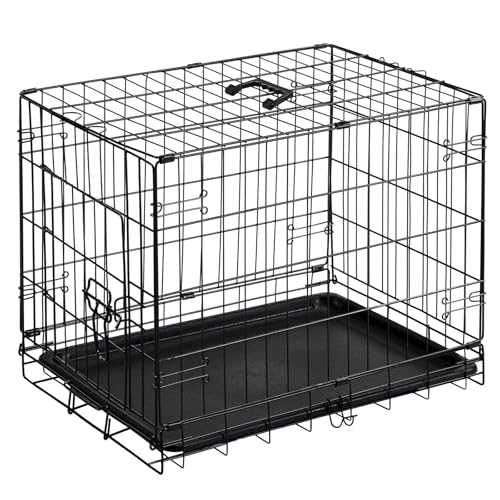
DUMOS 24 Inch Dog Crate, Foldable Puppy Small Dog Cage Pet Kennel
Chosen because it specifies Foldable Puppy Small Dog Cage Pet Kennel.
View on Amazon
FDW | 24" Foldable Metal Dog Crate | Black | Cage for Small Dogs
Chosen because it specifies 24" Foldable Metal Dog Crate and Black.
View on Amazon| Crate or type | Typical interior or exterior size | Approx. weight | Material and doors | Best use |
|---|---|---|---|---|
| MidWest iCrate 24-inch, single-door | About 24 x 18 x 19 in exterior | About 13 lb | Steel wire, 1 front door, divider panel, removable pan | Budget home training and everyday use |
| MidWest iCrate 24-inch, two-door | About 24 x 18 x 19 in exterior | About 15 lb | Steel wire, front and side doors, divider panel, pan | Rooms where access may change |
| Diggs Revol small | About 28.5 x 20 x 21.5 in exterior | About 50 lb | Aluminum and steel frame, multiple access points, removable tray | Furniture-style home setup and frequent use |
| Petmate Two Door Top Load 24-inch | About 24 x 16.7 x 14.5 in exterior | About 13 lb | Hard plastic, front and top doors | Vet visits and short car journeys |
| Soft-sided carrier, small-dog size | Commonly 18 x 11 x 11 in | About 3–5 lb | Fabric, mesh panels, zip doors | Light travel with calm, crate-trained dogs |
Dimensions are representative published dimensions and can vary by model revision or retailer measurement method. The usable interior is always smaller than the exterior, particularly on hard-sided carriers and crates with thick frames.
Best choices by situation
- Best budget choice: MidWest iCrate. Its steel wire construction, divider panel, folding design, and removable plastic pan provide the most function for a general-purpose crate. A 24-inch version commonly sells in the approximate $35–$70 range, depending on door configuration and bundle.
- Best for a permanent living-room setup: Diggs Revol. The reinforced frame, rounded corners, and more finished appearance make it easier to keep in a visible room. It is substantially heavier and generally costs several hundred dollars, so it is poor value if you only need a crate for occasional transport.
- Best for flexible room placement: a two-door wire crate. A front door and a side door allow the crate to face a hallway, sofa, or wall without blocking access. The extra door also adds hardware that can loosen or become noisy over time.
- Best for vehicle trips and veterinary appointments: Petmate Two Door Top Load. The top opening is useful when a small dog is reluctant to walk through a front door. Its solid sides reduce visual stimulation, but ventilation and interior space are less generous than a wire crate.
- Best for light carrying: a soft-sided carrier. It is easiest to lift and store, but not suitable for dogs that chew, push at zippers, or panic when confined. Fabric carriers should be used only when the dog is already reliable in a crate.
Head-to-head: wire, plastic, metal, and fabric
Wire crates
Wire crates offer the strongest balance of ventilation, visibility, price, and cleaning access. The open sides work well in warm rooms and let you check on the dog without opening the door. They also fold nearly flat, which is valuable in apartments or when storing the crate between uses.
The trade-off is noise and exposure. A nervous dog may bark at movement outside the crate, and a wire crate does little to block drafts or visual distractions. Do not place a blanket over the entire crate in warm conditions; leave ventilation paths open and monitor temperature.
Hard-sided plastic crates
Plastic crates are quieter and more enclosed, making them useful in cars and for dogs that settle better with reduced visual stimulation. The shell is relatively easy to wipe clean, and many models can be disassembled for storage. However, the thick walls reduce usable width, and the fixed shape is awkward to carry through narrow spaces.
Check the door latch carefully. A good latch should close fully without relying on a loose spring or a door that can be pushed inward. For vehicle use, follow the vehicle and crate manufacturer’s restraint guidance; a crate should not slide freely around the cargo area.
Heavy-duty metal crates
Heavy-duty crates are the strongest option for determined escape artists, but “heavy duty” is not a guarantee against injury or escape. Look for welded joints, protected hinges, closely spaced bars, and door hardware that cannot be manipulated from inside. Avoid protruding wire ends and large gaps that could catch a collar or paw.
These crates are usually expensive, heavy, and difficult to fold. They make sense for dogs that have already bent ordinary wire doors or repeatedly damaged plastic and fabric crates, rather than as a default choice for every small dog.
Soft-sided carriers
Soft carriers are convenient under airplane seats, on public transport, or when walking from a parked car to a destination. Mesh provides ventilation, but it can be torn by nails or teeth. Zippers are the first failure point, followed by mesh seams and the rigid insert that keeps the carrier upright.
A soft carrier should not be used as an escape-resistance solution. It is a portability solution for a calm dog that does not scratch, chew, or force its way through openings.
How to choose the right dimensions
Measure from the floor to the top of the head or ears, whichever is higher, while the dog is standing naturally. Measure from the nose to the base of the tail, then add roughly 3–6 inches to both height and length. Measure shoulder width as well, because a crate can be long enough but too narrow for comfortable turning.
For example, suppose a dog measures 15 inches from nose to tail base and 14 inches from floor to head. Adding 4 inches gives a target interior of approximately 19 inches long and 18 inches high. A nominal 24-inch wire crate may fit, but check its actual interior because the divider and door frame reduce usable space.
For a puppy, use a divider to create only the space needed for sleeping and turning. A crate that is too large can allow a puppy to sleep at one end and toilet at the other, making house-training harder. Recheck the fit every few weeks during rapid growth.
Placement under furniture and in a vehicle
Measure the opening, not just the available floor area. A crate advertised as 24 inches wide may need more than 24 inches of clearance to open its door, remove the tray, or reach the latch. Leave at least 2 inches above the crate for ventilation and access, and more if the top door or roof handle needs room.
- Under a desk: a low wire crate can work, but confirm that the desk crossbar does not obstruct the door.
- Under a raised bed: measure depth, height, and airflow at both ends. Do not push the crate flush against a wall.
- In a hatchback: measure the narrowest point of the cargo opening and the height below the parcel shelf. A plastic crate often fits more predictably than a wide furniture-style metal crate.
- Behind a vehicle seat: use a carrier designed for the available footprint, and ensure the door can open without contacting the seat.
Never judge vehicle suitability by exterior length alone. Check whether the dog can remain upright, whether ventilation is blocked by luggage, and whether the crate can be secured against sliding or tipping.
Durability, cleaning, and ownership costs
The first parts to wear are usually door latches, hinge pins, plastic trays, zipper seams, and rubber feet. Wire coatings can chip where the door rubs, allowing rust if the crate is kept damp. Plastic trays may crack when removed at an angle, especially in cold weather. Keep a replacement tray or washable liner available if the crate is used every day.
Clean accidents promptly with a pet-safe enzymatic cleaner, following the label directions. Wash fabric covers separately and dry them completely before reuse. Avoid thick bedding that reduces standing height or creates a chewing hazard. Inspect the crate weekly for bent bars, sharp edges, loose screws, damaged mesh, or a latch that does not fully engage.
A simple ownership calculation can clarify value. A $50 wire crate used four times a week for two years provides about 416 uses, or roughly 12 cents per use before replacement parts. A $300 premium crate used daily for the same period provides about 730 uses, or about 41 cents per use. The premium option is worthwhile only if its quieter operation, appearance, or stronger construction solves a real problem.
Final recommendation
Choose a 24-inch two-door wire crate, such as the MidWest iCrate, when you want the most adaptable and affordable home option. Choose the Diggs Revol when the crate will remain in a main living area and appearance, rigidity, and long-term daily use matter more than weight. Choose the Petmate Two Door Top Load for car and vet convenience, and choose a soft-sided carrier only for a calm, already crate-trained dog. Whichever style you select, prioritize the correct interior dimensions, a secure latch, unobstructed ventilation, and a placement that leaves the doors and cleaning tray fully usable.





Write Your Review
No reviews yet. Be the first to share your experience!