
Our Top Picks
Best Mud Flaps for Cars and Trucks
The best mud flaps are flexible enough to resist cracking, wide enough to protect the vehicle behind you, and shaped for your exact wheel opening without reducing tire or suspension clearance. For most daily drivers, molded thermoplastic flaps or vehicle-specific OEM-style kits offer the best balance; rigid universal rubber is better for heavy-duty work, while ultra-flexible polyurethane suits off-road vehicles with limited clearance.
Quick Picks by Driving Situation
| Driver or vehicle | Best choice | Why it fits | Typical price range |
|---|---|---|---|
| Small car or crossover | Vehicle-specific molded thermoplastic | Clean fit, moderate coverage, minimal ground clearance loss | $35–$100 per vehicle |
| Pickup used on-road | OEM-style molded flaps or medium rubber | Good spray control without excessive drag or sag | $50–$150 per vehicle |
| Truck with larger tires | Trim-to-fit polyurethane or flexible rubber | Handles tire movement and altered wheel offsets better | $80–$220 per vehicle |
| Construction, gravel, or farm use | Thick reinforced rubber, 1/4 inch or more | Resists stone impact and abrasion | $100–$300 per vehicle |
| Off-road SUV or 4×4 | Flexible polyurethane with breakaway mounting | Bends around obstacles and is less likely to tear from contact | $120–$350 per vehicle |
Material Comparison: Flexibility Matters More Than Thickness Alone
Molded thermoplastic
Molded thermoplastic is common on factory-style kits. It is relatively light, holds a shaped contour, and usually looks neat against the bumper or rocker panel. A typical flap is 2–4 mm thick. This material works well for commuting and highway driving, but inexpensive formulations can become brittle in cold weather or after years of ultraviolet exposure.
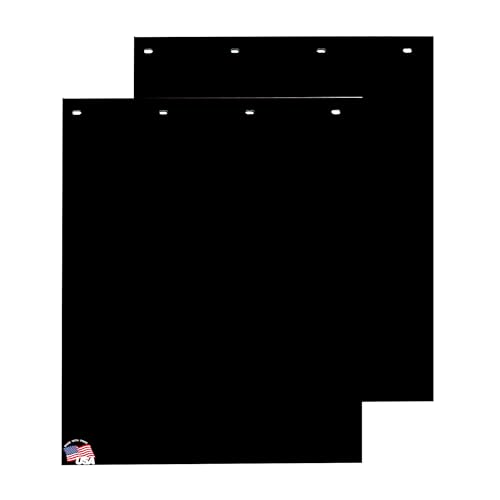
Buyers Products RC30PPB 24 x 30 Inch Black Polymer Mud Flaps, 2 Pack
Chosen because it specifies 2 Pack.
View on Amazon
BASENOR Mud Flaps for 2017-2023 Tesla Model 3 Splash Guards Fenders
Picked as a relevant option in this category.
View on AmazonRubber
Rubber flaps are heavier and usually flatter. A 3/16-inch flap is suitable for ordinary road spray, while 1/4-inch material is more appropriate for gravel roads, work trucks, and frequent towing. Rubber tolerates repeated impact well, but it can sag if the mounting points are too far apart. A sagging lower edge may approach the pavement or contact a steep driveway.
Polyurethane
Polyurethane is the flexible option for vehicles with suspension travel, larger tires, or frequent off-road use. It can bend and return to shape instead of splitting when struck. It generally costs more than basic rubber and may transmit more vibration through rigid mounts, so use washers and correctly sized fasteners.
Rigid plastic and composite
Rigid plastic can provide a precise appearance and low weight, but it has less tolerance for tire contact, ice buildup, and impact. It is best when the flap is closely matched to the factory wheel arch. Avoid a rigid universal panel on a truck with aftermarket wheels unless you have confirmed clearance through the full steering and suspension range.
Coverage: Choose Protection Without Creating Clearance Problems
Longer and wider is not automatically better. A flap should cover the tread area viewed from behind and extend far enough outward to intercept spray, but the lower edge must remain clear of the tire, exhaust, suspension, and road surface.
- Daily cars: about 6–9 inches below the mounting surface and 8–12 inches wide is often sufficient.
- Pickups: about 8–12 inches of drop and 10–16 inches of width usually provides better bed-side and following-vehicle protection.
- Heavy-duty or commercial use: 12–18 inches of drop may be useful, but check local regulations and maintain safe ground clearance.
- Off-road vehicles: a shorter, flexible flap can be safer than a long rigid one that catches rocks, ruts, or brush.
Measure from the lowest practical mounting point to the ground, then subtract at least 3 inches for a street car and 4–6 inches for a vehicle that regularly travels uneven surfaces. This is a starting point, not a substitute for checking the actual tire and suspension movement.
Vehicle Fit: The Most Important Buying Check
Vehicle-specific flaps are normally the easiest choice because their mounting holes, curvature, and dimensions follow the original wheel arch. This matters especially on cars with sculpted bumpers, side skirts, parking sensors, or liners that leave little flat mounting space.
Universal flaps are more adaptable but require accurate drilling and trimming. Before ordering, confirm:
- Year, make, model, cab or body style, and whether the vehicle has factory fender flares.
- Wheel and tire size, including any increase in tire width.
- Wheel offset and spacers, which can move the tire outward into the flap’s path.
- Suspension lift or lowering changes.
- Exhaust location, running boards, tow hooks, and nearby sensors.
- Whether the kit is intended for front wheels, rear wheels, or both.
On trucks, the same model can need different flaps for a standard bed, dually rear axle, wide fender flare, or factory step. A kit marketed for the correct truck but the wrong wheel package may still require trimming or spacers.
Installation Requirements Compared
| Kit type | Typical tools | Installation time | Skill level | Main risk |
|---|---|---|---|---|
| Vehicle-specific replacement | Socket set, trim tool, screwdriver | 30–90 minutes | Beginner | Broken clips or missing liner access |
| No-drill bracket kit | Socket set, wrench, torque wrench | 45–120 minutes | Beginner to intermediate | Bracket movement if fasteners are loose |
| Universal trim-to-fit | Drill, bits, jigsaw or utility knife, ruler | 1–3 hours | Intermediate | Misaligned holes or uneven trimming |
| Heavy-duty reinforced system | Drill, torque wrench, clamps, socket set | 2–4 hours | Intermediate to advanced | Excess weight stressing thin body panels |
How to Install Universal Mud Flaps Without Losing Clearance
- Turn the steering and inspect access. On the front axle, check clearance with the wheels turned fully left and right. Remove the wheel if access is limited.
- Make a cardboard template. Use it to establish the flap’s top edge, width, and mounting-hole positions before cutting the real material.
- Hold the flap in place at ride height. Keep the lower edge vertical or slightly angled rearward. Do not align it with a bumper that changes angle sharply.
- Check moving clearances. Look behind the flap for tire contact, suspension arms, brake lines, exhaust heat, and wheel-well liners.
- Drill oversized material carefully. Use washers on both sides where possible. Rubber and polyurethane can pull through small washers during repeated impacts.
- Test at full steering lock and after a short drive. Listen for rubbing, then recheck all fasteners. Re-tighten after the first 25–50 miles.
Do not use self-tapping screws alone in thin plastic liners for a heavy flap. Use existing factory holes, rivet nuts, backing plates, or a purpose-built bracket when the flap carries substantial weight.
What Wears Out First
The lower corners usually wear first because they strike stones, snow, curbs, and uneven pavement. Mounting holes are the next common failure point, especially when a flap is heavy or attached with small washers. A flap that begins to crack around its fasteners is not necessarily worn across its entire surface; replacing the washers or adding a backing strip may prevent further tearing.
Inspect the flaps at every oil change or at least twice a year. Replace them when they have split through a mounting hole, curl into the tire’s path, lose a large section of material, or no longer remain secure at highway speed. Wash off road salt and packed mud with water, then use mild soap. Avoid petroleum-based dressings, which can soften some rubber compounds and make the surface attract grit.
Best Mud Flaps: Final Buying Advice
Choose a vehicle-specific molded kit when appearance, simple installation, and stock tire fit matter most. Choose medium rubber when you want economical protection for ordinary pickup use. Choose thick reinforced rubber for repeated gravel, towing, or commercial work. Choose polyurethane when tire size, suspension travel, and off-road flexibility are more important than the lowest price.
The best mud flaps are the ones that remain firmly mounted while leaving safe clearance at full steering lock, full suspension compression, and normal ground contact angles. Verify those three conditions before prioritizing extra width or length.
Frequently Asked Questions
Are longer mud flaps always better?
No. Longer flaps can improve spray control, but they are more likely to drag, catch on obstacles, or contact the road. Match the length to your driving surface and suspension clearance.
Should front and rear mud flaps be the same size?
Usually not. Front flaps often need to accommodate steering movement, while rear flaps can be wider or longer because they do not steer. Use axle-specific designs when available.
Can mud flaps fit a vehicle with larger tires?
Yes, but the mounting position may need to move outward or rearward, and the flap may need trimming. Check the tire path with steering at full lock and the suspension loaded before final drilling.
FAQ
Are longer mud flaps always better?
Should front and rear mud flaps be the same size?
Can mud flaps fit a vehicle with larger tires?
More from Amazon
Programs that pair well with the guide above. Offers and eligibility are set by Amazon and may change.
Free shipping on eligible items, Prime Video and more. Eligible new members can start with a free trial.
Start a Prime free trialA Prime membership for ages 18-24 with a trial period. Eligibility is set by Amazon.
See Prime for Young AdultsAudiobooks and podcasts to listen to on the go. Eligible new members can start with a free trial.
Try Audible freeAd-free music streaming. Eligible new subscribers can start with a free trial.
Try Music Unlimited freeAs an Amazon Associate we earn from qualifying purchases.






Write Your Review
No reviews yet. Be the first to share your experience!