
Our Top Picks
 Meister SpeedKills Leather Speed Bag with Lightweight LatexMedium (9.5" x 6")0.5 poundsCheck on Amazon
 Meister SpeedKills Leather Speed Bag w/Lightweight Latex BladderSmall (7.5" x 5")5 x 5 x 7.5 inches0.3 poundsCheck on Amazon
Best Speed Bags for Faster, More Accurate Punching
The best speed bags are the ones that match your hand speed, available platform, and practice frequency: beginners usually benefit from a medium bag around 9 × 6 inches, while experienced users often prefer a smaller 7 × 5-inch bag for quicker rebounds. Before choosing, check that the bag’s loop fits your swivel, the swivel is smooth and secure, and your platform is rigid enough not to wobble.
Speed bag comparison: size, material, and setup
Dimensions below are approximate common sizes, not standardized categories; brands may measure the body differently. Bag weight is rarely listed consistently, so use dimensions and intended speed as the more useful comparison.
Meister SpeedKills Leather Speed Bag with Lightweight Latex Pocket - Black, Medium 9.5" x 6"
Chosen because it specifies Black and Medium 9.5" x 6".
View on Amazon
Redipo Boxing Speed Bag - PU Leather Speed Punching Bag, MMA Training Reflex Ball Boxing Equipment, Punching Bag Workout Kicking Training Home Gym Exercise Speed Ball (Black&Red)
Chosen because it specifies PU Leather Speed Punching Bag and MMA Training Reflex Ball Boxing Equipment.
View on Amazon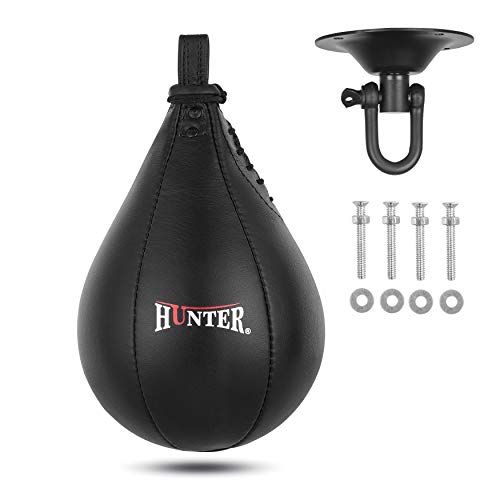
Hunter Leather Speed Bag for Boxing, Premium Cowhide Punching Speed Bag with Swivel, Lightweight Bladder for Fast Rebounds & Reflex Training
Chosen because it specifies Premium Cowhide Punching Speed Bag with Swivel and Lightweight Bladder for Fast Rebounds & Reflex Training.
View on AmazonMeister SpeedKills Leather Speed Bag w/Lightweight Latex Bladder - Black - Small (7.5" x 5") (19 cm x 12.7 cm)
Chosen because it specifies Black and Small (7.5" x 5") (19 cm x 12.7 cm).
View on Amazon| Bag type | Approx. body size | Typical shell | Best suited to | Setup considerations |
|---|---|---|---|---|
| Large training bag | 10 × 7 in | Leather or synthetic | First-time users and slower rhythm practice | Needs a compatible loop and a stable platform; the larger target is easier to track. |
| Medium all-rounder | 9 × 6 in | Leather or synthetic | Most home users building timing and coordination | Check platform clearance and whether the included swivel matches the bag’s attachment. |
| Small speed bag | 7 × 5 in | Usually leather or durable synthetic | Experienced users who can already keep a consistent rhythm | Requires accurate rebound and a firm mount; poor setup is more noticeable at speed. |
| Extra-small bag | 6 × 4 in | Leather or synthetic | Advanced accuracy and fast combinations | Not a forgiving first bag; confirm the swivel moves freely without excess side play. |
Sizes are approximate and do not guarantee a particular rebound speed. Inflation, bladder shape, seam placement, swivel friction, and platform rigidity all affect how a bag moves.
Choose by your setup and practice habits
| Your situation | Practical choice | Why it fits |
|---|---|---|
| New to speed bagging | 9 × 6 or 10 × 7 in bag; sturdy, adjustable platform if needed | A larger target gives you more room to learn timing before chasing speed. |
| Limited space or shared room | Wall-mounted platform with verified wall and stud compatibility | It avoids a floor stand, but the wall must safely support repeated impact and vibration. |
| Budget-conscious, occasional use | Synthetic bag with a replaceable bladder and standard-compatible loop | Typically costs less than leather and is easier to replace without committing to a premium setup. |
| Frequent training | Well-stitched leather or a reputable heavy-duty synthetic bag; serviceable swivel | Frequent impacts make seam quality, bladder replacement, and swivel maintenance more important. |
| Already comfortable with rhythm | 7 × 5 in bag, or a smaller size if your platform and swivel are consistent | A smaller target raises the precision demand without requiring a complete setup change. |
What matters most in a speed bag
Size: make accuracy the first filter
A larger bag is generally easier to hit and can be a better learning tool, but it is not automatically better for every beginner. If the bag is too large for your platform or hangs at an awkward height, it can make practice frustrating. Start with a medium size unless you have a specific reason to go larger or smaller. Once you can maintain a relaxed, repeatable rhythm, moving down one size is a sensible progression.
Bag height is part of the fit: with the platform adjusted, the bag should hang around eye level, with its widest area reachable without shrugging your shoulders. If more than one person will use the setup, an adjustable platform can make the difference between a workable shared station and a poor fit for one user.
Leather or synthetic: match material to use
Leather speed bags often appeal to frequent users because a well-made hide can hold up to repeated strikes and develop a supple feel. Quality varies, and leather still needs ordinary care: wipe away sweat, let it air-dry, and keep it out of damp storage. A low-quality leather bag with weak seams may not outlast a well-constructed synthetic one.
Synthetic materials—often polyurethane or other coated fabrics—can be less expensive and simpler to clean. They are a sensible choice for occasional practice or a first setup. Look for reinforced seams and an available replacement bladder, rather than treating the outer material as the only durability indicator. The bladder and seams are common failure points whichever shell material you choose.
Swivel quality: the overlooked source of bad rebound
The swivel controls the bag’s return path. A quality unit moves smoothly through the direction changes without binding, rattling excessively, or developing obvious side-to-side looseness. Swivels may use a ball hook, U-hook, or other mechanism; no type is automatically best if it does not fit your bag loop and platform mounting plate.
Check whether the swivel is included, whether its mounting holes match your platform, and whether it can be serviced or replaced. A bag that rebounds unpredictably may have a worn swivel, but first check that the bag is inflated correctly and the platform is secure. Replacing the bag alone will not fix a loose mount.
Platform compatibility and installation checks
Many speed bag platforms accept common swivel mounting plates, but hole spacing and fasteners are not universal. Compare the platform’s mounting pattern with the swivel before ordering, and confirm that the bag’s loop fits the swivel’s attachment. A product bundle can simplify matching, but still check that the platform itself suits your wall or stand.
- Wall-mounted platform: Confirm the manufacturer’s mounting requirements and attach it to suitable structural support, not just drywall. Use the specified hardware and verify that the platform sits level.
- Freestanding unit: Check its footprint, height range, base stability, and whether it can be weighted or anchored as specified. A lightweight stand may shift under repeated impact.
- Existing platform: Inspect for cracks, loose fasteners, and a surface that flexes. Tighten hardware and replace damaged parts before training.
- Clearance: Leave enough room for your hands and the bag’s full swing. Nearby walls, shelves, or equipment can interrupt rebound or create a collision hazard.
Set up for a smooth rebound
- Secure the platform first. Tighten the mount and swivel hardware according to their instructions. A moving platform changes the rebound and can loosen further during use.
- Inflate gradually. Use a pump with a suitable needle and follow the bag maker’s inflation guidance. Avoid overinflating: excessive pressure can stress seams and may make the bag feel unusually hard.
- Check bag orientation. Hang it so the swivel and loop move freely, without the bladder or seams catching on the attachment.
- Test slowly. Give the bag a gentle strike and watch whether it returns on a consistent path. If it wobbles, inspect the mount, swivel, and inflation before increasing speed.
- Recheck after early sessions. New hardware can settle. Look for loosening, seam damage, air loss, or unusual noise before each session.
Ownership costs and wear to expect
Entry-level synthetic bags commonly fall in the general market range of about $15–$40, while leather bags are often around $30–$80 or more. Swivels commonly range from roughly $10–$35, and platforms or complete wall-mounted setups can run from about $50 to several hundred dollars depending on adjustability, construction, and whether mounting hardware is included. These are broad 2026 market ranges, not fixed prices.
For frequent practice, the bladder often loses air or fails before the shell wears through; seams and the swivel are the next parts to inspect. A replaceable bladder can extend the useful life of an otherwise sound bag. Wipe the shell after use, let it dry fully, and avoid storing it inflated in hot or damp conditions. Do not compensate for a poor rebound by striking harder: first look for low inflation, a sticking swivel, loose fasteners, or a flexible platform.
For most home users, a medium bag with a compatible, smooth swivel and a rigid platform is the safest starting point. Choose leather for regular use if you value a traditional shell and can care for it; choose a well-stitched synthetic bag for a lower-cost entry. Move to a smaller bag only when your current setup rebounds consistently and your timing is ready for a tighter target.
Write Your Review
No reviews yet. Be the first to share your experience!