
Our Top Picks
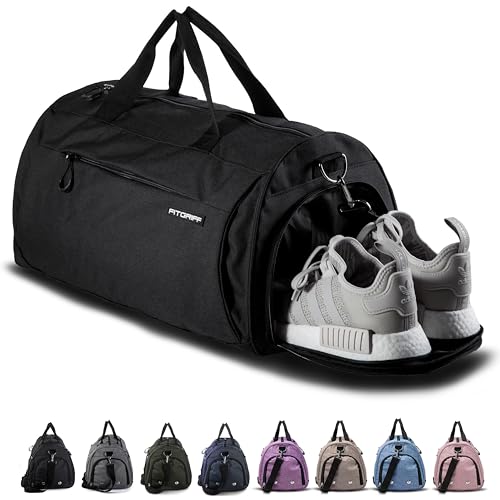 Fitgriff® Gym Bag for Men & Women with19 x 10 x 10″ (Small)19 x 10 x 10 Inches1.5 poundsCheck on Amazon
Best Gym Bags for Workouts, Commuting, and Travel
The best gym bags are the Nike Brasilia 9.5 for affordable everyday training, the Aer Gym Duffel 3 for office-to-gym commuting, the Patagonia Black Hole 55L for travel, and a compact 20–30L backpack or duffel for light workouts and limited storage.
The right choice depends less on a fashionable logo than on four practical questions: how much clothing you carry, whether shoes need their own compartment, how often the bag gets wet or dirty, and whether you will carry it by hand, over one shoulder, or on your back. A bag that works for a short strength session may be frustrating for swimming, team sports, or a two-day trip.

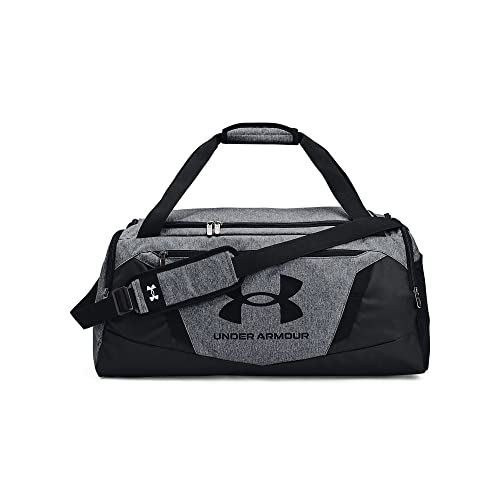
Under Armour unisex Undeniable 5.0 Duffle MD, 012 GRAY, OSFM
Chosen because it specifies 012 GRAY and OSFM.
View on AmazonFitgriff® Gym Bag for Men & Women with Shoe & Wet Compartment - Duffle Bag for Travel, Sports, Fitness & Workout (Full Black, 19 x 10 x 10″ (Small))
Chosen because it specifies Duffle Bag for Travel and Sports.
View on Amazon
BAGSMART Duffle Bag for Travel, Gym Bag for Women, Weekender Carry on
Chosen because it specifies Gym Bag for Women and Weekender Carry on.
View on AmazonBest gym bags by situation
- Best value for regular workouts: Nike Brasilia 9.5 Training Duffel. It offers a conventional duffel layout, a separate shoe compartment on many size versions, and enough room for clothes, a towel, toiletries, and accessories without the cost of a premium travel bag.
- Best for commuting to work: Aer Gym Duffel 3. Its structured opening, laptop storage, shoe compartment, and numerous smaller pockets make it easier to separate work equipment from sweaty training gear.
- Best for travel and large loads: Patagonia Black Hole Duffel 55L. Its weather-resistant recycled fabric, broad opening, and removable backpack straps are useful when a gym bag also serves as an overnight or airline carry-on-style travel bag.
- Best for a budget-conscious all-rounder: Adidas Defender 5 Duffel. It is a simple, spacious sports duffel with a coated base and a familiar shoulder-strap layout, although its organization is less elaborate than a commuting-focused bag.
- Best for minimal carry: a 20–30L gym backpack or small duffel. Choose this size for indoor shoes, one change of clothes, a towel, bottle, and basic toiletries. It is easier to store under a desk or in a locker than a 50–60L bag.
Head-to-head comparison
The figures below describe commonly sold versions and are useful for comparing scale, not for replacing the measurements on a particular retailer or manufacturer page. Duffel capacities can differ by size, and listed weights can change between revisions.
| Bag | Approx. capacity | Approx. dimensions | Approx. weight | Notable organization | Best use |
|---|---|---|---|---|---|
| Nike Brasilia 9.5 Medium | About 60L | About 25 × 12 × 12 in | About 1.1kg | End compartment, internal and external pockets | Frequent gym sessions and sports |
| Adidas Defender 5 Medium | About 51L | About 24.5 × 11 × 12 in | About 0.8kg | End pockets, coated base, zip top | Value-focused training |
| Aer Gym Duffel 3 | About 24L | About 19.5 × 9 × 9 in | About 1.1kg | Laptop sleeve, shoe compartment, accessory pockets | Work commute and urban gyms |
| Patagonia Black Hole Duffel 55L | 55L | About 22.8 × 13.4 × 9.5 in | About 1.2kg | Large main compartment, lid pocket, padded straps | Travel, tournaments, and bulky gear |
Capacity is not the same as usable space. A 55L bag with a rigid shoe tunnel, laptop padding, and multiple dividers may hold less clothing than an unstructured 60L duffel. Conversely, a highly organized 24L commuting bag can carry more useful daily equipment because every item has a predictable location.
How much capacity do you need?
20–30L: one workout and a work commute
This range is usually sufficient for training shoes, shorts or leggings, a shirt, a small towel, a 750ml bottle, deodorant, and compact toiletries. It becomes tight if you also carry a laptop, lunch, lifting shoes, a belt, or winter clothing. A dedicated shoe compartment is valuable here because shoes otherwise consume the bottom third of the main cavity.
35–45L: equipment-heavy training
Choose this size for boxing gloves, climbing shoes, a change of clothes, a towel, toiletries, and a meal container. It is also a sensible compromise for people who train before work and need to carry office clothing. Look for a wide opening rather than a narrow top zip; the difference matters when retrieving items from the bottom.
50–65L: travel or several activities
This is the most versatile large-duffel range, but it can become uncomfortable when fully loaded. A 55L bag filled with shoes, clothing, and toiletries can easily weigh 10–14kg. Removable backpack straps, a padded shoulder pad, reinforced handles, and a stable base matter more at this size than adding another small pocket.
Compartment layout: what is actually useful?
Shoe storage is worthwhile when the compartment is ventilated or separated from clean clothing. Measure the opening if you wear large shoes or high-top training footwear; a compartment described as “shoe storage” may fit only low-profile trainers. A shoe pocket also needs enough depth to avoid crushing the heel counter.
Wet-gear storage is different from shoe storage. A sweaty shirt or damp swimwear should go into a waterproof-lined pocket or a separate washable pouch. Many low-cost duffels have neither. If a bag lacks a wet compartment, pack a roll-top dry bag or reusable waterproof sack rather than putting damp items directly against fabric.
Small-item organization should cover keys, access cards, earbuds, chargers, and toiletries. Too many tiny pockets can reduce the main compartment while making bulky items harder to pack. For most users, one quick-access exterior pocket and one internal zip pocket are enough.
Laptop protection matters only for commuting models. A sleeve should hold the computer above the base rather than allowing it to rest directly on the floor. Check the stated dimensions rather than assuming a “laptop compartment” fits every 15- or 16-inch device.
Materials and carry comfort
Polyester and nylon duffels are usually light and affordable. Higher-denier fabrics, such as 900D or 1680D nylon, resist abrasion better but add weight and can feel stiff. Recycled ripstop fabrics can be durable while keeping weight moderate, as seen in the Black Hole line. A water-resistant coating helps with rain and locker-room splashes, but it does not make every seam or zip waterproof.
For comfort, inspect the load-bearing parts first: shoulder-strap anchors, handle stitching, zipper ends, and the base panel. A thin shoulder strap may be acceptable on a 24L bag but unpleasant on a loaded 60L bag. Backpack straps distribute weight more effectively, particularly when walking or cycling, but they can be awkward in crowded changing rooms.
A rigid base prevents the bag from collapsing and protects its contents, yet it also takes up storage space. If you keep the bag in a small locker or under a desk, a semi-structured design is often a better compromise than a fully stiff travel duffel.
A practical decision matrix
| Your situation | Recommended size | Priority feature | Suitable type |
|---|---|---|---|
| Beginner, 2–3 sessions weekly, little equipment | 20–30L | Light weight and simple access | Compact backpack or duffel |
| Daily gym plus office commute | 24–35L | Laptop sleeve and shoe separation | Structured commuter gym bag |
| Strength training with shoes, belt, towel, and meal | 35–45L | Wide opening and durable base | Medium duffel |
| Swimming or sports with wet clothing | 30–50L | Water-resistant wet-gear compartment | Sports duffel with lined pocket |
| Weekend travel or tournaments | 50–65L | Backpack straps and reinforced handles | Large travel duffel |
Ownership realities: cleaning and wear
The first parts to wear are commonly the bottom corners, zipper pulls, shoulder-strap stitching, and the lining of a shoe compartment. Avoid dragging the bag across concrete, overloading one pocket with metal accessories, or closing a zip over bulky gear. Pack shoes heel-to-toe and keep sharp objects in a pouch.
Empty the bag after every session. Air out damp clothing separately, wipe coated fabric with a damp cloth, and follow the care label before using detergent. Do not assume a coated bag belongs in a washing machine; heat and agitation can damage coatings, foam, and adhesives. Let the bag dry fully with every compartment open before storing it.
A simple cost-per-use calculation helps compare price with durability. For example, a $40 duffel used three times a week for two years gets approximately 312 uses, or about $0.13 per use before replacement. A $180 commuting bag used five times a week for three years gets about 780 uses, or about $0.23 per use. The more expensive bag may still be the better purchase if its organization prevents carrying a second laptop sleeve or separate shoe sack.
Final recommendation
Choose the Nike Brasilia 9.5 or Adidas Defender 5 if you want a roomy, affordable bag for ordinary workouts. Choose the Aer Gym Duffel 3 when your main problem is separating work, technology, shoes, and training clothes. Choose the Patagonia Black Hole 55L when the bag must also handle travel and heavy loads. If your routine is simple, do not buy capacity you will rarely use: a comfortable 20–30L bag with sensible shoe and wet-gear storage is often the easiest option to carry, clean, and store.

Write Your Review
No reviews yet. Be the first to share your experience!