
Key takeaways
- Confusing sleeve length with total bar length: A 7-foot bar does not have 7-foot sleeves. The shaft and sleeve measurements determine rack compatibility and plate capacity separately.
- Using nominal sleeve length: The advertised sleeve length may include a collar or non-loadable section. Look for “loadable sleeve length” when calculating plates.
- Ignoring plate thickness: Ten thin iron plates may fit where five thick bumper plates do not. Measure the actual plates you own.
- Buying a holder without checking diameter: Olympic bars are roughly 2 inches in sleeve diameter, but specialty bars may have different shapes or thicker ends.
- Assuming every short bar fits a rack: A 6-foot bar may have too little shaft outside the sleeves for some racks, especially wide models.
- Skipping structural support: Wall storage loaded with several bars can weigh more than 100 pounds (45 kg). Mount it to studs or suitable masonry anchors.
- Measuring only the footprint: Include loading space, walking paths, plate removal room, and vertical clearance—not just the stand’s base dimensions.
What's inside
Choosing the right barbell for a home rack is not only about total bar length. The loadable sleeve—the thick section where weight plates sit—must be long enough for your plates and compatible with the rack’s storage points, spotter arms, and surrounding clearance. This guide explains barbell sleeve length for home racks, including practical measurements for power racks, squat stands, wall storage, and vertical holders.
The Short Answer
For most home gyms, choose a standard Olympic barbell with sleeves about 16 inches long (40.6 cm) or more. A sleeve with approximately 13.5 to 16.5 inches (34.3 to 41.9 cm) of usable loadable length works for many home setups, but the exact usable area depends on the bar’s collars and sleeve design.
As an Amazon Associate we earn from qualifying purchases at no extra cost to you. Product prices and availability are accurate as of the date shown and are subject to change.
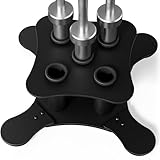


A 7-foot Olympic bar is usually about 86.6 inches (220 cm) long, with a shaft around 51.5 inches (130.8 cm) between the sleeves. That shaft length fits most full-size power racks and squat racks. If your room is narrow, a 6-foot or specialty bar may fit more easily, but its shorter shaft can change the bar’s position on a rack and may not work with every J-cup or spotter-arm spacing.
For storage, sleeve length is usually less important than the holder’s opening diameter, depth, spacing, and weight capacity. A vertical holder may accept several bar types, while a horizontal wall rack must have enough clearance between its hooks for the bar sleeves, collars, and plates.
Standard Sizes
The measurements below represent common barbell dimensions rather than a single mandatory industry standard. Always check the manufacturer’s specifications, especially for specialty bars.
| Barbell type | Overall length | Overall length in cm | Typical sleeve length | Typical sleeve length in cm | Typical weight |
|---|---|---|---|---|---|
| Men’s Olympic bar | 86.6 in | 220 cm | 16.0–16.5 in | 40.6–41.9 cm | 44 lb / 20 kg |
| Women’s Olympic bar | 79.1 in | 201 cm | 12.5–15.0 in | 31.8–38.1 cm | 33 lb / 15 kg |
| 6-foot Olympic bar | 72 in | 183 cm | 12.0–15.0 in | 30.5–38.1 cm | 25–35 lb / 11–16 kg |
| EZ curl bar | 47–55 in | 119–140 cm | 7.0–10.0 in | 17.8–25.4 cm | 15–25 lb / 7–11 kg |
| Trap or hex bar | 56–90 in | 142–229 cm | 8.0–16.0 in | 20.3–40.6 cm | 45–75 lb / 20–34 kg |
Olympic plates have a 2-inch (50.8 mm) center hole, so Olympic sleeves are generally close to 1.96 to 2.0 inches (49.8 to 50.8 mm) in diameter. Standard one-inch-hole plates require a different bar and should not be placed on a typical Olympic bar.
When calculating plate capacity, do not count the full sleeve length automatically. Collars, tapered ends, fixed bearings, and the plate’s center hub can reduce usable space. For example, a 16-inch sleeve may provide only 14.5 to 15 inches of practical loading area. A 45-pound Olympic plate is commonly about 1.3 to 2.4 inches (3.3 to 6.1 cm) thick, depending on whether it is iron, bumper, or competition-style. Six 2-inch-wide plates need about 12 inches of sleeve space before adding the collar.
How to Measure Your Space
- Measure the bar first. Record overall length, sleeve length, sleeve diameter, and the distance between the inside edges of the sleeves. For a full-size bar, plan around 86.6 inches (220 cm) of length.
- Measure rack clearance. Check the rack’s outside width and depth, then add room for your hands and plates. A practical lifting area is often at least 8 feet wide and 8 feet deep, although the exact requirement depends on the rack and exercise.
- Check ceiling height. A rack around 80 to 90 inches tall can be difficult to use in a basement with a low ceiling. Leave several inches above the rack for assembly and overhead movement.
- Measure the storage point. For a vertical holder, measure the inside diameter and depth of each tube. For wall storage, measure the hook width, mounting-hole spacing, and distance between bars.
- Calculate plate and collar clearance. Add the loaded plate width to the sleeve length, then allow space to slide plates on and off. Keep at least 2 inches (5.1 cm) of usable clearance beyond your normal plate stack where possible.
- Locate wall studs or a solid floor. A wall-mounted rack should attach to structural framing or an appropriate masonry anchor, not only drywall. A freestanding holder needs a level footprint and enough room that a stored bar cannot be bumped into a walkway.
- Check the rack’s capacity. Storage capacity and lifting capacity are separate ratings. A holder rated for 300 pounds (136 kg) of stored bars may not be designed to support a loaded barbell.
By Room or Use Case
Full Home Gym With a Power Rack
A full-size 7-foot Olympic bar is normally the easiest choice. Its approximately 51.5-inch shaft fits many power racks, while 16-inch sleeves provide room for common bumper and iron plate combinations. Leave at least 24 inches (61 cm) of open space around the rack’s sides if you frequently load plates from outside the uprights.
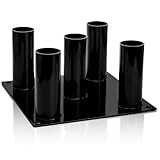
Vertical five-bar holders are useful when floor space is limited. Products in this category commonly cost about $30 to $70 and may store five bars, depending on the bar diameter and holder design. Verify that the tubes are deep enough for your longest bar and that the base footprint, often around 18 to 24 inches (46 to 61 cm) across, will not obstruct the rack.
Basement or Low-Ceiling Room
Measure from the finished floor to the lowest obstruction, including pipes and light fixtures. An 80-inch rack may technically fit under an 84-inch ceiling, but assembly and overhead pressing can still be uncomfortable. A shorter rack or squat stand may be better. A 6-foot Olympic bar can reduce side-to-side storage needs, but confirm that its shaft reaches both rack supports.
Apartment or Multipurpose Room
Wall-mounted horizontal storage keeps bars off the floor and can cost roughly $20 to $45 for a basic holder. One example of this style is a four-bar wall rack priced around $22.99. Before buying, confirm the bar spacing and mounting hardware, then add the bar’s sleeve diameter and collars to the required clearance. Use protective pads where the bar contacts the rack or wall.
Compact Corner Storage
A vertical floor stand is often the simplest option for one to five bars. A five-bar stand may be priced from about $30 to $70, with examples around $29.99 and $66.49. Corner placement works well, but allow enough room to lift a bar vertically without striking the ceiling, shelves, or a fan. Measure your longest bar and add at least 6 inches (15.2 cm) above its overall length if the holder stores bars upright.
Home Gym With Specialty Bars
Trap bars, triceps bars, and EZ curl bars vary considerably. A holder advertised for five Olympic bars may accept a hex bar only if its handles and frame fit the opening. A multi-function rack priced around $65.99 may accommodate different equipment, but inspect the tube diameter, spacing, and weight rating rather than relying on the product name. Store heavy specialty bars low when possible to improve stability.
Common Sizing Mistakes
- Confusing sleeve length with total bar length: A 7-foot bar does not have 7-foot sleeves. The shaft and sleeve measurements determine rack compatibility and plate capacity separately.
- Using nominal sleeve length: The advertised sleeve length may include a collar or non-loadable section. Look for “loadable sleeve length” when calculating plates.
- Ignoring plate thickness: Ten thin iron plates may fit where five thick bumper plates do not. Measure the actual plates you own.
- Buying a holder without checking diameter: Olympic bars are roughly 2 inches in sleeve diameter, but specialty bars may have different shapes or thicker ends.
- Assuming every short bar fits a rack: A 6-foot bar may have too little shaft outside the sleeves for some racks, especially wide models.
- Skipping structural support: Wall storage loaded with several bars can weigh more than 100 pounds (45 kg). Mount it to studs or suitable masonry anchors.
- Measuring only the footprint: Include loading space, walking paths, plate removal room, and vertical clearance—not just the stand’s base dimensions.
FAQ
What sleeve length is best for a home Olympic bar?
A sleeve with about 16 inches (40.6 cm) of total length and at least 14 inches (35.6 cm) of usable loading space is a practical target for most home gyms. Choose more usable length if you use thick bumper plates or regularly load heavy stacks.
Will a 6-foot bar fit a standard power rack?
It may, but do not assume it will. Measure the shaft length between the sleeves and compare it with the rack’s inside width and J-cup position. Many 6-foot bars are intended for narrower racks or stands, while a 7-foot bar is the safer general-purpose option.
How much space should be behind a barbell storage rack?
Leave at least 6 to 12 inches (15.2 to 30.5 cm) behind a freestanding holder so the bar does not scrape the wall. For a wall-mounted rack, follow the mounting instructions and keep enough room to lift bars onto the hooks without hitting the ceiling or nearby equipment.
Can one rack store Olympic, curl, and trap bars?
Sometimes, but only when the holder’s openings and weight capacity suit all three. Check each bar’s sleeve diameter, handle shape, overall width, and weight. A general-purpose floor stand can be convenient, but separate storage may be safer for an unusually wide or heavy trap bar.





Write Your Review
No reviews yet. Be the first to share your experience!