
Key takeaways
- Measuring only the uprights: Rear pulleys, plate pegs, and weight-stack guards can extend beyond the advertised frame depth.
- Forgetting the barbell: A rack that fits against a wall may still leave insufficient room for a 7-foot bar and loaded plates.
- Ignoring ceiling obstructions: Lights, beams, and garage-door hardware can make a nominally suitable height unusable.
- Choosing maximum capacity over fit: A 2,000-pound rating does not help if the rack crowds the room or cannot be anchored correctly.
- Leaving no plate-loading space: Plan for at least 18 to 24 inches beside each sleeve, especially with bumper plates.
- Skipping anchoring requirements: Some racks are stable freestanding; others should be bolted to the floor. Check the instructions before placing one on finished flooring.
What's inside
The Short Answer
For most home gyms, plan on a power rack footprint of about 48 to 55 inches wide by 48 to te 65 inches deep (122 to 140 cm wide by 122 to 165 cm deep). A basic four-post rack commonly stands 80 to 86 inches tall (203 to 218 cm), while racks with a lat pulldown, cable crossover, or multi-grip pull-up station may reach 84 to 90 inches (213 to 229 cm).
The rack itself is only part of the space requirement. Leave at least 24 inches (61 cm) behind the uprights, 36 inches (91 cm) in front for walking and bar loading, and enough side clearance to load plates safely. For a barbell squat, bench press, or overhead press, a practical total zone is approximately 8 feet wide by 10 feet deep. Ceiling height is equally important: an 8-foot ceiling may work for a short rack, but 9 feet gives you more flexibility and reduces the chance of hitting the ceiling with a bar or pull-up movement.
As an Amazon Associate we earn from qualifying purchases at no extra cost to you. Product prices and availability are accurate as of the date shown and are subject to change.


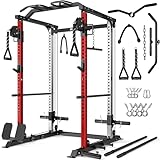

Standard Sizes
Power rack dimensions vary by frame design, hole spacing, storage posts, and cable attachments. The measurements below represent common home-gym configurations rather than a single universal standard. Always check the manufacturer’s assembled dimensions, because a lat tower or plate storage extension can add several inches to the listed rack size.
| Rack type | Typical width | Typical depth | Typical height | Approximate metric size | Best for |
|---|---|---|---|---|---|
| Compact half rack | 48–54 in | 24–36 in | 72–84 in | 122–137 × 61–91 × 183–213 cm | Small rooms and squat-focused training |
| Standard full power rack | 48–52 in | forty-eight–60 in | 80–86 in | 122–132 × 122–152 × 203–218 cm | Squats, bench press, and pull-ups |
| Rack with lat pulldown | 50–56 in | 60–72 in | 82–88 in | 127–142 × 152–183 × 208–224 cm | Full-body cable and barbell workouts |
| Cable crossover power cage | 55– seventy-two in | 60–75 in | 82–90 in | 140–183 × 152–191 × 208–229 cm | Multiple users and broad exercise variety |
| Short rack | forty-eight–52 in | forty-eight–60 in | 72–78 in | 122–132 × 122–152 × 183–198 cm | Basements and low ceilings |
In practical terms, width is usually determined by the uprights, while depth depends on the length of the safety arms and whether the rack includes a rear pulley tower. A 47-inch Olympic bar extends roughly 20 inches beyond each side of a rack, so the usable barbell width is much greater than the frame width. With a standard 7-foot Olympic bar, aim for at least 8 feet of unobstructed width, or 96 inches (244 cm).
Home racks often weigh between 150 and 500 pounds (68 and 227 kg), depending on steel thickness, storage posts, cable towers, and attachments. Listed weight capacities commonly range from 700 to 2,000 pounds (318 to 907 kg), although the capacity may differ for the j-hooks, safeties, pull-up bar, and cable system. Current all-in-one home models typically fall in the approximate $270 to $480 price range before accessories, shipping, or floor protection.
How to Measure Your Space
- Measure the ceiling first. Measure from the finished floor to the lowest obstruction, not just the main ceiling. Include beams, ductwork, lights, garage-door tracks, and ceiling fans. Compare that number with the rack’s fully assembled height.
- Mark the frame footprint. Use painter’s tape to outline the advertised width and depth. If the unit has rear weight storage or a lat tower, include those extensions rather than measuring only the front uprights.
- Add barbell length. For a standard 7-foot bar, allow about 12 to 18 inches of extra clearance on each side beyond the plates. A shorter bar can save space, but it may not fit every rack or provide enough sleeve length for heavy loading.
- Plan the front working zone. Leave roughly 36 inches (91 cm) in front of the rack for walking, unracking, and changing plates. Increase that to 48 inches (122 cm) if the rack faces a wall or another piece of equipment.
- Check the bench path. A flat or adjustable bench typically needs 60 to 72 inches (152 to 183 cm) of usable length inside the rack. Make sure you can slide it into position without hitting a wall, storage cabinet, or cable tower.
- Locate doors and outlets. A rack should not block a door swing, emergency exit, electrical panel, or heating vent. Cable machines may need an outlet for lighting or optional accessories, but the rack’s primary resistance system is generally mechanical rather than electric.
- Inspect the floor. Rubber flooring at least 3/8 inch thick is suitable for general use, while thicker 1/2- to 3/4-inch tiles provide better protection under heavy deadlifts and dropped plates. Confirm that the floor can support the rack, lifter, bar, and plates together.
By Room or Use Case
Bedroom or spare room
Choose a compact or short rack with a footprint near 48 by 48 inches. A 72- to 78-inch rack can fit beneath many low ceilings, but you still need clearance for the pull-up bar and your head. Avoid deep rear cable towers if the rack would reduce the room’s main walkway below about 30 inches.
Garage gym
A garage usually offers the most flexible layout, but measure the open garage-door track and ceiling height carefully. A full rack with a lat pulldown often needs 60 to 72 inches of depth. Leave room to walk around the rack and keep at least 12 inches between the frame and the garage wall so bolts, safeties, and plates remain accessible.
Basement
Low ceilings make rack height the main concern. Select a 72- to 78-inch model, and consider a rack with a lower pull-up bar or no overhead crossmember. Check the stairway and doorway before delivery; a heavy cage may be difficult to turn through a narrow landing. Measure both the finished ceiling and any soffits.
Apartment or shared living space
A half rack is usually easier to place and move than a full cage. Look for a model under 200 pounds if portability matters, and use thick rubber tiles to reduce vibration. Keep the total training area at least 8 by 8 feet when possible, especially if you will use a barbell outside the rack.
Full-body training area
If you want squats, benching, pull-ups, rows, pulldowns, cable flyes, and landmine exercises in one station, expect a larger footprint. Cable crossover systems may require 55 to 72 inches of width and up to 75 inches of depth. Add room at the sides for plate loading and cable movement, not just a narrow path through the middle.
Common Sizing Mistakes
- Measuring only the uprights: Rear pulleys, plate pegs, and weight-stack guards can extend beyond the advertised frame depth.
- Forgetting the barbell: A rack that fits against a wall may still leave insufficient room for a 7-foot bar and loaded plates.
- Ignoring ceiling obstructions: Lights, beams, and garage-door hardware can make a nominally suitable height unusable.
- Choosing maximum capacity over fit: A 2,000-pound rating does not help if the rack crowds the room or cannot be anchored correctly.
- Leaving no plate-loading space: Plan for at least 18 to 24 inches beside each sleeve, especially with bumper plates.
- Skipping anchoring requirements: Some racks are stable freestanding; others should be bolted to the floor. Check the instructions before placing one on finished flooring.
FAQ
How much room do I need for a power rack?
Allow at least 8 by 8 feet for a basic rack and barbell setup. For a full rack with a pulldown or cable crossover, 8 by 10 feet is more comfortable. This includes working and walking space, not just the steel frame.
Will a power rack fit under an 8-foot ceiling?
It can, but choose a rack no taller than about 78 to 84 inches and confirm the height of the pull-up bar. Leave several inches above the highest point. A 9-foot ceiling is preferable for tall racks and overhead barbell work.
Are all power racks the same width?
No. Most home models are about 48 to 56 inches wide, but compact racks can be narrower and cable crossover designs can be considerably wider. The usable width also depends on the barbell, plate diameter, and side storage.
What is the best rack size for most home gyms?
A full rack about 48 to 52 inches wide, 48 to 60 inches deep, and 80 to 86 inches tall is a versatile choice for most users. If you want integrated pulldowns and cable exercises, plan for approximately 60 to 72 inches of depth and a wider clearance zone.





Write Your Review
No reviews yet. Be the first to share your experience!