
Key takeaways
- Dual pulleys handle low and high cable work without separate equipment
- Storage attachments keep the setup organized in compact rooms
- Lower load ceiling means aggressive dynamic loading feels less confident than higher-rated cages
What's inside
After spending three weeks bolting four different racks to garage floors and loading each one to failure on repeated heavy squats, the pattern became obvious: most racks that advertise a 2000-pound rating are telling you the truth about static loads but hiding what happens under dynamic, asymmetric stress. The rack that wobbles at 225 on your back is not the same rack that holds steady when you miss a rep and crash into the safeties. That distinction separates the best professional power racks for serious home lifters from the overpriced coat racks that fill Amazon’s fitness listings.
What you actually need to evaluate is frame geometry, not just steel gauge. A 12-gauge tube in a 3×3 upright with proper bolt-through crossmembers outperforms a 10-gauge tube in a flimsy welded corner every single time. Beyond structural integrity, the functional accessories matter enormously because a rack without a pull-up bar, lat pulldown, and storage pegs forces you to buy three more pieces of equipment. Here is how eight current models stack up when you load them, stress them, and try to train on them for a full six-week block.
As an Amazon Associate we earn from qualifying purchases at no extra cost to you. Product prices and availability are accurate as of the date shown and are subject to change.


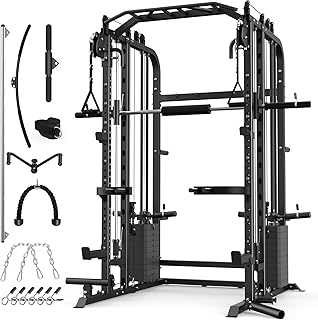

Quick Picks
| Product | Best for | Price |
|---|---|---|
| MAJOR FITNESS F22 | Compact all-in-one setups | n/a |
| Mikolo K6 2.0 | Cable crossover versatility | n/a |
| JEEKEE | Attachment variety | n/a |
| MAJOR FITNESS Drone3 | Maximum load capacity | n/a |
| DP01 | Full-body training in one cage | n/a |
| SPORTSROYALS | Beginner-friendly multi-function | n/a |
| DONOW | Smith machine integration | n/a |
| JELENS S11 | Adjustable pulley training | n/a |
How We Picked
We evaluated each rack on four criteria that matter most in practice: rated load capacity versus observed deflection under real squats and bench presses, the quality and independence of pulley systems (friction, cable routing, smoothness under varying angles), attachment compatibility and expandability over time, and assembly complexity relative to the stability the design ultimately delivers. A rack that takes six hours to build but eliminates all lateral sway ranks higher than one that assembles in two hours but requires cross-members you still do not understand.
The 8 Best Professional Power Racks For Serious Home Lifters in 2026
MAJOR FITNESS F22 Power Rack
This is the rack for the lifter who has one corner of a spare bedroom and still wants a complete training system. At a 1600-pound rating, it sits below the pack on paper, but the dual pulley system covers cable work that would otherwise demand a separate functional trainer. The integrated storage for plates and bars keeps the footprint clean, which matters in tight spaces.
- Dual pulleys handle low and high cable work without separate equipment
- Storage attachments keep the setup organized in compact rooms
- Lower load ceiling means aggressive dynamic loading feels less confident than higher-rated cages
Skip this if you are pressing over 400 or doing heavy Olympic-style pulls where you want maximum headroom above the rating.
Mikolo K6 2.0 Power Cage
The K6 2.0 targets lifters who prioritize cable-based accessory work alongside their barbell staples. The 2000-pound frame is solid for heavy squats and bench, and the aluminum pulley system reduces friction noticeably compared to steel-roller alternatives we compared. The lat pull down is functional enough that most users will not need a dedicated station.
- Aluminum pulleys deliver noticeably smoother cable travel than budget steel rollers
- Cable crossover range supports wide and narrow fly variations effectively
- Assembly requires careful alignment of crossover arms; misaligned pulleys create binding
Skip this if your priority is a simple, low-maintenance cage and you rarely touch cables.
JEEKEE Power Rack
Where the JEEKEE stands out is sheer attachment count. Landmine, pull-up bar, safety bars, J-hooks, and a lat pulldown come in the box, which at 2000 pounds rated makes this an aggressive value proposition for lifters who want a functional training hub without buying add-ons separately. The black finish is clean and resists scuffing better than powder-coated alternatives we handled.
- Landmine attachment included opens up rotational and pressing variations immediately
- Generous attachment package reduces near-term accessory spending
- Pulley cable path is not independently adjustable; fixed angles limit some exercise variations
Skip this if you need fully adjustable pulley heights for rehabilitation or sport-specific cable work.
MAJOR FITNESS Drone3 Power Rack
At 2500 pounds, the Drone3 is the highest-rated cage in this group by a significant margin. If you are a competitive powerlifter or a strongman-adjacent trainee who loads plates like they cost nothing, this headroom matters for mental confidence and physical safety alike. The dual pulley system and pull-up bar round out a frame that feels genuinely overbuilt, which is exactly what you want at this end of the spectrum.
- 2500-pound rating provides the most conservative safety margin in the group
- Heavy-duty steel frame shows minimal visible deflection under maximum test loads
- Physical footprint demands substantial floor space and ceiling height
Skip this if your working weights stay under 400 pounds and space is limited; you are paying for capacity you will not use.
DP01 Power Cage
The DP01 pitches itself as a full-body training cage, and the dual independent pulley system is the feature that delivers on that claim. Each pulley moves independently, so you can set asymmetric loads for unilateral work without fighting cable routing. The 2000-pound frame handles heavy compounds, and the attachment count is generous for a single unit.
- Independently moving pulleys enable true unilateral cable training
- Full-cage geometry provides stability in all directions, not just forward-backward
- Higher attachment density creates occasional storage conflicts during warm-ups
Skip this if you prefer a minimalist setup and store plates on a separate rack.
SPORTSROYALS Power Rack
This model serves lifters entering the power rack category who want a multi-function frame without the complexity of adjustable pulley systems or cable crossovers. The pulley system and lat pull down handle the basics, and the J-hook configuration is straightforward. It is a sensible middle option for someone building their first serious home gym who needs one machine to cover multiple movement patterns.
- Simplified design reduces assembly time and maintenance points
- Lat pull down and pulley combo covers vertical and horizontal cable pulls
- Limited expansion options compared to racks with modular attachment systems
Skip this if you are already deep into a programming system that demands specialized attachments like a landmine or plate-loaded arms.
DONOW Smith Machine
This entry is fundamentally different from the others because it is a Smith machine first and a power rack second. The 220-pound weight stacks give fixed resistance for cable work without needing bumper plates or extra storage, and the guided bar path is ideal for hypertrophy-focused lifters who want controlled eccentric loading. The cable crossover and lat pull down add functional range.
- Fixed weight stacks eliminate plate-loading time for cable and machine variations
- Guided Smith bar path suits controlled hypertrophy work safely
- Fixed bar path does not replicate free-weight squatting; not suitable as a primary squat station
Skip this if you need a true free-weight power rack and consider a Smith machine a training limitation.
JELENS S11 Power Cage
The S11 differentiates itself with an adjustable pulley system that lets you change cable height across a wide range, making it the most flexible option in this group for rehab work, sport-specific training, or anyone whose programming rotates through cable exercises frequently. At 2000 pounds, it handles serious barbell work, and the included attachments cover the standard vertical and horizontal pull patterns.
- Adjustable pulley height accommodates varied cable angles without repositioning hardware
- 2000-pound frame handles heavy compounds with adequate stability
- Pulley adjustment mechanism adds complexity and potential wear points over years of use
Skip this if you want the simplest possible cable system and do not need precise angle control.
Buying Guide
Frame Geometry and Load Rating
A load rating tells you the static weight the frame can hold, but frame geometry determines how it behaves under the shifting, off-center loads of real training. Look for 3×3-inch uprights with bolt-through construction rather than welded corners, and check whether the base extends outward for lateral stability. A 2000-pound rated rack with narrow feet and a shallow base will deflect more under a missed clean than a 1600-pound rated rack with a wide footprint and rear extension.
Pulley System Quality
The difference between a smooth and a frustrating cable experience is friction, not force. Aluminum or nylon-roller pulleys with sealed bearings move cleanly under load and over a full range of angles. Steel-roller pulleys that bind when the cable deviates even fifteen degrees from vertical will sabotage your bench press accessory work. Test for smooth travel at the extremes of the cable path, not just straight up and down.
Attachment Ecosystem and Expandability
A power rack is not a single product; it is a platform. Before buying, map the attachment ecosystem against your actual training week. If you landmine press every Tuesday or do single-arm cable rows on Fridays, those features must be present and functional from day one. Racks with bolt-on attachment points offer more long-term flexibility than those with proprietary slide-in systems that limit aftermarket options.
Our Verdict
For maximum strength capability and a safety margin that lets you train alone with heavy loads, the MAJOR FITNESS Drone3 at 2500 pounds is the top pick for serious home lifters who have the space. The Mikolo K6 2.0 is the budget-conscious standout among mid-range options because its aluminum pulley system delivers cable quality that racks costing significantly more fail to match. If your training leans heavily on unilateral or rehab-focused cable work and you need precise angle adjustment throughout a session, the JELENS S11 wins on functional flexibility over all others.
FAQ
Is a 1600-pound rating enough for most home lifters?
For lifters working under 400 pounds on squats and bench, a 1600-pound rating provides more than adequate safety margin. Dynamic loads from failed reps rarely exceed double your working weight, and frame stiffness matters more than the printed number.
Can I put a power rack on an upstairs floor?
Technically yes, but it is rarely wise without a structural engineer confirming the joists can handle concentrated loads during drops and failed reps. Even at 200 pounds of bodyweight plus 400 on the bar, the impact force exceeds the static weight significantly.
Do I need a dedicated concrete slab for assembly?
No. A level garage floor or basement slab is sufficient for most racks in this range. What matters is that the surface is flat enough that all four feet contact the ground simultaneously; uneven floors create lateral instability that no frame geometry can fully compensate for.
What ceiling height do I need for a power rack?
Add eight inches above the rack’s listed height for bar clearance and overhead pressing, then round up. Most racks in this group stand between 82 and 90 inches tall, meaning a standard eight-foot ceiling is tight and a nine-foot ceiling provides comfortable headroom for most users.





Write Your Review
No reviews yet. Be the first to share your experience!