
Our Top Picks
A trail shoe is a specific answer to a specific kind of ground. Road runners who drift onto a dirt path for the first time usually need only a bit more grip and a sturdier upper, while someone logging weekend miles on rocky, root-laced singletrack needs protection underfoot and reliable traction on loose slopes. The keyword sounds generic, but the right pick depends almost entirely on where your runs actually happen and how much cushioning your feet like.
This guide is for runners choosing a first or replacement pair of trail shoes from well-known running brands. The listings here are brief: each title gives a brand, model name, color, and size, but few technical details. For that reason, the comparisons below stay general and tie to the model names and categories in the titles. Check the full listing for weight, stack height, heel drop, lug depth, and width options before committing, and use the brand’s size guidance since fit varies between models.
Quick Picks

New Balance Men's 410 V9 Trail Running Shoe, Castlerock/Black, 9.5
One of the consumer electronics options compared in this guide.
View on Amazon
ASICS Men's Gel-Venture 11 Running Shoes, 8.5, Black/Carrier Grey
One of the consumer electronics options compared in this guide.
View on Amazon
Brooks Men’s Cascadia 19 Mountain Trail Running Shoe - Black/Black/Ebony - 11.5 Medium
One of the consumer electronics options compared in this guide.
View on Amazon
Saucony Men's Excursion TR14 Trail Running Shoe, Grey/Gold, 11
One of the consumer electronics options compared in this guide.
View on Amazon
ALTRA Men's Lone Peak 9 Trail Running Shoe, Black, 12
One of the consumer electronics options compared in this guide.
View on Amazon
Brooks Women’s Cascadia 19 Mountain Trail Running Shoe - Coconut/Misty Blue/Ebony - 9.5 Medium
One of the consumer electronics options compared in this guide.
View on Amazon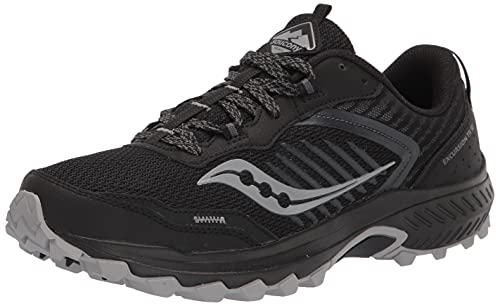
Saucony Men's Excursion TR15 Trail Running Shoe, Black/Shadow, 10
One of the consumer electronics options compared in this guide.
View on Amazon| Product | Best for | Key spec from the title |
|---|---|---|
| New Balance 410 V9 | Easy-going trail and park runs | Trail running shoe, Castlerock and Black |
| ASICS Gel-Venture 11 | Beginners moving off the road | Running shoe, Black and Carrier Grey |
| Brooks Cascadia 19 | Rugged mountain terrain | Mountain trail running shoe, men’s and women’s versions |
| Saucony Excursion TR14 | Value-minded trail beginners | Trail running shoe, Grey and Gold |
| Saucony Excursion TR15 | Updated Excursion for steady runs | Trail running shoe, Black and Shadow |
| ALTRA Lone Peak 9 | Longer trail days | Trail running shoe, Black |
| Salomon XA PRO 3D | Runners who like a technical look | Trail running shoes, Monument, Ebony, Red Dahlia |
How to Choose
Start with the terrain
Packed dirt and gravel paths ask for modest lugs and a flexible sole. Muddy, rocky, or steep routes call for deeper lugs, a firmer midsole, and more protection from sharp stones. Many models blur these categories, so match the shoe’s stated purpose, such as the mountain trail label on the Brooks Cascadia, to your usual ground rather than the one you hope to run next year.
Cushioning, drop, and fit
Cushioning level changes how the shoe feels on long runs: softer midsoles forgive tired legs, while firmer ones give a more connected ride. Heel drop and toe box width matter just as much, and they vary by brand. Try to leave about a thumb’s width of space in front of your longest toe for downhill running, and follow each brand’s size chart, since the listed sizes in this group are for single variations.
Grip, upper, and protection
Outsole rubber and lug pattern decide traction on wet rock and loose dirt. Uppers range from light mesh to reinforced fabrics, and a toe bumper adds protection against rocks and roots. Budget-tier trail shoes tend to trade away durability or weather resistance, so look at what the full listing says about materials. Waterproof ratings and specific rubber compounds should only be assumed when stated on the listing.
Sizing, color, and general care
The titles here list specific sizes and colors, so confirm that the size you need is the one shown and read the variation menu. General guidance only: break shoes in on short runs before a long outing, rotate pairs if you run often, and replace them when the cushioning feels flat or the tread is worn. In 2026 many runners keep one road pair and one trail pair, which extends the life of both.
The 7 Best Options
New Balance 410 V9
The 410 V9 is listed as a men’s trail running shoe in Castlerock and Black. The version number points to a model that has been revised over several seasons, and it speaks to runners who want a straightforward trail option from a well-known brand. Runners who stick to park trails, gravel paths, and dry forest tracks are the likeliest fit, and it works as a first trail pair for someone who is not sure how often the dirt will replace the pavement.
- Strength: a trail-specific model from a brand with broad size offerings.
- Strength: a neutral color scheme that hides trail dust.
- Trade-off: the title lists no technical details, so check cushioning and lug depth on the listing.
Skip it if you need a rugged shoe for steep mountain terrain.
ASICS Gel-Venture 11
This men’s running shoe in Black and Carrier Grey carries the Gel-Venture name. It is aimed at runners who are moving from pavement to light trails and want a familiar brand. A shopper who already wears ASICS road shoes can use that experience as a starting point for size, though trail models can fit differently, and anyone planning rocky or muddy routes should look closely at the tread described on the full listing.
- Strength: eleven versions suggest a long-running model with refinement.
- Strength: a recognizable brand makes sizing easier for runners who already wear ASICS.
- Trade-off: the title calls it a running shoe rather than a trail-specific design, so confirm its tread on the listing.
Skip it if you want a mountain-ready outsole.
Brooks Cascadia 19
Brooks lists the Cascadia 19 as a mountain trail running shoe, in men’s Black, Black, and Ebony and in a women’s Coconut, Misty Blue, and Ebony colorway. The mountain label signals a shoe meant for rugged routes rather than park paths. Because the same model appears for men and women, couples and running partners can look at one design in two fits, and anyone choosing between them should follow the brand’s size guidance for the specific version they pick.
- Strength: purpose-built for mountain trails, per the title.
- Strength: available in both men’s and women’s versions.
- Trade-off: a specialized shoe may feel more than needed on mellow paths.
Skip it if your runs stay on smooth, packed trails.
Saucony Excursion TR14
The Excursion TR14 is a men’s trail running shoe in Grey and Gold. As the earlier version in the Excursion line, it suits runners who like the series and want a trail-ready shoe without chasing the newest release. Pairing this listing with the TR15 is a useful way to compare, since the two share a name and a similar purpose, and the differences are best read from the full descriptions rather than assumed.
- Strength: trail-specific design from a mainstream running brand.
- Strength: choosing an earlier version can make sense for runners who just want a proven line.
- Trade-off: the title offers no cushioning or weight details.
Skip it if you want the newest iteration of the line.
Saucony Excursion TR15
The TR15 follows the TR14 in the Excursion family, listed as a men’s trail running shoe in Black and Shadow. It fits runners who want a dark, versatile colorway and the next step in the model’s evolution. A darker colorway tends to hide mud and dust after a few outings, which matters for runners who wear their trail shoes to the trailhead and back and do not want to scrub the upper after every run.
- Strength: a newer version in a trail-focused line.
- Strength: neutral color pairs easily with everyday wear.
- Trade-off: the visible title does not name any design changes, so compare against the TR14 on the listing.
Skip it if you need a shoe for technical, rocky terrain.
ALTRA Lone Peak 9
ALTRA lists the Lone Peak 9 as a men’s trail running shoe in Black. The ninth version points to a model that has been revised many times, and the trail label in the title shows it is meant for off-road running. Runners planning longer outings will want to read the full listing for cushioning and fit notes, since a shoe that feels fine for five miles can feel different at fifteen.
- Strength: a long-lived model name in the trail category.
- Strength: all-black styling is easy to keep looking clean.
- Trade-off: the toe box shape and cushioning differ from other brands, so read the fit notes on the listing.
Skip it if you prefer a snug, traditional fit.
Salomon XA PRO 3D
The XA PRO 3D appears as men’s trail running shoes in Monument, Ebony, and Red Dahlia. The model name and bold color suit runners who like a technical look. Buyers should read the listing for weight, lacing system, and width, because the title offers only the name, color, and a single size, and a shoe chosen on style alone can disappoint on a long descent.
- Strength: from a brand centered on trail and mountain sport.
- Strength: a bold colorway stands out on the trail.
- Trade-off: the title lists no weight or lug information, so confirm on the listing.
Skip it if you want a soft, road-like feel.
Which One Fits Your Situation
You run rugged mountain routes
The Brooks Cascadia 19 is the pick that names mountain trail use right in its title, and the Salomon XA PRO 3D is worth a look for a technical style, once its full listing confirms the tread and weight.
You are moving from road to light trail
The ASICS Gel-Venture 11 or the New Balance 410 V9 provide a familiar brand and a gentle introduction.
You want to compare two generations of a model
The Saucony Excursion TR14 and TR15 let you see how a line evolves, with the TR15 as the newer option.
You log long days on varied trails
The ALTRA Lone Peak 9 is built around a model name favored for longer outings, though fit should be checked carefully.
Common Mistakes
- Buying on color alone and ignoring the intended terrain.
- Skipping the size chart because the number matches a road shoe.
- Wearing trail shoes for the first time on a long race-day run.
- Ignoring tread wear until traction clearly fades.
- Assuming a shoe is waterproof without a stated rating on the listing.
Related guides
Frequently Asked Questions
How are trail shoes different from road shoes?
Trail shoes generally add more aggressive outsoles, sturdier uppers, and extra protection for uneven ground. Road shoes focus on smooth surfaces and cushioning.
Can trail shoes be used on pavement?
Yes, but deep lugs can feel firm and wear faster on hard surfaces. Many runners keep a separate road pair, and a mixed route that crosses pavement before reaching the trailhead is the usual reason a trail shoe ends up on asphalt at all.
How long do trail shoes last?
It depends on terrain, body weight, and weekly mileage. Replace them when the midsole feels flat or the tread is visibly worn. Keeping a simple log of weekly miles on each pair makes that decision easier, and rotating two pairs lets the cushioning recover between runs.
Should trail shoes be a half size larger?
Some runners size up slightly for downhill room and sock thickness. Follow the brand’s fit guidance and try them with your usual running socks. Feet swell over long runs, so a little extra room helps, but a shoe that is too loose lets the heel slide and the toes slam forward on descents, which is its own kind of discomfort.
FAQ
How are trail shoes different from road shoes?
Can trail shoes be used on pavement?
How long do trail shoes last?
Should trail shoes be a half size larger?
More from Amazon
Programs that pair well with the guide above. Offers and eligibility are set by Amazon and may change.
Free shipping on eligible items, Prime Video and more. Eligible new members can start with a free trial.
Start a Prime free trialA Prime membership for ages 18-24 with a trial period. Eligibility is set by Amazon.
See Prime for Young AdultsAudiobooks and podcasts to listen to on the go. Eligible new members can start with a free trial.
Try Audible freeAd-free music streaming. Eligible new subscribers can start with a free trial.
Try Music Unlimited freeAs an Amazon Associate we earn from qualifying purchases.


Write Your Review
No reviews yet. Be the first to share your experience!